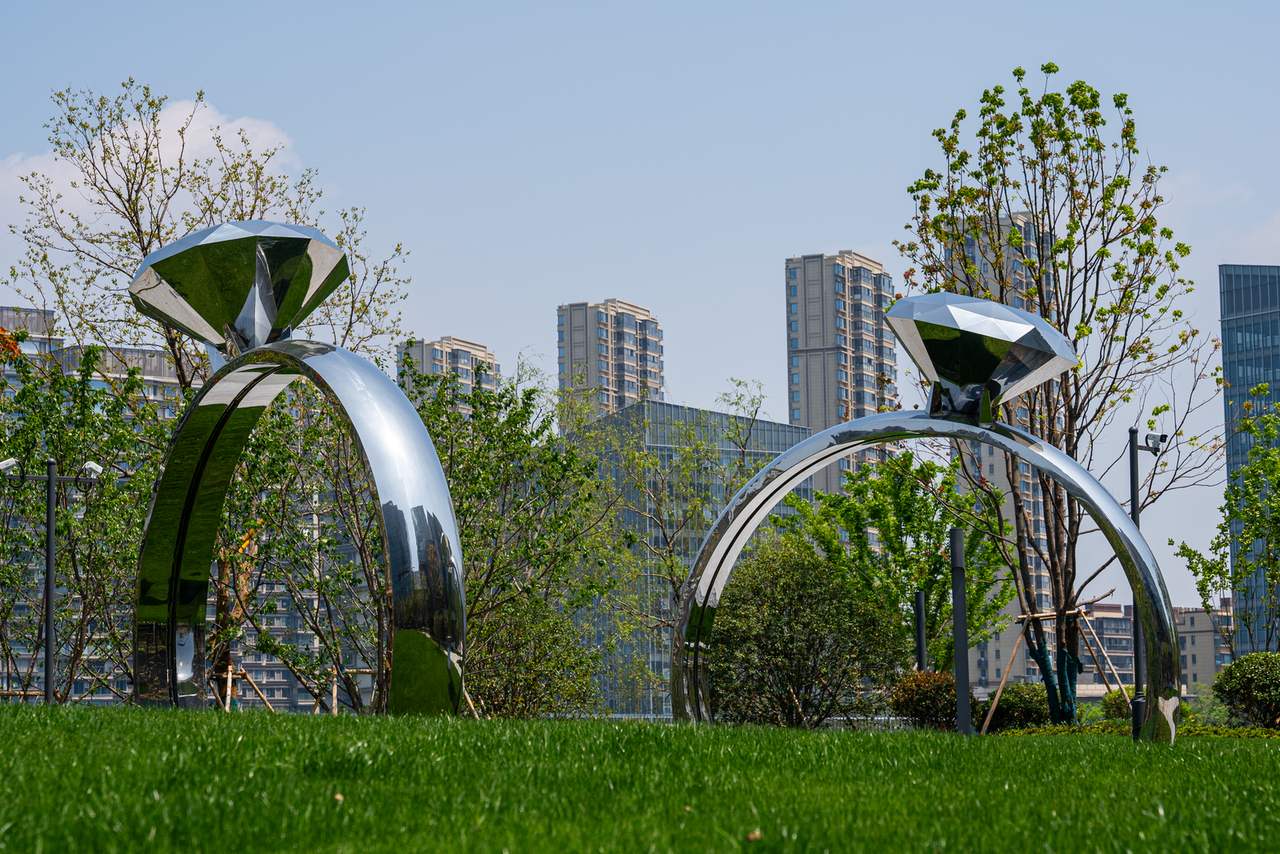
Stainless Steel Sculpture: A Complete Guide to Design, Finishes, Fabrication, and Outdoor Use
A stainless steel sculpture can serve as a striking focal point in a public plaza, commercial development, hotel entrance, landscape, or architectural environment. Its combination of strength, modern appearance, and versatile surface treatments makes stainless steel a popular material for contemporary artworks. Depending on the design, it can be transformed into polished abstract forms, geometric installations, large outdoor landmarks, or detailed decorative pieces.
However, selecting stainless steel does not automatically guarantee that a sculpture will perform well in every environment. Material grade, sheet thickness, structural design, welding quality, surface finishing, drainage, and installation details all influence its appearance and service life. A reflective sculpture, for example, requires careful surface preparation, while a large outdoor installation needs an appropriate support structure and foundation.
This guide explains how to plan a stainless steel sculpture project, compare material grades and finishes, understand fabrication methods, and evaluate quality before delivery. It is intended for developers, architects, landscape designers, public art consultants, and procurement teams sourcing stainless steel artwork for commercial or public spaces.
1. What Is a Stainless Steel Sculpture?
A stainless steel sculpture is a three-dimensional artwork manufactured primarily from stainless steel. It can be created in many forms, including abstract compositions, geometric structures, figurative artwork, animal sculptures, lettering, and architectural installations. The material can be cut, bent, rolled, welded, polished, brushed, or coated to achieve different shapes and visual effects.
Compared with some traditional sculpture materials, stainless steel offers a combination of structural strength and surface versatility. It can create a clean, contemporary appearance and can be adapted to both indoor and outdoor applications. Its suitability for a particular project still depends on the selected grade, design, fabrication quality, and environmental conditions.
1.1 Common Types of Stainless Steel Sculpture
Stainless steel sculptures can be classified according to their artistic form and intended application. Abstract sculptures often use flowing curves, intersecting planes, or geometric structures to create visual movement. Figurative sculptures represent people, animals, or recognizable objects, while architectural sculptures are designed to complement buildings, entrances, plazas, or landscape features.
Reflective sculptures are another common category. Their polished surfaces interact with surrounding buildings, people, vegetation, and natural light. Brushed or matte sculptures create a more restrained appearance, while painted stainless steel can introduce specific colors into a project. Some artworks combine stainless steel with stone, glass, lighting, or other materials to achieve a more complex design.
1.2 Indoor and Outdoor Stainless Steel Sculptures
Indoor stainless steel sculptures are commonly installed in hotel lobbies, shopping centers, office buildings, reception areas, and cultural venues. These projects may prioritize surface quality, visual detail, color coordination, and the relationship between the artwork and interior architecture. Since indoor environments are generally more controlled, material selection may focus more heavily on appearance and fabrication requirements, although cleaning and handling still matter.
Outdoor stainless steel sculptures are used in parks, public plazas, waterfronts, gardens, commercial developments, and urban landscapes. They need to account for rain, humidity, temperature changes, wind exposure, airborne pollutants, and possible contact with corrosive substances. Outdoor projects therefore require more careful consideration of stainless steel grade, surface design, drainage, structural support, and maintenance.
2. Why Choose Stainless Steel for Sculpture?
Stainless steel offers several practical and aesthetic advantages for sculpture projects. It can support a wide range of shapes and finishes, making it suitable for both expressive artwork and architectural applications. However, the benefits depend on using an appropriate material specification and manufacturing process for the intended environment.
2.1 Modern Appearance and Surface Versatility
One of the main reasons designers choose stainless steel is its ability to achieve different visual effects. A mirror-polished surface can reflect surrounding architecture and landscape, making the sculpture visually dynamic as people move around it. A brushed finish provides a softer metallic appearance, while a matte finish can reduce glare and create a more understated effect.
Stainless steel can also be painted, colored, or combined with other materials. These options allow designers to coordinate the sculpture with a building facade, landscape concept, corporate identity, or public art theme. The surface treatment should be selected early because it may influence fabrication sequences, welding treatment, polishing requirements, and maintenance arrangements.
2.2 Strength and Structural Flexibility
Stainless steel has useful mechanical properties for sculpture manufacturing. It can be formed into sheets, tubes, plates, and structural components that support different artistic geometries. Depending on the design, fabricators can use hollow sections, internal frames, ribs, stiffeners, and connection plates to create a stable structure without making every part solid.
This flexibility is particularly useful for large sculptures. A hollow stainless steel structure can reduce material use and overall weight compared with a solid metal form, although the internal structure still needs to be engineered for the expected loads. The appropriate thickness and reinforcement depend on the sculpture's dimensions, shape, support conditions, and installation environment.
2.3 Corrosion Resistance and Maintenance
Stainless steel contains chromium, which contributes to the formation of a passive surface layer that helps resist corrosion. This makes it suitable for many environments where ordinary carbon steel would require more extensive protective coatings. Nevertheless, stainless steel is not completely corrosion-proof. Its performance depends on the grade, surface condition, exposure conditions, and maintenance practices.
Outdoor sculptures may be exposed to salt, pollutants, dirt, standing water, and other contaminants. These can affect surface appearance and, under certain conditions, contribute to localized corrosion. Selecting an appropriate grade, avoiding poorly designed water traps, using suitable fabrication practices, and cleaning the sculpture periodically can help maintain its appearance.
3. Choosing the Right Stainless Steel Grade
Not all stainless steel grades perform in the same way. The correct specification should be based on the installation environment, expected exposure, fabrication requirements, and project budget. For sculpture buyers, it is important to discuss the actual site conditions with the manufacturer instead of selecting a grade based only on its name or general reputation.
3.1 304 Stainless Steel
Grade 304 is a widely used austenitic stainless steel with good general corrosion resistance and formability. It is commonly used for indoor sculptures and many outdoor applications where exposure conditions are relatively moderate. It can be cut, bent, welded, and polished, making it suitable for a wide range of sculpture designs.
However, 304 stainless steel may be less suitable for environments with significant chloride exposure, such as coastal locations or areas where deicing salts are frequently used. Surface contamination and poor maintenance can also affect its performance. For projects in more aggressive environments, another grade may be more appropriate.
3.2 316 Stainless Steel
Grade 316 contains molybdenum, which improves its resistance to certain forms of corrosion, particularly in chloride-containing environments. It is often considered for outdoor sculptures in coastal areas, waterfront developments, and locations exposed to more demanding environmental conditions.
Although 316 generally offers better chloride resistance than 304, it should not be treated as immune to corrosion. Design details, surface finish, fabrication quality, and maintenance remain important. The final grade should be selected according to the actual exposure conditions and, where necessary, professional material advice.
3.3 Other Stainless Steel Grades
Other stainless steel grades may be considered for specific project requirements. Some grades offer different combinations of strength, corrosion resistance, formability, or cost. However, not every grade is equally suitable for complex forming, welding, or highly polished sculpture surfaces.
For most architectural and public art projects, buyers should avoid choosing a grade solely because it is less expensive or has a higher strength value. The material needs to work with the sculpture's design and fabrication process. The manufacturer should identify the proposed grade in the technical quotation and explain why it is suitable for the intended application.
3.4 Comparing 304 and 316 Stainless Steel
The following comparison provides a general reference for project discussions. Actual performance depends on material specifications, environmental exposure, fabrication, surface condition, and maintenance.
| Comparison Item | 304 Stainless Steel | 316 Stainless Steel |
|---|---|---|
| General Corrosion Resistance | Good for many common environments | Generally higher in chloride-containing environments |
| Typical Applications | Indoor sculptures and moderate outdoor environments | Coastal, waterfront, and more demanding outdoor environments |
| Forming and Welding | Suitable for common sculpture fabrication processes | Also suitable, with process selection based on the application |
| Relative Material Cost | Generally lower | Generally higher |
| Selection Consideration | Evaluate exposure and maintenance conditions | Consider where additional chloride resistance is required |
4. Stainless Steel Sculpture Finishes
The surface finish determines how a stainless steel sculpture interacts with light and its surroundings. It also affects the visibility of fingerprints, scratches, fabrication marks, and environmental contamination. Buyers should confirm the intended finish using clear descriptions, reference photographs, or physical samples before production begins.
4.1 Mirror Polished Stainless Steel
Mirror polishing creates a highly reflective surface that can reflect nearby buildings, landscapes, people, and changing light conditions. It is commonly used for contemporary public art, landmark sculptures, commercial plazas, and architectural installations where visual impact is important.
Achieving a consistent mirror finish requires careful grinding and polishing. Surface defects, uneven weld treatment, scratches, and differences between connected panels can become particularly noticeable. Large sculptures may need to be divided into sections for fabrication, so the manufacturer should pay close attention to transitions and alignment during final assembly.
Mirror-polished surfaces also require suitable handling and cleaning. Protective materials should be used during transportation and installation to reduce the risk of scratches. After installation, regular cleaning may be needed to remove fingerprints, dust, water marks, and other contaminants.
4.2 Brushed Stainless Steel
Brushed stainless steel has a directional surface texture created through mechanical abrasion. It produces a softer metallic appearance than a mirror finish and can be suitable for architectural sculptures, indoor installations, and outdoor artwork where a less reflective surface is preferred.
The brushing direction should be planned across the sculpture's visible surfaces. If different panels have inconsistent grain directions or surface textures, the finished artwork may appear uneven. Buyers should therefore confirm the expected texture and direction through a sample or approved finish reference.
4.3 Matte and Bead-Blasted Finishes
Matte finishes reduce surface reflectivity and create a more subdued appearance. Depending on the required effect, manufacturers may use mechanical finishing or other surface treatment methods. Bead blasting can create a more uniform textured surface, although the final appearance depends on the blasting media, process parameters, and material condition.
These finishes may be suitable for sculptures where the design emphasizes shape and proportion rather than reflection. They can also help reduce the visual prominence of certain surface reflections, although they do not eliminate the need for consistent fabrication and surface preparation.
4.4 Colored and Coated Stainless Steel
Stainless steel sculptures can be given colored surfaces through suitable coating or coloring processes. This allows designers to introduce specific visual themes, coordinate with nearby architecture, or create a stronger contrast within a landscape. The selected process should be appropriate for the base material and intended exposure conditions.
Before production, buyers should confirm the color reference, gloss level, coating type, and expected maintenance requirements. Large sculptures may need to be finished in separate sections, so color consistency between components should be checked. The project team should also clarify how scratches or coating damage can be repaired after installation.
5. Stainless Steel Sculpture Fabrication Process
Stainless steel sculpture fabrication involves several connected production stages. The exact sequence depends on the sculpture's shape, dimensions, surface finish, and structural design. A small decorative sculpture may require relatively simple cutting and assembly, while a large reflective artwork can involve complex forming, welding, polishing, and trial installation.
5.1 Design Review and Production Drawings
Before fabrication begins, the manufacturer reviews the approved concept and develops the information needed for production. This may include three-dimensional models, dimensioned drawings, sectional details, material specifications, component divisions, and connection details.
The review should identify whether the proposed geometry can be formed and assembled using the available manufacturing processes. It should also consider how the sculpture will be transported and installed. Any changes that affect the artistic appearance, overall dimensions, or material specification should be approved before production starts.
5.2 Cutting and Forming Stainless Steel Components
Stainless steel sheets, plates, tubes, and other components are cut according to the production drawings. Depending on the required shape and accuracy, the manufacturer may use laser cutting, waterjet cutting, sawing, or other suitable processes. The cut components are then prepared for bending, rolling, or other forming operations.
Forming is used to create curved panels, cylindrical sections, folded edges, and other three-dimensional shapes. Complex sculptures may require custom templates or forming fixtures to maintain the intended geometry. Dimensional checks during this stage help reduce problems during assembly.
5.3 Welding and Structural Assembly
After the components have been formed, they are joined through suitable welding or mechanical connection methods. Welding may be used to assemble the outer shell, connect internal supports, and create the main structural framework. The welding procedure should be selected according to the material grade, thickness, joint design, and required quality level.
For large sculptures, the manufacturer may assemble the artwork in sections rather than producing it as one complete structure. This approach can make workshop handling and transportation easier, but it requires careful control of joint positions, alignment, and connection details. The fabrication team should also manage welding distortion so that the final sculpture maintains its intended shape.
5.4 Grinding and Polishing
Welded areas and surface transitions may need grinding and polishing to achieve the specified appearance. For mirror-polished sculptures, this stage can be particularly demanding because visible marks may remain if surface preparation is incomplete. The manufacturer should use an appropriate sequence of abrasives and polishing operations to achieve a consistent result.
Finishing should be checked under suitable lighting conditions. A surface that appears uniform in one lighting environment may show differences when exposed to direct sunlight or strong artificial lighting. For high-visibility projects, sample approval and staged inspection can help maintain consistency.
5.5 Trial Assembly and Final Inspection
If the sculpture is manufactured in several sections, trial assembly can confirm that the components fit together before delivery. It also allows the team to check alignment, connection positions, surface transitions, and the overall appearance. Problems identified in the workshop are generally easier to resolve than issues discovered after transportation to the installation site.
Final inspection may include dimensional verification, weld checks, surface-finish evaluation, material documentation, and packaging review. The manufacturer should also identify each component clearly and provide relevant assembly or handling information for the installation team.
6. Designing Stainless Steel Sculptures for Outdoor Use
Outdoor stainless steel sculptures need to perform under environmental conditions that can change throughout the year. Rain, humidity, airborne pollutants, salt, wind, and temperature variation may influence material performance and maintenance requirements. A sculpture intended for a protected courtyard may have different requirements from one installed beside the sea or in an exposed public plaza.
6.1 Consider Climate and Environmental Exposure
The installation location should be assessed before selecting the stainless steel grade and surface treatment. Coastal environments may expose sculptures to airborne salt and chloride deposits, while industrial areas may contain pollutants that affect surface condition. Urban locations may also expose artwork to vehicle emissions, dust, and cleaning chemicals.
Designers should consider whether the sculpture is exposed to direct rainfall, whether water can collect on horizontal surfaces, and whether the artwork is located near sprinklers, swimming pools, or other potential sources of chemical exposure. These details can influence both material selection and the design of joints, cavities, and drainage features.
6.2 Prevent Water Traps and Surface Contamination
Water accumulation can create maintenance problems and contribute to corrosion risks under certain conditions. Sculpture designs should avoid unnecessary water traps, inaccessible cavities, and details that collect dirt or debris. Where hollow structures are used, drainage and ventilation should be considered as part of the engineering design.
Fabrication cleanliness is also important. Carbon steel particles, grinding dust, and unsuitable tools can contaminate stainless steel surfaces during production. Such contamination may affect the appearance and corrosion performance of the finished artwork. Appropriate handling, tool management, and surface cleaning procedures should be included in the manufacturing process.
6.3 Structural Design for Wind and Outdoor Loads
Large outdoor sculptures may be exposed to wind loads and other environmental forces. The structure needs to transfer these loads through its internal supports, connection points, base plates, and foundation. The required design depends on the sculpture's height, shape, projected surface area, weight, and installation location.
Structural calculations should be completed by qualified professionals using the applicable design requirements. The fabrication team should work from approved engineering information and ensure that the manufactured components match the specified structural details. Foundation and anchor arrangements should also be coordinated with the site construction team before installation.
6.4 Cleaning and Maintenance Requirements
Regular cleaning helps remove dirt, fingerprints, salt deposits, and other contaminants from stainless steel sculptures. The cleaning frequency depends on the environment, surface finish, and exposure level. Coastal and industrial locations may require more frequent inspection and cleaning than protected indoor or outdoor environments.
Cleaning methods should be compatible with the stainless steel grade and finish. Abrasive tools or unsuitable chemicals can damage the surface or leave visible marks. The manufacturer should provide maintenance recommendations that explain suitable cleaning methods and identify products or practices that should be avoided.
7. Structural Design, Transportation, and Installation
A stainless steel sculpture is not complete when fabrication ends. It must be transported, positioned, connected, and secured according to the approved installation plan. These requirements should influence the design and production strategy from the beginning, particularly for large sculptures that cannot be delivered as a single piece.
7.1 Internal Support Structures and Foundations
Large stainless steel sculptures may use internal frames, ribs, stiffeners, support plates, or other reinforcement components. These elements help maintain the structure's shape and transfer loads to the foundation. Their design depends on the sculpture's geometry, dimensions, material thickness, and environmental exposure.
The foundation may involve reinforced concrete, embedded plates, anchor bolts, or other engineered arrangements. The sculpture manufacturer should coordinate the connection details with the project's structural engineer and civil contractor. The foundation should be completed and inspected before the sculpture is delivered for installation.
7.2 Modular Fabrication for Large Sculptures
Large sculptures are often divided into transportable modules. This can reduce the difficulty of moving oversized artwork through roads, ports, workshop entrances, or construction sites. It can also make lifting and positioning more manageable.
However, modular fabrication requires careful planning of connection locations and assembly tolerances. The sections must fit together correctly while maintaining the intended visual continuity. For reflective sculptures, joints and transitions require additional attention because differences in alignment or polishing may be especially visible.
7.3 Transportation and On-Site Installation
Transportation planning should account for the dimensions, weight, surface finish, and fragility of each component. Custom supports and protective packaging may be required to prevent deformation, scratching, or impact damage. For international projects, the team should also consider shipping container dimensions, loading arrangements, export documentation, and local delivery access.
On-site installation may require cranes, lifting frames, specialist rigging, temporary supports, and trained installation personnel. The installation sequence should be confirmed before delivery, including lifting points, access routes, connection procedures, and safety arrangements. The project team should also verify that the foundation and surrounding site are ready to receive the sculpture.
8. How Much Does a Stainless Steel Sculpture Cost?
The cost of a stainless steel sculpture depends on its dimensions, design complexity, material grade, fabrication methods, surface finish, structural requirements, and delivery arrangements. A simple indoor sculpture and a large mirror-polished outdoor landmark may differ significantly in production time and material consumption. A meaningful quotation therefore requires project-specific information.
8.1 Main Factors Affecting the Cost
Size is an important cost factor because larger sculptures generally require more material, larger workshop space, additional handling equipment, and more extensive structural planning. However, complexity can be equally important. A relatively small sculpture with intricate curves, detailed components, or demanding surface finishes may require substantial skilled labor.
Material grade and thickness also influence the quotation. Higher-grade stainless steel may increase material cost, while thicker components may require more demanding cutting and forming operations. Mirror polishing, special coatings, and other customized finishes can add further production time.
Additional costs may include engineering, foundation coordination, trial assembly, packaging, transportation, lifting equipment, and installation. For overseas projects, shipping, customs clearance, import duties, and local taxes should be clarified separately.
8.2 Information Needed for an Accurate Quotation
To obtain a more accurate quotation, buyers should provide the sculpture's concept images or drawings, approximate dimensions, preferred stainless steel grade, surface finish, installation location, and expected delivery date. Architectural drawings, site photographs, and information about the foundation can help the manufacturer assess structural and installation requirements.
Buyers should also clarify whether the quotation includes design development, engineering coordination, fabrication, finishing, packaging, shipping, and installation. If some services are excluded, they should be identified clearly. This makes it easier to compare different manufacturers on a consistent basis and avoid unexpected costs later.
9. How to Choose a Stainless Steel Sculpture Manufacturer
The quality of the finished artwork depends heavily on the manufacturer's ability to translate the design into a practical production process. Buyers should evaluate more than the supplier's product photographs or initial price. Relevant experience, material knowledge, fabrication equipment, surface finishing skills, quality control, and project coordination all deserve attention.
9.1 Review Previous Stainless Steel Sculpture Projects
Ask to see completed projects that are comparable in material, size, design complexity, and installation environment. A manufacturer experienced in mirror-polished outdoor sculptures may have different capabilities from one that mainly produces small brushed stainless steel decorations.
Reviewing different stages of previous projects can provide more information than viewing finished photographs alone. Where available, ask for examples of fabrication, trial assembly, surface finishing, and completed installation. This can help you understand how the manufacturer manages technical challenges throughout production.
9.2 Evaluate Fabrication and Finishing Capabilities
Stainless steel sculpture manufacturing requires a combination of metalworking and finishing skills. Buyers should assess whether the manufacturer can handle the required cutting, forming, welding, grinding, polishing, and assembly processes. For large or complex artwork, the workshop should also have suitable space and equipment for component handling and trial assembly.
Surface finishing deserves particular attention. A manufacturer may be able to assemble the required shape but lack the experience needed to produce a consistent mirror or brushed finish. Ask how surface quality is controlled, how visible welds are treated, and how different sections are matched during final assembly.
9.3 Confirm Quality Control and Project Management
A reliable supplier should have a clear process for reviewing drawings, verifying materials, checking dimensions, inspecting welds, evaluating finishes, and preparing components for delivery. Buyers should understand when inspections take place and what documentation can be provided.
Project management is equally important. Confirm the design approval process, production milestones, communication arrangements, quotation inclusions, delivery schedule, and responsibilities for installation. These details are especially important when the sculpture forms part of a larger construction or landscape project.
9.4 Discuss Your Project with the Manufacturer
Before confirming an order, discuss the intended application and technical requirements directly with the manufacturer. Provide available drawings, reference images, dimensions, preferred finishes, and site information. This gives the production team a basis for evaluating material suitability, fabrication methods, and possible installation challenges.
Yifeng Sculpture undertakes customized sculpture projects for different architectural, commercial, and public environments. You can explore our sculpture project portfolio to review examples of completed work or learn more about our custom sculpture services. Sharing your project requirements with our team can help establish a suitable direction for design and production.
10. Conclusion
A successful stainless steel sculpture project depends on more than selecting a visually attractive design. Material grade, surface finish, fabrication techniques, structural engineering, transportation, and installation all influence the final result. For outdoor applications, environmental exposure and maintenance requirements should be evaluated before production begins.
For developers, architects, landscape designers, and procurement teams, working with an experienced manufacturer can help connect artistic requirements with practical production decisions. Before requesting a quotation, prepare your reference images, dimensions, preferred finish, and installation information. If you are planning a stainless steel sculpture for a public space, hotel, commercial development, or architectural project, contact Yifeng Sculpture to discuss your design and fabrication requirements.
Frequently Asked Questions About Stainless Steel Sculpture
Q1. Is stainless steel sculpture suitable for outdoor use?
Yes, a stainless steel sculpture can be suitable for outdoor use when the material grade, structural design, surface finish, and installation details are selected according to the environment. Coastal locations and areas exposed to chloride-containing substances may require more corrosion-resistant grades, such as 316 stainless steel. Drainage, fabrication cleanliness, and regular maintenance are also important for long-term performance.
Q2. What is the best stainless steel grade for a stainless steel sculpture?
The best grade for a stainless steel sculpture depends on the installation environment and project requirements. Grade 304 is commonly used in many indoor and moderate outdoor environments, while grade 316 is often considered for coastal and more demanding chloride-exposure conditions. Buyers should discuss the actual site conditions with the manufacturer before confirming the material specification.
Q3. What finishes are available for a stainless steel sculpture?
Common finishes for a stainless steel sculpture include mirror polishing, brushed finishing, matte finishing, bead-blasted textures, and colored or coated surfaces. Each finish creates a different visual effect and has different handling and maintenance requirements. Buyers should confirm the desired appearance through reference images or approved samples before fabrication begins.
Q4. How is a large stainless steel sculpture manufactured and installed?
A large stainless steel sculpture is generally produced through a combination of cutting, forming, welding, grinding, polishing, and assembly. It may be divided into smaller modules to make workshop production and transportation easier. The installation process can involve cranes, lifting equipment, engineered connections, and a prepared foundation. Component divisions and installation details should be planned during the design stage.
Q5. How do I maintain an outdoor stainless steel sculpture?
To maintain an outdoor stainless steel sculpture, remove accumulated dirt, fingerprints, salt deposits, and other contaminants using cleaning methods suitable for the material and surface finish. Inspect the sculpture periodically for surface changes, damaged coatings, or areas where water collects. The cleaning frequency should reflect local environmental conditions, with more frequent attention in coastal and industrial areas.
Related Pages:
.png?imageMogr2/format/webp)

