
Features
Why Choose Us?
Full In-House Control
Design, engineering, fabrication and installation under one roof — one team, one contact, no outsourcing gaps.
Verifiable Engineering
Engineers calculate load, wind and anchoring; every steel and alloy batch ships with mill certificates.
Any Scale, Any Material
Stainless steel, bronze, aluminium, forged and cast metal — from a single plaza piece to landmark scale.
Worldwide Installation
Fully insured door-to-door logistics, our own crew on site, and material certificates with a maintenance guide.
We Have The Best Solutions for Your Business
Yifeng Sculpture is a public art studio based in Ningbo, China, producing large-scale sculpture since 2003. We are one accountable team from first sketch to final bolt — creative planning, detailed design, engineering, fabrication and installation all happen in-house, so the artwork you approve is the artwork you receive. Our studio pairs sculptors with structural and mechanical engineers who calculate load, wind resistance and anchoring before a single panel is cut, and our founder is a Member of the Royal Society of Sculptors (UK).
We fabricate in stainless steel, bronze, aluminium, forged and cast metal, delivering monumental, kinetic, memorial and custom commissions for urban parks, commercial districts, transit hubs and campuses — from a single plaza piece to landmark works tens of metres in scale. For overseas clients we manage fully insured door-to-door logistics, send our own installation crew to site, and back every work with material certificates, a care guide and after-sales conservation.
Why Cities and Developers Commission Public Art Sculpture
The commissioning logic is more practical than most people assume. A plaza without a focal point is a paved void; with the right piece it becomes a destination, and destinations change behaviour. Visitors arrive earlier, stay longer, take photographs that circulate for free, and describe the location by the artwork instead of by a street number. For developers this shows up in leasing conversations; for cities it shows up in how residents talk about their own district.
There is also a wayfinding function that clients routinely undervalue until installation day. A tall, distinctive form is visible from three blocks away and from an approaching highway, which no signboard can match. When we review a site plan, we map sightlines from the main approaches before we sketch anything, because a beautiful sculpture that nobody sees until they are already in the plaza has quietly surrendered half of its value.
The Main Types of Public Art Sculpture We Build
Over two decades of commissions, most briefs fall into a handful of recognisable categories. Knowing which one you are buying changes the engineering, the material strategy and the maintenance conversation, so we make clients name the category early.
- Landmark gateway pieces: large-scale works that mark an entrance or district boundary and are read primarily from a distance.
- Kinetic and wind-driven works: moving elements that keep a plaza feeling alive between events, engineered around bearings and balanced loads.
- Interactive installations: pieces the public can touch, walk through or trigger, which push ingress protection and structural safety checks to the front of the process.
- Light-integrated works: sculptures designed with their lighting from day one, so the night image is composed rather than improvised.
- Memorial and narrative works: commissions that carry a story for a community, where the review process involves more stakeholders and more patience.
The category also determines the risk profile. A gateway piece is mostly an engineering exercise once the form is fixed; an interactive piece is a public-safety exercise; a memorial is a consensus exercise. We have delivered all three kinds, and the projects that went smoothly were the ones where everyone agreed on the category before the first model was made.
Siting a Public Art Sculpture: What We Check Before Drawing
Site review is where most of the value is created or lost. Before we put a single curve on paper, our team walks or surveys the location and answers a short list of unglamorous questions, because each one of them has ended projects elsewhere.
- Approach sightlines: where the work will first be seen from, and whether anything blocks that view today or after planned planting grows in.
- Ground conditions: soil capacity, existing services and the footing geometry the structure will realistically need.
- Wind and exposure: open waterfront sites load a tall form very differently from a courtyard sheltered by towers.
- Public flow: how pedestrians, cyclists and vehicles pass the site, and how clearance zones protect both the public and the artwork.
- Lighting and power: whether a supply exists, where it would enter, and how the night image will be composed.
Only after those answers exist do proportions and materials get discussed. It sounds like the cart before the horse for clients who arrive with a Pinterest board, but the sequence protects them: a concept drawn against real site data survives engineering review, while a concept drawn against mood boards tends to come back from the structural engineer with red ink and a shorter form.
Choosing Materials for Public Art Sculpture Outdoors
Material selection is driven by exposure first and appearance second. Coastal and waterfront sites change the specification immediately, and a material that looks identical on a showroom sample can age very differently two hundred metres from salt water.
| Material | Best suited to | Watch-outs we design around |
|---|---|---|
| 316 stainless steel | Coastal, waterfront and high-exposure landmarks | Tea staining if surface finish and drainage are not detailed correctly |
| 304 stainless steel | Inland plazas, campuses and sheltered urban sites | Not the right grade near salt spray; isolation from carbon steel is essential |
| Hot-dip galvanised steel with coating | Large structural cores and play-adjacent works | Coating system and touch-up protocol decide the ten-year appearance |
| Aluminium | Large, light forms and suspended elements | Galvanic corrosion at mixed-metal joints without isolating washers |
| Bronze and copper alloys | Memorial and narrative works where patina is part of the concept | Client must accept that the surface keeps changing — by design |
We always produce physical finish samples in the specified system and view them on site in real light. A colour approved on a laptop screen has been approved by nobody, and daylight at the actual coordinates — especially over water — is flatter and more revealing than any render suggests.
Scope, Programme and Change Control on a Public Art Sculpture Project
Scope definition is where a commission is quietly won or lost, long before anyone discusses figures. A brief that describes only the artwork leaves the footing, the sub-base, the power supply, the crane access and the reinstatement of finished paving unassigned, and unassigned items return later as change orders. We therefore write a scope matrix during consultation that names every item and states plainly whether it sits with the studio, with the landscape contractor or with the client's own team. Naming it costs an hour of conversation; discovering it on installation day costs weeks.
Programme follows the same logic. Fabrication should not begin until the design is frozen, and the design should not be frozen until the survey reflects the real site rather than an assumption, which means the critical path usually runs through site information rather than through the workshop. When clients ask us to compress a programme, we look first at whether structural sign-off, sample approval and site access can run in parallel, because those three gates account for most of the delay we see on stalled schemes. Compressing fabrication itself is the last lever we would pull, never the first.
Change control is the third quiet lever. Arts projects attract stakeholders with opinions, and an open invitation to comment at any time will consume a fabrication slot that was never reserved for revision. We fix a limited number of review gates, document what was agreed at each, and treat anything after the freeze as a formal variation with an honest assessment of its effect on delivery. Clients who adopt that discipline get a predictable installation date; clients who do not get an argument in the last fortnight of the programme.
The Studio Behind the Work
Designing and fabricating for public space since 2003
More than 3000 completed works delivered
Installations across 23 countries
Academic grounding from top art academies and the Royal Society of Sculptors
From Concept to Installation: The Four-Step Process
Cross-border commissions fail at the seams between organisations, so we keep the whole chain inside one studio. Our four-step process — consultation, concept development, fabrication, installation — is deliberately boring, because boring is what an overseas client needs when the workshop is on another continent.
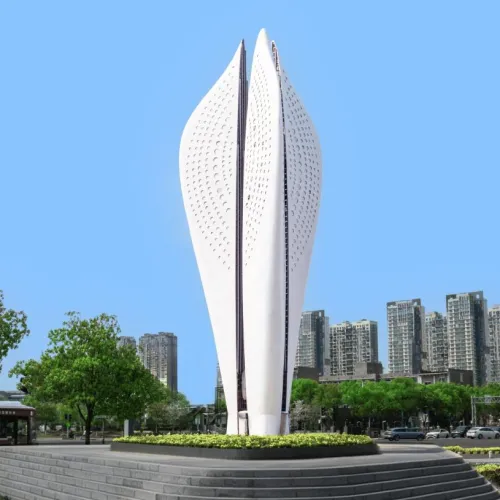
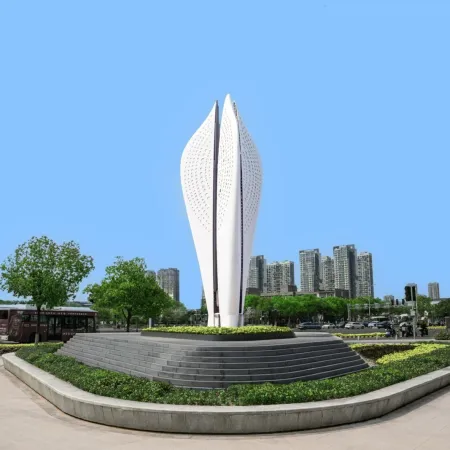
Consultation captures the site data, the brief and the stakeholders' definitions of success. Concept development turns that into drawings and models tested against the survey, with engineering running in parallel rather than after. Fabrication happens in our own workshop, including a trial assembly so the installation crew on site sees a rehearsed sequence. Installation is planned with lifting points, rigging and a written finishing procedure agreed before the crate is ever opened. The same discipline carried our team through a 20.8-metre stainless gateway documented as Peach Blossom, where site tolerances and wind exposure were settled long before steel was cut.
What Overseas Buyers Should Clarify Before Signing
Most of the pain we are asked to rescue comes from contracts that never specified the difficult parts. When we review an incoming enquiry, the questions that predict a smooth project are remarkably consistent, and none of them is about style.
Ask who owns the structural engineering and whether calculations are issued by the studio or outsourced. Ask how the work ships — knocked down in sections or as complete modules — and who is responsible at each handover point. Ask what documentation arrives at completion: record drawings, material certificates, maintenance schedules and touch-up materials. A studio that answers these without hesitation has built for other countries before and expects its work to be inspected long after the ribbon-cutting. That is the standard we hold ourselves to on every public art sculpture we ship.
You can see how the four-step process from consultation to installation works on our services page, and landmark-scale commissions of every category are collected in the project gallery.
If you are planning a commission, send us the site plan, the brief and the images you have gathered so far. We will tell you honestly what will work at your coordinates, what the engineering will demand and what the maintenance story looks like in year ten — because a public art sculpture only earns its place if it still commands it a decade later.
Featured Products
Collection about Us
User Reviews
What users say about Us
Frequently Asked Question
Do you have any question?
Stainless steel 304 and 316, weathering steel, bronze, granite and coated aluminum are the proven core. The right choice depends on climate, proximity to the sea, the level of public contact and the maintenance the owner commits to.
Edges are rolled or radiused where people pass, surfaces are specified against cuts and snagging, structures are checked for wind load and human loads, and climbing or leaning behavior is anticipated in the engineering. Safety is resolved in the design, not with signage after the fact.
To a foundation engineered for the site's wind conditions and ground, using anchor bolts or embed plates detailed for both strength and appearance. Anchors are positioned so they are hidden in the finished work but accessible for inspection.
Consultation on the site and intent, Concept Development with drawings and models, client approval, Fabrication in the workshop, and Installation with the site team. Since 2003 that four-step process has carried our studio through more than 3,000 completed works.