
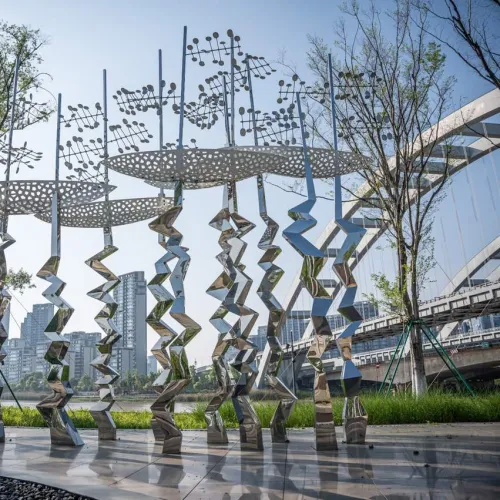
Features
Why Choose Us?
Full In-House Control
Design, engineering, fabrication and installation under one roof — one team, one contact, no outsourcing gaps.
Verifiable Engineering
Engineers calculate load, wind and anchoring; every steel and alloy batch ships with mill certificates.
Any Scale, Any Material
Stainless steel, bronze, aluminium, forged and cast metal — from a single plaza piece to landmark scale.
Worldwide Installation
Fully insured door-to-door logistics, our own crew on site, and material certificates with a maintenance guide.
We Have The Best Solutions for Your Business
Yifeng Sculpture is a public art studio based in Ningbo, China, producing large-scale sculpture since 2003. We are one accountable team from first sketch to final bolt — creative planning, detailed design, engineering, fabrication and installation all happen in-house, so the artwork you approve is the artwork you receive. Our studio pairs sculptors with structural and mechanical engineers who calculate load, wind resistance and anchoring before a single panel is cut, and our founder is a Member of the Royal Society of Sculptors (UK).
We fabricate in stainless steel, bronze, aluminium, forged and cast metal, delivering monumental, kinetic, memorial and custom commissions for urban parks, commercial districts, transit hubs and campuses — from a single plaza piece to landmark works tens of metres in scale. For overseas clients we manage fully insured door-to-door logistics, send our own installation crew to site, and back every work with material certificates, a care guide and after-sales conservation.
How Urban Sculpture Is Planned, Approved and Built
Public commissions follow a path with more stakeholders than a private one, and the sequence matters. The strongest projects we have delivered all ran roughly the same course:
- Consultation: the site is studied on foot and in drawings — approach routes, sight lines, wind corridors, evening lighting, the events that crowd the space.
- Concept development: maquettes and 3D models are tested against the real proportions of the space, with materials and fixing strategy agreed while change is still cheap.
- Fabrication: engineering, forming, welding and finishing in the workshop, with trial assembly and stage photographs for the committee at agreed checkpoints.
- Installation: sectioned transport, engineered lifting, on-site finishing and commissioning, sequenced around the city's programme rather than against it.
A project director at a development firm in Southeast Asia once told us the committee approved our proposal after seeing trial-assembly photographs of the complete piece standing in our yard. For a public process, watching risk retire in advance carried more weight than any render, and the installation itself was uneventful — which is exactly what a city wants its headline project to be.
Siting: Where Urban Sculpture Works and Where It Fails
The same artwork can thrive in one location and fail in another. When we review a site with a client, we work through the location types below before any design is fixed, because the siting decision shapes scale, material and even the narrative.
| Location | What works there | Common failure |
|---|---|---|
| Central plaza | A single strong landmark with clear approach views | Scale that crowds the space or blocks gathering |
| Waterfront | Reflective and kinetic forms that answer wind and water | Materials and fixings not rated for salt exposure |
| Street corridor | Vertical, slim profiles read from moving traffic | Base clutter competing with signage and street furniture |
| Park and greenway | Playful, tactile pieces that invite families to linger | Fragile finishes and climbable details never engineered for it |
| Transit node | Bold silhouettes legible in seconds under artificial light | Fine detail lost at speed; access planned after the fact |
Notice that every failure listed is a planning failure, not an artistic one. Each of them is cheap to avoid during concept development and expensive to correct once concrete is poured.
The Stakeholders Every Public Commission Must Serve
A gallery artist answers to a curator; urban sculpture answers to a room of people with different definitions of success. Part of a studio's job is translating between them early enough that nobody is surprised at the unveiling:
- The city and its reviewers: they need documentation, safety logic and a maintenance plan they can defend in writing.
- The designer and landscape architect: they need the piece to hold its proportion against paving levels, planting and facade lines.
- The developer or client: they need the program to hold — a concept that survives committee rounds without losing its character.
- The public: they need the piece to be legible, safe to approach and worth photographing, on the day it opens and ten years later.
- The facilities team: they need access for cleaning, inspection and lighting service that does not require closing the plaza.
When these groups are brought in at different stages, the artwork becomes a negotiation; when they see the same model early, the artwork keeps its idea intact. That is why our consultation step exists, and why we present physical maquettes rather than images alone wherever a committee is involved.
Committees also change between the sketch and the unveiling, and a proposal that survived one round of reviewers must often survive another without losing its character. The way we protect a concept through that process is documentation: every proportion decision, every sight-line study and every material test is recorded plainly, so a new reviewer inherits the reasoning rather than just the picture. It sounds bureaucratic, and it is the least bureaucratic thing we do — it is what lets the artwork argue for itself in a room we are not in, months after the meeting where it was first approved.
Scale, Proportion and the Human Eye
Scale is the most expensive mistake in public art because it is only fully visible once the piece is standing. We test proportion the slow way: measured drawings against the real elevation, sight-line checks from the approach road, eye-level reviews from where people will actually stand, and a maquette viewed in daylight at the site whenever distance allows. A form that feels generous in a model can crowd a doorway at full size, and a slim vertical that looks elegant in a render can disappear behind tree canopies within a few seasons. The discipline is not artistic timidity; it is what allows a bold idea to survive contact with the city.
Sight lines also change with the calendar, not just with the seasons. A plaza hosts markets and stages and food stalls; a waterfront promenade fills with festival crowds; street trees grow. We revisit the view corridors at the scale of the event calendar as well as the elevation, because a piece that only works on an empty render is not public art yet. The most durable compliments our work receives are the unplanned ones — people meeting "at the sculpture" without ever being told to, photographers finding new angles as the light moves, children treating a form as playground furniture that was engineered, from the first drawing, to be treated exactly that way.
Choosing Materials for the Public Realm
Material in the public realm is a storytelling decision as much as a technical one. A stainless steel form on a waterfront says one thing; a weathering steel figure in a heritage street says another; a brightly coloured painted work in a family park says a third. We start from the story the space needs to tell, then narrow the candidates by exposure: grade 316 near salt water, 304 inland, galvanized and coated systems where painted colour is part of the identity, weathering alloys where a living surface is wanted and runoff can be managed.
Two details decide more than the material itself. The first is isolation: wherever two different metals touch in a wet environment, one of them corrodes, so every connection in our work carries isolating washers or sleeves matched to the metals involved. The second is water management: a form that traps rain in pockets, or directs runoff across a visible face, will stain no matter what it is made of. Sampling happens after these questions are settled, with physical samples viewed at the site in real light, because a finish approved on a screen has been approved by nobody.
Budget discipline belongs in this conversation too, though not in the way clients sometimes fear. The material is usually a modest share of a commission's overall effort; the engineering, forming and finishing around it are where the real resource goes. Choosing a cheaper material that demands a heavier structure and more service visits is rarely the saving it looks like on the day of the quote. When we recommend the more demanding option — and sometimes we recommend the simpler one just as firmly — it is because we have modelled the piece's whole life in that material, not because one brochure photograph looked better. Good urban sculpture is an argument for a place made in metal, and the metal should be chosen by the place, not by the catalogue.
Durability, Safety and Life After the Opening
Public work is judged on a twenty-year clock, not an opening-day clock. Structural wind-load checks, corrosion-matched materials, isolation at dissimilar-metal joints, drainage that leaves no standing water and fixings that can be reached and re-tensioned — these decisions decide whether the piece stays an asset. We hand over record drawings, material certificates and a written maintenance rhythm with every commission, because the facilities team should never have to guess what the artwork needs.
Safety in public space also extends below the artwork. Base plates sit flush or shielded so nobody trips; edges are radiused where crowds pass; climbable details are either engineered as climbing or detailed out; and lighting is aimed so the piece is visible without blinding an adjacent cycle path. None of this appears in the unveiling photographs, and all of it appears in the letters a city writes itself ten years later — either thanking itself for the foresight, or budgeting the corrections. Urban sculpture ages in public, and the quality of its engineering is the only thing that decides whether that ageing becomes patina or problem.
Public Art Record at a Glance
Creating public artwork since 2003
3000+ completed works delivered
Installed across 23 countries
Design, engineering and fabrication under one roof
Our four-step process from consultation to installation is described on the services page. A 9-metre wind-driven landmark built for a public waterfront is documented as Sailing Competition, and the full collection of civic commissions, from kinetic devices to memorial works, is gathered in the project gallery.
If your city, campus or development is considering urban sculpture, send us the site plans, the photographs and the story you want the space to tell. We will answer with an honest read of the location — what it will support, where the risks sit and how the piece should be built to last. Planned that way, urban sculpture stops being decoration beside the road and becomes the reason people remember the place.
Featured Products
Collection about Us
User Reviews
What users say about Us
Frequently Asked Question
Do you have any question?
Sight lines from the main approaches and traffic, pedestrian access, wind exposure between buildings, underground utilities for the foundation, and night lighting. Urban sites are constrained, so the sculpture must be designed with the site, not dropped onto it.
With design wind speeds for the specific exposure — street canyons between tall buildings can accelerate wind significantly — and either sealed forms calculated for drag or perforated and lattice forms that let wind pass. The structural basis is documented and reviewed before fabrication.
Vehicular and public access for cleaning, fixing inspection on a schedule, drainage checks and lighting maintenance. Urban pieces collect traffic film and need washing more often than park pieces, so the maintenance plan should fit real city operations.
Begin with one well-sited flagship piece rather than a scattered set — it establishes quality, process and public support. Share the candidate sites with us through the website, and we will help you read what each location can carry.