
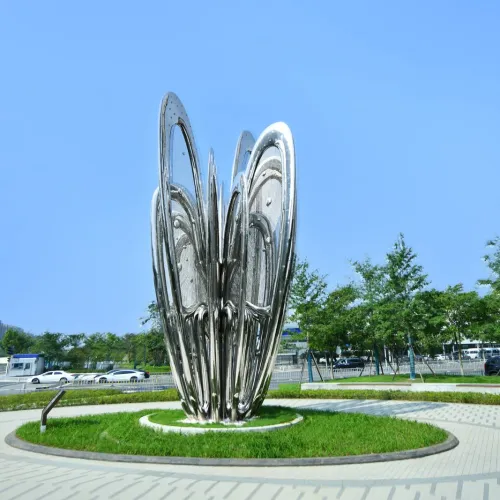
Features
Why Choose Us?
Full In-House Control
Design, engineering, fabrication and installation under one roof — one team, one contact, no outsourcing gaps.
Verifiable Engineering
Engineers calculate load, wind and anchoring; every steel and alloy batch ships with mill certificates.
Any Scale, Any Material
Stainless steel, bronze, aluminium, forged and cast metal — from a single plaza piece to landmark scale.
Worldwide Installation
Fully insured door-to-door logistics, our own crew on site, and material certificates with a maintenance guide.
We Have The Best Solutions for Your Business
Yifeng Sculpture is a public art studio based in Ningbo, China, producing large-scale sculpture since 2003. We are one accountable team from first sketch to final bolt — creative planning, detailed design, engineering, fabrication and installation all happen in-house, so the artwork you approve is the artwork you receive. Our studio pairs sculptors with structural and mechanical engineers who calculate load, wind resistance and anchoring before a single panel is cut, and our founder is a Member of the Royal Society of Sculptors (UK).
We fabricate in stainless steel, bronze, aluminium, forged and cast metal, delivering monumental, kinetic, memorial and custom commissions for urban parks, commercial districts, transit hubs and campuses — from a single plaza piece to landmark works tens of metres in scale. For overseas clients we manage fully insured door-to-door logistics, send our own installation crew to site, and back every work with material certificates, a care guide and after-sales conservation.
What a Metal Sculpture Must Survive Outdoors
Outdoor metal is in a permanent argument with water, salt, sun and people. Rain finds every horizontal ledge; coastal air attacks any grade of steel that is not properly chosen; ultraviolet light chews through coatings that were specified by colour alone; and the public will climb, touch, lean and fasten things to anything within reach. None of this is a reason to avoid metal — it is the reason the details matter more in metal than in any other medium, and why we spend more drawing time on joints, edges and drainage than on anything else.
- Water management: every ledge is sloped or drained, so the piece sheds water instead of harvesting it in hidden pockets.
- Galvanic isolation: dissimilar metals are separated with washers and sleeves, because a steel bolt in an aluminium skin is a corrosion cell.
- Crevice control: overlapping joints are sealed or opened deliberately, since the worst rust starts where water sits in a gap nobody can see.
- Structural safety: wind loading, load paths and holding-down details are engineered for the real site exposure, then checked by the local engineer.
- Public contact: edges are returned, climbing is either invited or designed out, and every reachable fixing is tamper-resistant.
These five concerns decide whether the piece still looks commissioned after ten winters. They are invisible when done well and unavoidable when done badly, which is why our drawing package treats them as design content rather than as the fabricator's problem.
Choosing Between Stainless Steel, Corten, Aluminium and Bronze
Each metal brings its own temperament, and the choice is driven by exposure, form and the surface story the concept needs. Grade 316 stainless steel is our baseline within reach of salt water or de-icing salt, with 304 stainless a sound choice inland; both can be mirror polished, brushed or bead blasted. Weathering steel offers rich, self-protecting colour but demands detailing that keeps its rust-laden runoff away from pale paving. Aluminium builds large, light, complex forms but must be isolated from steel; bronze and copper give depth and a patina that becomes part of the artwork itself.
| Metal | Best suited to | Watch-outs |
|---|---|---|
| 316 stainless steel | Coastal sites, mirror or brushed finishes, fine detail | Cost; shows fingerprints unless grain is specified |
| 304 stainless steel | Inland plazas and parks with the same formal range | Not for marine splash zones |
| Weathering steel | Strong silhouettes, warm earthy colour, industrial contexts | Runoff staining; needs distance from light paving |
| Aluminium | Large light forms, intricate perforated skins | Must be isolated from steel; softer surface |
| Bronze / copper | Figurative work, deepening patina, heritage settings | Material cost; surface keeps changing by design |
The table is a starting point, not a verdict, because the site always gets a vote. We have specified 304 stainless for an inland campus where 316 would have been bought out of habit, and we have upgraded a seemingly sheltered plaza to marine-grade after a site visit found de-icing salt drifting from an adjacent road. Exposure is rarely what the drawings suggest: wind carries salt inland, snow ploughs throw grit, and reflective paving doubles the ultraviolet load on a coating. This is why the consultation step always includes standing on the site rather than reading about it, and why our material recommendation arrives with the observations that produced it, written down so the reasoning survives the project team.
Surface Finishes and What They Do Over Time
Finish is the difference between a metal sculpture that photographs beautifully on opening day and one that still does a decade later. Mirror polish gives maximum drama and maximum evidence of every handler; a fine brushed grain hides contact and repairs far better; a bead-blasted surface reads evenly in harsh sun but holds pollution in traffic-heavy air; powder coating offers any colour but depends wholly on the quality of the pretreatment beneath it. We approve finishes with physical samples in the full system, viewed on site in real light, because a colour chosen on a screen has been chosen by nobody.
A ten-metre perforated steel work with integrated lighting that we built, documented as Butterfly Dance, carried a finish chosen exactly this way: three sample panels stood on the plaza for a week before the surface system was signed off. Other metal and steel-work pieces, from lattice pavilions to woven facades, sit in our project gallery.
Structure, Welding and Hidden Steel
Much of a metal sculpture is steel nobody will ever see. The internal frame carries the wind loads, resists vibration, and gives the visible skin something honest to attach to; hot-dip galvanizing protects that hidden structure where coatings cannot be reached again; bolted splices are placed where they can be tensioned and inspected. Welding is where craftsmanship becomes visible or ruined: on stainless, each weld zone is properly cleaned and passivated, and on polished work the grain is restored so the repair disappears into the surface.
We fabricate in our own workshop rather than subcontracting, because metal tolerances compound. Each section is checked against the master model, the complete work is trial-assembled in the yard against the site survey, and the site installation becomes a repeat performance of something already proven. That discipline is the quiet reason our metal pieces meet the ground the way the model promised.
Thermal movement is the detail most often missed in metal work, and outdoors it never stops arguing. A span of metal grows and shrinks every day; rigid connections that ignore this slowly tear coatings, crack welds and open gaps that then hold water. So we build movement into the structure on purpose — slotted fixings, flexible joints, clearances that look generous on the drawing and earn their space within a season. Fixing patterns are calculated the same way, with fastener expansion matched to the skin so a perfectly tight installation does not loosen itself by the second summer. None of this is visible to the public, and all of it is visible in the piece's tenth year.
From Consultation to Installation: The Four-Step Process
Metal commissions reward sequence, and every one of ours runs through the same four steps, each ending with something the client can review before the next stage begins.
- Consultation: site exposure, context and intent are assessed together, because the metal choice depends on all three.
- Concept development: form, material system, finish samples and structural strategy are issued as one package.
- Fabrication: cutting, forming, welding and finishing in our workshop, with trial assembly before anything ships.
- Installation: engineered lifting, a written site sequence, and commissioning of lighting or movement before handover.
The Studio Behind the Metal
Fabricating metal public artwork since 2003
More than 3000 completed works delivered
Projects installed in 23 countries
Design, engineering and fabrication under one roof
Caring for a Metal Sculpture After Handover
Metal gives more than it takes in maintenance, provided the caretaker knows what the piece is made of. We hand over record drawings, a material and fastener schedule, and a plain maintenance note covering washing intervals, drainage checks and what to watch for at the joints. A twice-yearly wash with ordinary equipment keeps stainless bright in most climates; coatings want periodic inspection at the edges where wear starts; weathering steel and bronze mostly want to be left alone. The point is that none of it requires specialist crews — only information, which is what we supply.
Where the work carries lighting, movement or water, the aftercare note becomes a schedule rather than a suggestion. Drivers and connections are mounted where a technician can reach them without scaffolding, drainage is checked at the same rhythm as the lamps, and every system is commissioned through full cycles before handover so the caretaker starts from a proven baseline rather than a promise. We have inherited enough metal pieces designed by others to know the pattern of neglect, and it almost always begins with a component nobody could reach and a document nobody was given.
You can read how the four steps from consultation to installation are structured on our services page, including what each stage delivers.
Send us the drawings, the site photographs and the exposure you are working with, and we will tell you honestly which metal system fits, how the surface will age and what the piece will need from its caretakers. Chosen and detailed this way, a metal sculpture is the most durable promise a public space can make.
Featured Products
Collection about Us
User Reviews
What users say about Us
Frequently Asked Question
Do you have any question?
Plate is laser-cut or plasma-cut to the developed surfaces from the 3D model, formed on presses and rolls, then welded into the final geometry. Large compound curves are built from many small panels, and the fit-up is checked repeatedly against the model as the form closes.
By matching the alloy to the environment and protecting the structure: 316 stainless for marine sites, hot-dip galvanizing under coatings for carbon steel, anodizing for aluminum, and drainage details that stop water from sitting in any joint. The detailing matters as much as the alloy.
Mirror polish, brushed satin, bead-blasted matte, powder coating, patina on bronze, and the self-weathering surface of weathering steel. Finish samples are approved before the full surface work begins, because finish defines how the sculpture reads in daylight.
Structural welds follow qualified procedures and are inspected before finishing; welds on visible surfaces are ground and blended so they disappear into the form. Where a weld carries load, its quality is treated as structural work, not cosmetic work.