
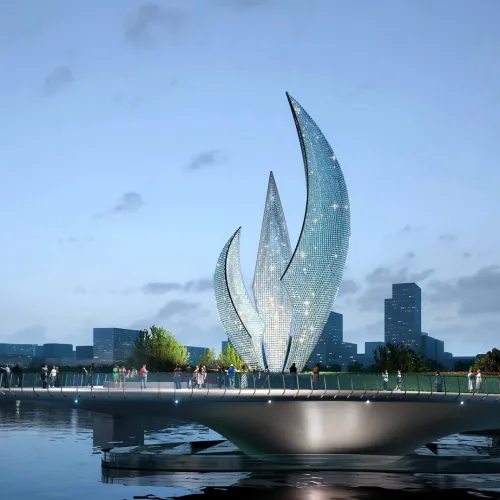
Features
Why Choose Us?
Full In-House Control
Design, engineering, fabrication and installation under one roof — one team, one contact, no outsourcing gaps.
Verifiable Engineering
Engineers calculate load, wind and anchoring; every steel and alloy batch ships with mill certificates.
Any Scale, Any Material
Stainless steel, bronze, aluminium, forged and cast metal — from a single plaza piece to landmark scale.
Worldwide Installation
Fully insured door-to-door logistics, our own crew on site, and material certificates with a maintenance guide.
We Have The Best Solutions for Your Business
Yifeng Sculpture is a public art studio based in Ningbo, China, producing large-scale sculpture since 2003. We are one accountable team from first sketch to final bolt — creative planning, detailed design, engineering, fabrication and installation all happen in-house, so the artwork you approve is the artwork you receive. Our studio pairs sculptors with structural and mechanical engineers who calculate load, wind resistance and anchoring before a single panel is cut, and our founder is a Member of the Royal Society of Sculptors (UK).
We fabricate in stainless steel, bronze, aluminium, forged and cast metal, delivering monumental, kinetic, memorial and custom commissions for urban parks, commercial districts, transit hubs and campuses — from a single plaza piece to landmark works tens of metres in scale. For overseas clients we manage fully insured door-to-door logistics, send our own installation crew to site, and back every work with material certificates, a care guide and after-sales conservation.
Why Sculpture Design Cannot Be Separated From Fabrication
Designing sculpture on a screen is seductive because every surface is smooth and every joint is invisible. In a workshop, a compound curve needs a forming strategy, a polished skin needs a welder who can work without leaving distortion, and a thin edge needs stiffening that nobody sees. When design and fabrication are separated, these realities arrive as cost increases or silent simplifications of the artist's intent.
We therefore involve the people who will build the piece during the design stage, not after approval. It is a slower week at the beginning and a much quieter month at the end. On a reflective light installation, for example, the position of every internal stiffener affects how the outer surface reads, so the detail has to be decided as part of the composition rather than added by the engineering team afterwards.
The Four Stages of Sculpture Design at Our Studio
Our process follows the same four-step arc as every commission — consultation, concept development, fabrication, installation — with the design work concentrated in the first two steps and validated continuously through the last two.
- Consultation: we gather site survey, sightlines, access routes, power availability and the client's definition of success before any form is proposed.
- Concept development: sketches, digital models and physical models are tested at real scale against the elevation or plaza, with a materials direction attached to each option.
- Design development: the chosen concept becomes shop drawings — structure, connections, finishes, lighting, and the split lines that allow the piece to travel.
- Fabrication support: the designer stays involved through forming, welding and finishing so that the built object matches the approved drawings.
Clients sometimes ask to skip straight to a visual, and we understand the pressure: committees approve what they can see. But an image without a structural scheme and a material schedule is not sculpture design, it is a promise. The version we send is accompanied by the engineering assumptions behind it, so nobody discovers the frame for the first time during a contractor's tender review.
Design Decisions That Decide Maintenance for the Next Decade
Good sculpture design anticipates the people who will look after the work long after everyone involved has moved on. These are the questions we resolve on paper rather than on a ladder.
- Surface orientation: horizontal or upward-facing surfaces hold water and dirt, so we slope or drain them by design.
- Joint placement: welds and seams are positioned where a grinder or polisher can reach them without damaging adjacent finish.
- Fastener access: every bolt that will need re-tensioning stays reachable after cladding, planting or paving is complete.
- Lighting serviceability: drivers, ballasts and connectors are grouped behind accessible hatches instead of being sealed into the artwork.
- Repairability: the finish system is documented with a touch-up procedure so a local team can correct minor damage without a full refinish.
These choices rarely cost more than the alternatives; they simply have to be made early. A design that hides its fasteners irreversibly, or seals its power supply with no hatch, saves nothing and hands the owner a problem that grows with every passing year.
Form, Proportion and the Site: How We Test a Design
Proportion is the hardest thing to judge from a screen, so we test it in three ways. First, a measured drawing places the form against the real elevation or plaza boundary at true scale. Second, we view a digital model from the height and angle that actual visitors will have, including from a car on the approach road. Third, for significant commissions we build a study model that the client can handle and photograph on site.
| Design question | How we test it | What changes if the test fails |
|---|---|---|
| Does the silhouette read from distance? | Scaled elevation drawing plus view tests from main approaches | Height and through-openings are adjusted, not the concept |
| Does it crowd the door or path? | Eye-level and plan views against circulation routes | Footprint is rotated or slimmed to protect clearances |
| Will the surface age evenly? | Physical finish samples viewed on site in real daylight | Grain direction, gloss level or coating system is revised |
| Can it be built and shipped? | Fabricability review with the workshop and a transport split study | Split lines and internal framing are added at invisible joints |
| Will it hold in the wind? | Structural verification against local wind load and connection design | Section sizes and anchor strategy are increased where required |
A design that fails one of these tests is not a failure of imagination; it is a normal turn in the process. What matters is that the test happens while changes are still cheap. We have never regretted an extra week of development, but we have seen clients regret a rushed approval that locked in a proportion nobody had checked at eye level.
Common Sculpture Design Problems We Are Asked to Fix
Most rescue work arrives with the same diagnosis: a beautiful concept that was never taken through engineering. A cantilever that looked effortless in the visualisation needs a hidden frame, and the hidden frame has to fit inside a skin that was never thickened for it. Our first task is usually to rebuild the interior without altering the silhouette, which is possible far more often than clients expect — but it takes a design fee that would have been unnecessary at the start.
The second recurring problem is surface continuity. Welded assemblies pull, polished skins reveal every ripple under the sun, and panels that met perfectly on a screen can show an uneven grain once fabricated. Good sculpture design solves this with the build sequence: order of assembly, which joints are ground and which are left as intentional lines, and where the grain direction changes. Those decisions belong in the drawing set, not in a conversation at the polishing bench.
The third is lighting added late. Retrofitting illumination into a finished piece means external fixtures bolted on afterwards, visible cable runs and glare where the design wanted a soft wash. Where a client wants a night presence, we treat the light as part of the drawing from the beginning, including the cavities, the driver locations and the access needed to maintain them.
The Studio Behind the Work
Designing and building sculptures since 2003
More than 3000 completed works delivered
Works installed in 23 countries
Academic background from major art academies and the Royal Society of Sculptors
Materials in Sculpture Design: Choosing by Exposure
Material selection is a design decision, not a purchasing decision, because the surface is what the public actually experiences. Grade 316 stainless steel is our baseline within roughly a kilometre of salt water; 304 stainless or a correctly specified coated steel serves inland sites well. Aluminium allows large light forms but demands isolation at every steel connection to prevent galvanic corrosion, and bronze or copper suits projects where a patina that keeps changing is part of the concept.
Finishes behave differently under the same sky. A mirror polish is spectacular and unforgiving, showing every fingerprint and panel joint. A fine brushed grain conceals handling marks and repairs far better in daily use. Bead blasting reads evenly in strong sun but holds pollution, and painted systems depend entirely on the coating specification and a scheduled re-coat. We produce samples in the specified system, and when the geometry allows, we produce a full-size mock-up panel of a critical detail — because a colour approved on a screen has been approved by nobody.
Delivering a Design to a Client on Another Continent
Overseas clients approve drawings rather than objects, so the drawing package has to carry the whole conversation. We issue design sets with the structural scheme, the material and finish schedule, the lighting layout and the assembly sequence visible from the start. Comments are collected in defined rounds, and once the design is frozen, changes move to a documented variation process so nobody is guessing about what was agreed. Work such as the layered light-and-structure piece documented as Wisdom Tree was coordinated this way, with structural and lighting details settled before the first panel was cut.
The handover package matters just as much as the artwork. Clients receive record drawings, material references, a finish schedule and maintenance guidance, so the design intent stays legible to the facilities team a decade later. You can see how our four steps run on our services page, and finished commissions of every type are collected in the project gallery.
If you have an intention, a site and a deadline, send them to us with whatever drawings already exist. We will come back with options that are honest about structure and cost drivers, because good sculpture design is not the drawing that looks best on a screen — it is the one that can still stand in the plaza, in the wind, exactly as intended, long after everyone who approved it has moved on.
Featured Products
Collection about Us
User Reviews
What users say about Us
Frequently Asked Question
Do you have any question?
We read the site, the audience and the intention, then sketch in parallel directions before developing the strongest one in 3D. The brief defines the problem; the concept responds to the site rather than to the brief's wording.
Sketching, 3D modeling, photorealistic rendering into site photography, structural analysis with engineers, and physical maquettes for scale judgment. Digital tools handle geometry; the maquette still answers questions about proportion that screens flatten.
Yes, and design is exactly where changes belong. We expect iteration during Concept Development and present the work at review points so the client steers the direction — while changes after fabrication starts are the ones everyone should avoid.
When the client approves the final design package: geometry, materials, finishes and structural basis. Fabrication drawings are then developed from the approved model, so what is built is exactly what was approved.