
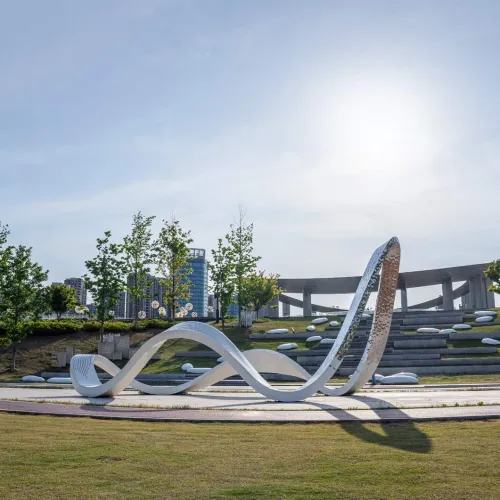
Features
Why Choose Us?
Full In-House Control
Design, engineering, fabrication and installation under one roof — one team, one contact, no outsourcing gaps.
Verifiable Engineering
Engineers calculate load, wind and anchoring; every steel and alloy batch ships with mill certificates.
Any Scale, Any Material
Stainless steel, bronze, aluminium, forged and cast metal — from a single plaza piece to landmark scale.
Worldwide Installation
Fully insured door-to-door logistics, our own crew on site, and material certificates with a maintenance guide.
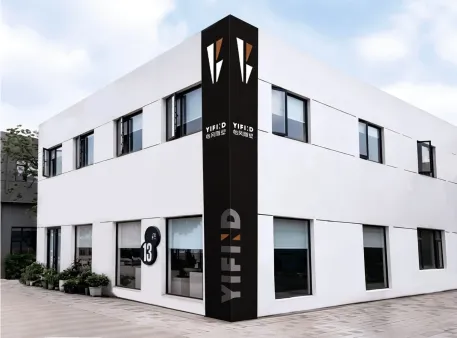
We Have The Best Solutions for Your Business
Yifeng Sculpture is a public art studio based in Ningbo, China, producing large-scale sculpture since 2003. We are one accountable team from first sketch to final bolt — creative planning, detailed design, engineering, fabrication and installation all happen in-house, so the artwork you approve is the artwork you receive. Our studio pairs sculptors with structural and mechanical engineers who calculate load, wind resistance and anchoring before a single panel is cut, and our founder is a Member of the Royal Society of Sculptors (UK).
We fabricate in stainless steel, bronze, aluminium, forged and cast metal, delivering monumental, kinetic, memorial and custom commissions for urban parks, commercial districts, transit hubs and campuses — from a single plaza piece to landmark works tens of metres in scale. For overseas clients we manage fully insured door-to-door logistics, send our own installation crew to site, and back every work with material certificates, a care guide and after-sales conservation.
What Makes Contemporary Sculpture Different From a Classical Commission
A classical or figurative commission arrives with most decisions already settled. Everyone involved can look at the maquette and agree whether the figure is convincing, so the approval conversation is about craft. Contemporary work removes that shared reference. Two people can stand in front of the same form and one can see restraint while the other sees an unfinished idea, which is why the approval route has to be defined in writing before fabrication rather than negotiated at the end.
The upside is that the form is genuinely open. Because there is no figure to imitate, the design can respond to the actual conditions of a site: the direction of the wind, the reflected light off a glass lobby, the level at which a child's eye passes, the distance from which a driver will see it. That responsiveness is what makes a contemporary piece feel as though it belongs to a place, and it is also what makes it hard to copy from a reference image.
| Question to ask | A strong answer sounds like | A weak answer sounds like |
|---|---|---|
| What is the idea? | One sentence naming the concept and its site | Several themes listed without a hierarchy |
| Why this material? | Physical reasons, exposure and structure | Preference, fashion or an image to match |
| How is it approved? | Named samples, drawings and a sign-off gate | Trust the rendering, decide on site |
| How does it weather? | A stated ageing behaviour and a service plan | Assurance that nothing will change |
| What is handed over? | As-built drawings, materials records, spares | A photograph and a handshake |
Judging Contemporary Sculpture Without a Familiar Subject
Selection panels often struggle most with work that has nothing to compare against. A useful discipline is to judge the proposal on four grounds that do not depend on taste: whether the idea is legible in one sentence, whether the form responds to the site rather than to a studio series, whether the material is used honestly, and whether the piece can be maintained by the people who will own it. A proposal that fails the fourth test is a liability no matter how strong the first three are.
- Concept clarity: if the argument needs three paragraphs to reach first base, the public will not make the journey at all.
- Site response: ask what would change if the piece were moved elsewhere; a good answer is that it could not simply be moved.
- Material honesty: painted steel pretending to be cast bronze reads as a compromise within two seasons, and the public notices before the panel does.
- Structural ambition: a delicate idea carried by a visibly heavy armature is a drawing that was never resolved in three dimensions.
- Maintenance reality: a piece that needs a specialist visit to stay legible will drift out of use long before it fails physically.
Panels also do well to see the work in the round, which is rarely possible at concept stage. We build small physical models and, where the form is complex, a section model showing how a viewer will actually encounter the piece while walking past: entering light, then silhouette, then surface, then detail. That sequence is what the public experiences, and it is a far better basis for a decision than a single rendered view from a drone height nobody will ever stand at.
Materials and Techniques in Contemporary Sculpture
The palette is broad, but the useful split is between materials that change and materials that hold. Grade 316 stainless steel is the sensible outdoor baseline close to salt water, with 304 or well-prepared painted steel inland; aluminium allows large light forms but needs isolation at every steel connection; bronze and copper are chosen when a changing surface is part of the idea. Casting, fabrication, forming and digital cutting are combined more often than most clients expect, since one piece may be folded sheet, machined nodes and cast details in a single assembly.
Movement and light have moved from novelty to ordinary vocabulary, and that shift has brought engineering to the centre of the discussion. A kinetic element needs a bearing strategy, a drive that can be serviced, a safety concept for anyone who can reach it and a behaviour for the day the power fails. An illuminated surface needs an outdoor-rated protection class, accessible drivers and a light output that can be replaced years later. None of that limits the idea; it decides whether the idea is still working in year five.
The Studio Behind the Work
Fabricating and engineering artists' concepts since 2003
More than 3000 completed works delivered
Projects installed in 23 countries
Drawing on training links with Tsinghua Academy of Fine Arts, China Academy of Art and the Royal Society of Sculptors
When a Studio Fabricates Contemporary Sculpture for an Artist
- Understand the intent: we begin with the artist's own description of what the piece is about, before any drawing is translated.
- Translate to buildable form: the concept is converted into fabrication drawings, and every departure from the original is flagged rather than quietly absorbed.
- Maquette and mock-up: scale models and full-size sections confirm proportion, surface and colour before the main fabrication run.
- Fabrication fidelity: weld quality, joint rhythm and finish are held to a written standard that the artist has seen and accepted.
- Documentation and credit: the artist receives as-built records and the fabrication history, and the authorship of the work stays with the artist.
The hardest part of that relationship is usually the middle of the job, when the artist sees a full-size section for the first time and realizes that a surface reads differently at three metres than it did at thirty centimetres. We expect that moment and build a review gate around it, because a change caught there is a day of work while a change caught after the frame is closed is a re-fabrication. Working with visiting artists across several countries has taught us that the conversation is easier when the studio can show, not only tell.
How Contemporary Work Ages in a Public Place
A public site is unforgiving, and the pieces that survive are the ones whose ageing was designed rather than hoped for. Surface treatments that fail unevenly are worse than treatments that fail evenly, because blotchy change reads as neglect while uniform change reads as age. Detailing decides the rest: drainage that keeps water off horizontal faces, isolation between dissimilar metals, and service access to every element the public will touch.
Interpretation matters as much as metal. A contemporary piece with no explanation is sometimes read as a maintenance problem; a short, plain statement on a discreet plaque or a project page changes how the same object is treated by the public. We have seen works go from being climbed on and levered at to being pointed out to visitors, purely because someone finally wrote two lines explaining what the thing was for.
Ambition and scale are not the same thing in this category, and the most durable work is often the most restrained. One clear move carried through an entire piece usually reads better from a distance than several ideas competing for attention, and it is also easier to build, to finish and to repair. When we review a proposal we look for that single move first, because a form that keeps explaining itself in the drawings is usually a form that has not yet been decided.
Commissioning Contemporary Sculpture With Confidence
The clients who get the best results are not the ones with the boldest taste; they are the ones who define the decision process early. Agree who approves, what evidence they approve from, and what happens if the approved sample cannot be achieved at full scale. Then hold the programme to those gates. Ambiguity in the process is what produces cautious, forgettable work, because a studio that does not know how a decision will be made tends to design defensively.
You can see how the four-step process from consultation to installation works on our services page, and a 3.2-metre kinetic stainless work built around movement and airflow is documented as Fish Swarm. Kinetic, lit and cast works sit alongside each other in the project gallery.
Send us the intent, the site conditions and the approval route, and we will tell you honestly what a contemporary sculpture can carry structurally, how it should be finished and how it will age where you intend to put it. Commissioned with a clear idea and an honest engineering conversation, contemporary sculpture gives a place the one thing a familiar figure cannot: a form that belongs to no other site in the world.
Featured Products
Collection about Us
User Reviews
What users say about Us
Frequently Asked Question
Do you have any question?
We start from sketches or reference forms, build the geometry in 3D, and work through material selection, structure and surface with the artist. Test panels confirm finishes, and a maquette or full-size section is approved before the full fabrication begins.
The artistic intent, the site context, the level of interaction the client wants, and the boundaries the design must respect — structure, safety, maintenance and the surrounding architecture. A clear brief keeps the design exploration productive instead of circular.
Complex curved surfaces are checked against the 3D model with full-size templates, welds are inspected before finishing, and finishes are compared to approved samples under daylight. The approval standard is fixed at the sample stage so finishing does not drift.
Simple geometric forms move faster than large compound-curve pieces, and interactive or kinetic elements add engineering and testing time. The concept phase is where the schedule is won or lost: a design approved once, completely, keeps fabrication on a straight line.