

Features
Why Choose Us?
Full In-House Control
Design, engineering, fabrication and installation under one roof — one team, one contact, no outsourcing gaps.
Verifiable Engineering
Engineers calculate load, wind and anchoring; every steel and alloy batch ships with mill certificates.
Any Scale, Any Material
Stainless steel, bronze, aluminium, forged and cast metal — from a single plaza piece to landmark scale.
Worldwide Installation
Fully insured door-to-door logistics, our own crew on site, and material certificates with a maintenance guide.
We Have The Best Solutions for Your Business
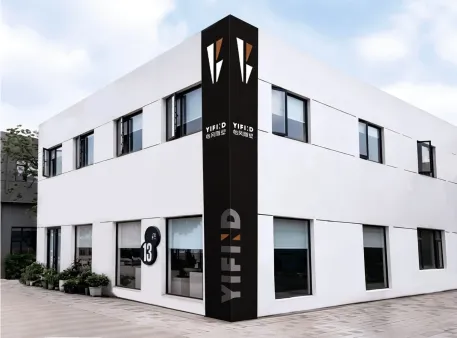
Yifeng Sculpture is a public art studio based in Ningbo, China, producing large-scale sculpture since 2003. We are one accountable team from first sketch to final bolt — creative planning, detailed design, engineering, fabrication and installation all happen in-house, so the artwork you approve is the artwork you receive. Our studio pairs sculptors with structural and mechanical engineers who calculate load, wind resistance and anchoring before a single panel is cut, and our founder is a Member of the Royal Society of Sculptors (UK).
We fabricate in stainless steel, bronze, aluminium, forged and cast metal, delivering monumental, kinetic, memorial and custom commissions for urban parks, commercial districts, transit hubs and campuses — from a single plaza piece to landmark works tens of metres in scale. For overseas clients we manage fully insured door-to-door logistics, send our own installation crew to site, and back every work with material certificates, a care guide and after-sales conservation.
What Sculpture Fabrication Actually Covers
Clients sometimes read fabrication as a single trade — cutting, forming and welding metal — and budget accordingly. In practice a professional sculpture fabrication scope reaches into every discipline the finished piece will touch. A credible workshop takes responsibility for all of the following, not just the parts that happen in the shop:
- Engineering and secondary steel: internal armatures, base frames and the load paths that carry the piece through wind and handling.
- Material development: selecting and testing the sheet, plate, castings or composites that will hold the form outdoors.
- Surface work: polishing, brushing, bead-blasting, coating and patination developed on physical samples, not screens.
- Mockups and trial assembly: building critical joints and, where the geometry is complex, the whole piece once before it ships.
- Logistics and installation: sectioning for transport, engineered lifting points, crane planning and on-site finishing.
- Documentation: record drawings, material certificates and a maintenance plan the owner can actually follow.
When a quote arrives that only prices the welding hours, the missing items do not disappear — they migrate to the site, where every hour costs more and every improvisation is visible to the public for the next twenty years.
Where Fabrication Projects Go Wrong
The failures we are asked to rescue follow a pattern. A sculptural canopy arrives with panel joints that nobody sampled, so the grain runs in two directions under sunlight. A kinetic piece is built without a trial assembly and the drive components do not line up on site. A mirror-polished form is finished in a dusty yard and the polishing shows swirl marks that no amount of later cleaning will remove. None of these is an artistic failure; all of them are process failures that a disciplined workshop would have caught weeks before packing.
The asymmetry is what hurts. An extra week of sampling and inspection in the workshop costs a fraction of what a site crew, a second crane mobilization and a repair crew cost once the piece is in place. We would much rather argue about weld details at the modelling stage than defend a visible repair after handover, and clients who have been through a repair season on a public plaza tend to agree with us.
Tolerance, Templates and Trial Assembly
Three habits separate a sculpture workshop from a general metal shop. First, we survey the real site — the actual opening, the actual paving level, the actual bolt pattern — instead of trusting a model that may be two revisions old. Second, we build templates and jigs for every repeated or curved element, so the tenth segment matches the first. Third, we assemble the complete piece in the yard against the surveyed conditions, photograph it, adjust it, and only then pack it. On the day the truck arrives, the site sees a repeat performance rather than a first attempt.
Materials and Methods Compared
Material choice drives nearly every downstream decision in sculpture fabrication: the forming method, the joining method, the finish, the structure and the maintenance rhythm. The table below summarizes how we brief clients at the start of a project, before drawings fix anything in place.
| Material | Typical use | Strengths | Watch-outs |
|---|---|---|---|
| 316 stainless steel | Coastal and landmark work | Resists salt corrosion; holds mirror or brushed finishes | Higher material and forming cost |
| 304 stainless steel | Inland plazas and interiors | Reliable, widely available, finishes well | Needs distance from salt spray |
| Carbon steel + coating | Large internal structures, painted skins | Strong and economical for structure | Hot-dip galvanizing and coating quality decide its life |
| Aluminium | Large light forms, canopies | Light weight, easy weight handling | Must be isolated at every contact |
| Bronze / corten | Memorial and heritage contexts | Patina is part of the concept | Runoff staining needs drainage design |
The right answer is rarely the most expensive material; it is the one whose failure mode the client can live with. A brushed 304 finish inland will outperform a badly executed mirror 316, and a well-detailed galvanized armature under a composite skin will outlast both if the coating schedule is followed.
The Four-Step Workflow From Brief to Handover
Every commission we take runs through the same four steps, refined across more than two decades of sculpture fabrication. The steps are simple to state and unforgiving to skip:
- Consultation: we study the site, the audience, the wind and light conditions, and the client's program, and we say honestly what the location will and will not support.
- Concept development: sketches become maquettes and 3D models; materials, finishes and fixing strategies are chosen while change is still cheap.
- Fabrication: engineering, forming, welding, finishing and trial assembly happen in the workshop, with stage photos and samples going to the client at agreed checkpoints.
- Installation: sectioning, packing, shipping, engineered lifting, on-site finishing and commissioning run to a written sequence the site manager can plan around.
A recent commission from a design director at a landscape practice in Australia followed exactly this path: the concept survived unchanged from maquette to plaza because every practical question — lifting points, joint lines, drainage, lighting drivers — was answered during concept development rather than on site. That is the quiet advantage of a studio where design and fabrication share a floor.
The Checks That Happen Before a Piece Leaves the Workshop
Before any work of ours ships, a fixed list of checks is signed off: weld inspection on structural joints, dimension checks against the surveyed site data, finish review under daylight lighting, fastener torque records, lifting point verification and a dry-run of any lighting or movement systems. Each item is cheap at this stage and expensive at every later stage, which is precisely why the list exists.
The Studio Behind the Work
Fabricating public sculpture since 2003
More than 3000 completed works delivered
Installations across 23 countries
Design, engineering and fabrication under one roof
That record was built one delivery at a time, mostly for clients who will never meet us in person before the artwork arrives. Distance raises the stakes of process discipline rather than lowering them: when the site is in another hemisphere, the trial assembly, the packing photographs and the written installation sequence are the only things standing between a smooth handover and a difficult month.
How to Brief a Fabrication Partner
A useful brief does not need to be long, but it needs four things: the site drawings or a survey, the intended location and audience, the exposure conditions (coast, wind, snow, water features), and any fixed constraints such as lifting restrictions, heritage settings or lighting intent. With those four inputs a competent workshop can price honestly, flag risks early and propose finishes that will actually behave in the location you have.
Ask to see samples in the specified finish system, ask which checks happen before dispatch, and ask who signs off the installation method. The answers to those three questions predict the quality of the finished piece better than any render, and a studio that answers them without hesitation is a studio that expects to hand over work it will still be proud of in a decade.
Working With a Fabrication Studio Across Borders
Most of our clients commission from another continent, and distance changes the way sculpture fabrication has to be managed. The answer is not more meetings; it is more evidence. We send stage photography at every agreed checkpoint, courier physical finish samples before the first panel is cut, and hold a written record of every decision so that approvals never depend on somebody's memory of a call. Time differences stop being a friction once the questions are answered in documents rather than in live conversation, because the next working day always starts with the answer already waiting.
If you are comparing overseas partners, ask each one what arrives with the shipment. A workshop confident in its process will offer trial-assembly photographs, weld inspection records, material certificates, labelled fastener kits and an installation method statement as standard items. A workshop that promises only "we will handle it" is asking you to accept risk you cannot see from ten thousand kilometres away. Cross-border sculpture fabrication rewards clients who demand evidence early, and it rewards studios who have already built the habit of producing it.
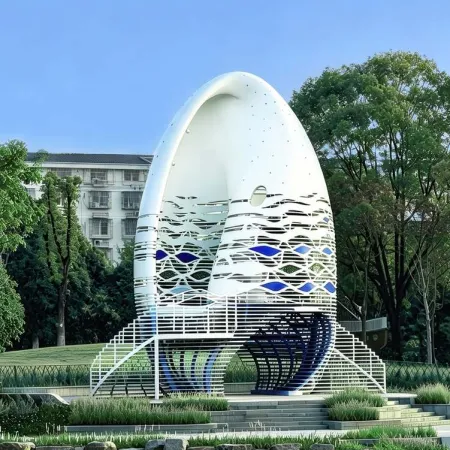
You can see how our consultation-to-installation process is structured on the services page. A 10-metre perforated form built with layered metal skins and integrated lighting is documented as Butterfly Dance, and the full range of fabricated works, from kinetic devices to landmark gates, sits in the project gallery.
Send us the drawings, the site photographs and the constraints, and we will tell you plainly what sculpture fabrication will involve, where the risks sit and which material system will serve the artwork for the longest. Handled with that discipline, sculpture fabrication stops being the risky stage of a public art project and becomes the stage where the concept finally becomes real.
Featured Products
Collection about Us
User Reviews
What users say about Us
Frequently Asked Question
Do you have any question?
Laser and plasma cutting, plate rolls and press brakes, welding cells, casting for bronze work, polishing and finishing stations, and survey tools for dimensional checking. The equipment matters less than the people who set it up — sculpture fabrication is still handwork at its core.
Full-size templates and dimensional checks are taken against the model at each stage, structural welds are inspected, and surface finishes are compared to approved samples. Each section passes inspection before it is allowed into the next stage.
At engineered joints designed to be invisible in the finished work. Sections are assembled and fitted in the workshop — a full trial erection where possible — so they mate precisely on site after transport.
The fabrication team prepares the anchor set-out drawings, lift points and assembly sequence that the installation crew executes. Because the same studio controls both, nothing is discovered for the first time on site.