
Features
Why Choose Us?
Full In-House Control
Design, engineering, fabrication and installation under one roof — one team, one contact, no outsourcing gaps.
Verifiable Engineering
Engineers calculate load, wind and anchoring; every steel and alloy batch ships with mill certificates.
Any Scale, Any Material
Stainless steel, bronze, aluminium, forged and cast metal — from a single plaza piece to landmark scale.
Worldwide Installation
Fully insured door-to-door logistics, our own crew on site, and material certificates with a maintenance guide.
We Have The Best Solutions for Your Business
Yifeng Sculpture is a public art studio based in Ningbo, China, producing large-scale sculpture since 2003. We are one accountable team from first sketch to final bolt — creative planning, detailed design, engineering, fabrication and installation all happen in-house, so the artwork you approve is the artwork you receive. Our studio pairs sculptors with structural and mechanical engineers who calculate load, wind resistance and anchoring before a single panel is cut, and our founder is a Member of the Royal Society of Sculptors (UK).
We fabricate in stainless steel, bronze, aluminium, forged and cast metal, delivering monumental, kinetic, memorial and custom commissions for urban parks, commercial districts, transit hubs and campuses — from a single plaza piece to landmark works tens of metres in scale. For overseas clients we manage fully insured door-to-door logistics, send our own installation crew to site, and back every work with material certificates, a care guide and after-sales conservation.
Where Stainless Steel Sculpture Performs Best
Stainless earns its place wherever the artwork faces weather, hands and time at once. Within roughly a kilometre of salt water, grade 316 is the sensible baseline; inland, 304 serves well and leaves budget for richer form or better structure. The material suits three situations especially well:
- Coastal and waterfront sites: salt spray, humidity and storm exposure make corrosion-resistant grades the only honest starting point.
- Interactive and touchable works: smooth surfaces tolerate public contact, clean easily and do not flake paint onto hands or clothing.
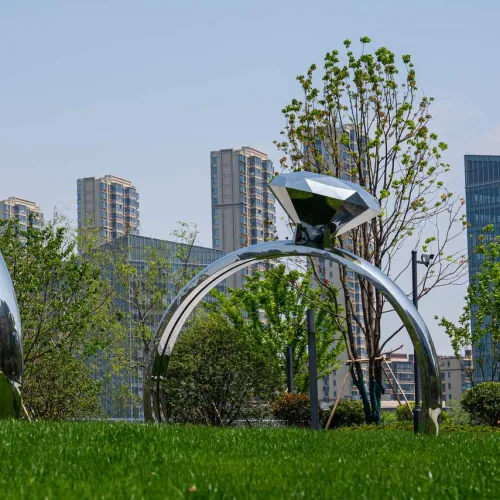
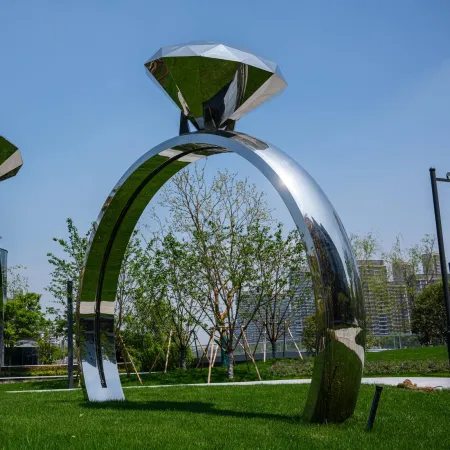
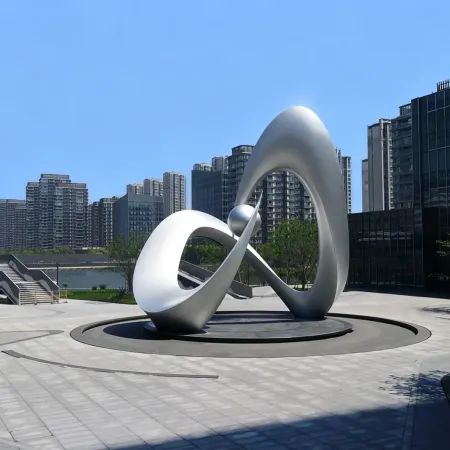
- Reflective landmarks: a polished or satin surface gathers the sky, the water and the passing city into the artwork, changing it through the day.
There is a fourth situation worth naming: sites where the artwork stands near water features, irrigation or pool systems. Chlorinated spray and fertiliser drift are aggressive to ordinary finishes, and stainless — properly detailed, with drainage and isolation thought through — shrugs off conditions that would strip paint or cloud anodising within a few seasons. It is the quiet reason so many fountains, courtyards and resort commissions end up specified in metal that does not depend on a coating for its survival.
The common thread is longevity under public conditions. A painted work may look equal on opening day; the difference appears in year eight, when one surface is being re-coated and the other is being washed.
304 or 316: Matching the Grade to the Site
The two grades most used in outdoor artwork differ mainly in molybdenum content, which is what gives 316 its resistance to chloride attack. Choosing between them is a site question, not a prestige question, and it is one of the first decisions we fix during concept development. The table below is how we walk clients through it.
| Factor | 304 stainless | 316 stainless |
|---|---|---|
| Corrosion resistance | Strong inland performance | Resists chloride and salt spray |
| Best setting | Inland plazas, campuses, interiors | Coastal fronts, pools, marinas |
| Finish behaviour | Holds mirror and brushed finishes | Same finishes, better in marine air |
| Forming and welding | Well understood across the industry | Similar technique; weld tint needs careful removal |
| Maintenance rhythm | Routine washing on a set interval | Routine washing; tolerates harsher exposure |
One warning we give every client: the grade on the certificate must match the grade in the specification. Reputable workshops provide material certificates with the handover package, because a substitution discovered years later, when tea-staining appears on a coastal site, is nobody's favourite conversation.
Surface Finishes and What Each One Asks of You
Finish determines how the piece is read — and how it is maintained — for the next two decades. We always produce physical samples in the specified system and view them on site in real light before anything is committed:
- Mirror polish: maximum reflection and drama, but it shows fingerprints, joint lines and any polishing inconsistency, so it demands disciplined workmanship and periodic washing.
- Brushed satin: a directional grain that hides handling and small repairs far better than polish; the most forgiving choice for busy public sites.
- Bead-blasted: an even, soft matte that reads consistently in strong sun, though it holds dirt in polluted air and wants a steadier cleaning rhythm.
- PVD or colored coating: adds tinted, metallic tones; performance depends on coating quality and on isolating it from abrasion and cleaning chemicals.
There is no universally right finish, only a fit between the surface, the site's air and the owner's appetite for maintenance. We put that trade-off in writing during concept development rather than discovering it in year three.
Engineering: Wind Load, Structure and Safety
A reflective form draws the eye; the internal structure keeps it standing. Every outdoor commission we build goes through wind-load checks appropriate to the site's recorded conditions, with internal armatures, base frames and anchor details engineered to match. Kinetic and elevated elements add dynamic loads and access questions: how a maintenance crew reaches a light fitting ten metres up matters as much as how the piece looks on opening day. Fixings are specified so they can be reached, re-tensioned and, where needed, replaced without dismantling the artwork.
- Structural review: wind, self-weight and handling loads checked against the site's real exposure data.
- Foundation interface: base plates and anchors coordinated with the ground works while the concrete is still being designed.
- Service access: lighting drivers, movement components and drainage points placed where hands can actually reach them.
- Trial assembly: the complete piece is built once in the workshop against surveyed site data before anything ships.
The Craft Behind a Clean Surface
What separates a fine stainless steel sculpture from a merely adequate one usually hides in the welds. Every visible weld on our work is dressed and blended so the surface reads as continuous metal, with the grain re-run to match the surrounding finish; heat tint is removed because it is where corrosion starts. Forming is done over shapes developed from the maquette, so the curvature stays true to the artist's proportions rather than approximated from flat patterns. On a 3.2-metre kinetic commission for a waterfront, the fish-scale panels had to keep a continuous reflection while rotating on their axes — the geometry only survived because design and fabrication argued it out across the same workshop floor.
Scale changes how a surface must be finished, too. A jewellery-smooth transition that delights at arm's length is invisible across a plaza; what matters at landmark size is the evenness of the grain and the honesty of the reflection, checked from the distances the public will actually use. For that reason our finish inspections on large works are done from the ground, in the light the site will provide, with someone standing where the photographs will one day be taken. A stainless steel sculpture is judged by strangers at range, and we finish it for them, not for the workshop.
The Studio Behind the Work
Building stainless steel artwork since 2003
More than 3000 completed works delivered
Installations across 23 countries
Design, engineering and fabrication under one roof
Problems We Meet in Existing Stainless Steel Works
A good part of our repair work involves stainless steel sculpture built elsewhere, and the faults repeat with remarkable consistency. The most common is tea-staining — brown discolouration that follows a streak down the surface — and in most cases the cause is design rather than material: water carrying salt or pollution across the artwork and drying on it, again and again, because a drainage detail above the piece was never considered. Washing removes the stain; changing the runoff path removes the cause. We always check what sits above and behind a piece before we blame the grade.
The second recurring fault is corrosion starting at the welds, where heat tint was polished over instead of removed, or where carbon steel tools contaminated the surface during grinding. The third is galvanic attack at connections, where stainless met a dissimilar metal without isolation and the joint quietly corroded in the wettest month of the year. Every one of these failures is invisible at handover and expensive at year five, which is why our shop practices — tint removal, dedicated tooling, isolating washers — exist for reasons the client never has to think about.
When we assess an existing piece, the sequence is simple: identify the water, identify the metals, identify the access. Repairs designed around those three answers hold; repairs designed around the symptom return within a season or two. The same logic applies to new work, which is why the site survey and exposure review happen before any drawing of ours is issued.
Caring for Stainless Steel Outdoors
Stainless rewards simple, regular attention. Routine washing with mild detergent removes the salt film and airborne dirt that would eventually cause tea-staining, especially near the coast; drainage pockets are checked so water does not sit; fasteners are inspected on the same schedule as the wash. Every handover we make includes record drawings, material certificates and a written maintenance rhythm, because an owner who knows what the piece needs will keep it looking like the day it was installed.
Our four-step process from consultation to installation is laid out on the services page. A kinetic stainless commission built from mirrored fish-scale panels is documented as Fish Swarm kinetic device, and the wider family of reflective and engineered works is collected in the project gallery.
If you are weighing a stainless steel sculpture for a coastal frontage, a plaza or a civic gateway, send us the site and the intent, and we will advise honestly on grade, finish and structure before anything is drawn in stone. Chosen with that care, a stainless steel sculpture is not a maintenance burden but the calmest object on the site — gathering the weather, the light and the city into its surface for decades.
Featured Products
Collection about Us

User Reviews
What users say about Us
Frequently Asked Question
Do you have any question?
Mirror polish, brushed satin, bead-blasted matte, vibration finish and colored PVD coatings, plus painted or powder-coated surfaces. Each finish changes how the piece reads — mirror multiplies the surroundings, satin diffuses light softly, matte keeps the form dominant.
Surfaces are developed from the 3D model into cutting patterns, formed on rolls and presses, then welded and dressed. Visible welds are ground and blended until the seam disappears, and the whole surface is finished to the approved sample before packing.
Grade 316 with correct detailing performs well near the sea, but detailing matters: crevices that trap salt spray, and surfaces that cannot be washed, cause staining even in good alloys. We design drainage, avoid crevice traps and write a washing schedule into the maintenance notes.
Periodic washing with fresh water, especially in coastal or winter-salt environments, inspection of fixings, and touch-up polishing where surface damage occurs. Compared with coated metals, stainless rewards simple care with decades of unchanging appearance.