
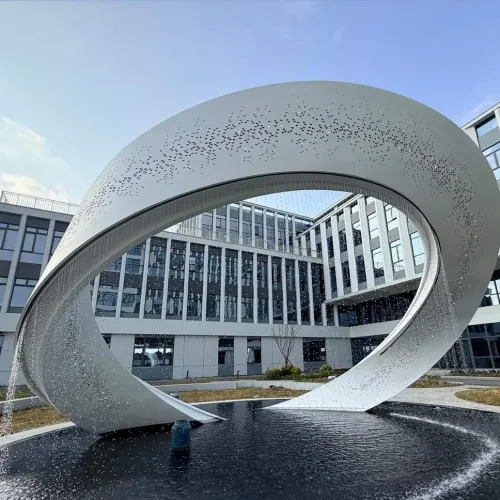
Features
Why Choose Us?
Full In-House Control
Design, engineering, fabrication and installation under one roof — one team, one contact, no outsourcing gaps.
Verifiable Engineering
Engineers calculate load, wind and anchoring; every steel and alloy batch ships with mill certificates.
Any Scale, Any Material
Stainless steel, bronze, aluminium, forged and cast metal — from a single plaza piece to landmark scale.
Worldwide Installation
Fully insured door-to-door logistics, our own crew on site, and material certificates with a maintenance guide.
We Have The Best Solutions for Your Business
Yifeng Sculpture is a public art studio based in Ningbo, China, producing large-scale sculpture since 2003. We are one accountable team from first sketch to final bolt — creative planning, detailed design, engineering, fabrication and installation all happen in-house, so the artwork you approve is the artwork you receive. Our studio pairs sculptors with structural and mechanical engineers who calculate load, wind resistance and anchoring before a single panel is cut, and our founder is a Member of the Royal Society of Sculptors (UK).
We fabricate in stainless steel, bronze, aluminium, forged and cast metal, delivering monumental, kinetic, memorial and custom commissions for urban parks, commercial districts, transit hubs and campuses — from a single plaza piece to landmark works tens of metres in scale. For overseas clients we manage fully insured door-to-door logistics, send our own installation crew to site, and back every work with material certificates, a care guide and after-sales conservation.
Why a Custom Sculpture Starts With a Written Brief
A custom commission is only as good as the sentence the client is willing to commit to. Mood boards communicate taste but not requirements, and a studio that receives only images has to guess at the things that actually drive the design: how far away the viewer stands, whether people will touch the piece, whether it must be seen at night from a road, and who will look after it afterwards. Written requirements are not bureaucracy; they are what stops a project from being redesigned in the final month.
The brief we find most useful fits on a single page. It names the site and its conditions, the experience the client wants a visitor to have, the constraints already fixed by the building or the plaza, and the identity of the person who can say yes. Anything beyond that is useful, but those five items are the ones that decide whether the first concept is close or simply pretty, and they cost the client nothing but an hour of thought.
The Four Steps Behind Every Custom Sculpture
- Consultation: we review the site, the brief and the constraints, then tell the client what is realistic before any design effort is spent on an idea that cannot be built.
- Concept development: the proposal is developed through sketches, scale models and material options until one direction is chosen and documented.
- Fabrication: the piece is engineered, built and finished in the workshop, with a trial assembly before anything is packed for shipping.
- Installation: the work is delivered, fixed, finished and commissioned on site, then handed over with as-built records and service guidance.
The sequence matters because each step closes options for the next one. Once the concept is signed off, moving a form by half a metre may be straightforward, but changing the material after fabrication drawings are issued is effectively a new project. Clients who understand that rhythm make faster decisions and get more design for their attention, because they know which choices are still cheap and which have already been paid for.
| Stage | What we do | What you approve | What you receive |
|---|---|---|---|
| Consultation | Site and requirement review, feasibility advice | The design brief and constraints | A written scope and design direction |
| Concept development | Sketches, models, material and finish options | One chosen direction and finish | Concept drawings and a physical model |
| Fabrication | Engineering, build, finish and trial assembly | Samples, drawings and inspection records | The finished work, packed for shipping |
| Installation | Delivery, fixing, finishing and commissioning | The installed position and final appearance | A completed and tested installation |
| Handover | Records, briefing and service guidance | The maintenance routine | As-built drawings, materials list, spares |
What the Client Needs to Provide Before Design
The quality of a custom sculpture is decided partly by information the client already holds. Survey data, service locations and photographs taken from the actual viewpoints are worth more than any amount of descriptive writing, and they are the fastest way to shorten the design phase. If a structural engineer or architect is already on the project, involving them from the first conversation removes a whole category of late surprises.
- Site information: measured dimensions, photographs from the approach, existing levels, and the position of power, water and drainage.
- Exposure conditions: distance from the coast, prevailing wind, de-icing salt use and any local vandalism history.
- Intended experience: whether people walk past, walk through, touch, climb, photograph or gather, since each answer changes the design.
- Decision structure: who approves, how many review rounds are expected and whether a committee or a single owner holds the final word.
- Maintenance capacity: who will clean and inspect the work, and with what equipment, because that answer rules finishes in or out.
When that information is thin, we still proceed, but we say so plainly and design for the worst case: a more robust finish, a more generous structure and a drainage detail that tolerates a badly drained plaza. That is not a criticism of the client; it is simply the honest way to run a commission when the site cannot be visited before the concept is due, and it is far cheaper than correcting a wrong assumption after installation.
Material and Engineering Choices in a Custom Sculpture
Because nothing is standard, material selection in a custom sculpture is an argument about exposure and intent rather than a default. Grade 316 stainless steel is the sensible baseline within about a kilometre of salt water, with 304 stainless or a properly prepared painted steel serving inland; aluminium allows large light forms but needs isolation at every steel connection; bronze and copper suit work where a changing surface is part of the concept. Fabricated sheet, machined nodes and cast details are frequently combined in one piece.
Engineering comes next, and it is the part clients should interrogate hardest. Wind load on a large sculptural form can be far greater than the visual mass suggests, so we calculate the wind area, the fixing reactions and the base requirements, and we detail the piece so it can be lifted, aligned and re-tensioned on site. Where an element moves or lights up, the drive, the bearings, the outdoor protection class and the behaviour on power failure are specified with the artwork rather than left to a subcontractor.
Prototypes, Samples and How Approval Should Work
Every custom commission has one moment where the client finally sees the surface rather than a rendering of it. We plan for that moment explicitly with a full-scale sample panel, a section of the actual joint or a small cast of the actual detail, viewed in place and in real daylight. A colour approved on a screen has been approved by nobody, and a joint approved on a rendering has never been built by anyone.
Approval gates need writing down. We ask clients to confirm the sample, the drawing set and the installation method as separate items, because bundling them into one sign-off is how a small preference becomes an expensive change order. Where a client genuinely cannot decide without seeing more, we would rather build a second sample than start fabricating a piece that a committee has not really accepted.
The Studio Behind the Work
Made-to-order public art since 2003
More than 3000 completed works delivered
Projects installed in 23 countries
A four-step process from consultation to installation
Shipping and Installation for an Overseas Custom Sculpture
A custom sculpture that travels abroad raises questions that never appear in a domestic project. The piece has to be broken into parts that fit a container and can be reassembled to the same tolerances; joints have to be designed for the tools that will actually be available at the other end; and packing has to protect a finished surface across a sea voyage. We build the piece once in the workshop, mark every part against the assembly drawings and photograph the trial assembly so the site team has a reference.
On site, the sequence is agreed with the local team in advance: who provides the crane, who holds the permits, who is allowed to weld, and how the finished surfaces will be protected while other trades keep working around them. Having delivered to projects in 23 countries, we have learned to write that plan down and confirm it twice, because the assumptions that cause difficulty overseas are almost never about the artwork; they are about who was expected to do what on the day.
Choosing a Studio for a Custom Sculpture Commission
Ask what the studio will refuse to do. A team that engineers its own structures and finishes its own work will tell you when an idea cannot be delivered safely or economically, and that honesty is worth more than unconditional enthusiasm. Ask also for the survey method, the sample protocol and the name of the person who will run the installation, because those three answers describe the standard of the finished piece better than any image.
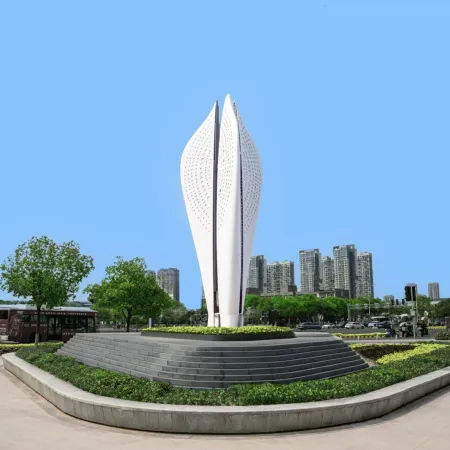
You can see how the four-step process from consultation to installation works on our services page, and a 20.8-metre stainless steel petal gateway built as a landmark entrance is documented as Peach Blossom. Made-to-order commissions of every scale sit together in the project gallery.
Send us the site information, the experience you want visitors to have and the dates you cannot move, and we will come back with a clear scope, an honest view of what is buildable and a process you can hold us to. Run properly, a custom sculpture is not a gamble on taste; it is a documented project whose drawings, samples and records all point at the same object standing in the place it was designed for.
Featured Products
Collection about Us
User Reviews
What users say about Us
Frequently Asked Question
Do you have any question?
Site photos with a sense of scale, the approximate dimensions and position, the intended message or theme, and any drawings or reference images you already have. With those in hand, the first consultation produces a useful direction instead of general questions.
Yes. Many commissions start from a napkin sketch, a photo of another work the client likes, or a theme written in one sentence. The concept phase turns that starting point into drawings and models the client can evaluate and revise.
Revisions belong in Concept Development, where changes are quick — adjusting a model takes days, changing steel takes weeks. We present the design in enough detail at that stage that the client can commit before fabrication drawings are released.
Through the concept package: final drawings, the 3D model, material and finish samples, and often a physical maquette. Fabrication starts only when the client has approved that package, because changes after steel is cut are expensive for everyone.