
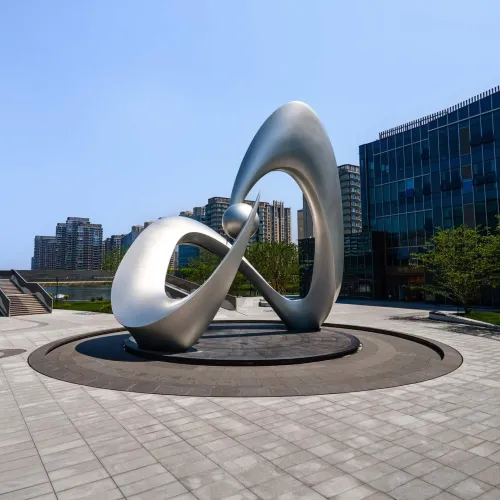
Features
Why Choose Us?
Full In-House Control
Design, engineering, fabrication and installation under one roof — one team, one contact, no outsourcing gaps.
Verifiable Engineering
Engineers calculate load, wind and anchoring; every steel and alloy batch ships with mill certificates.
Any Scale, Any Material
Stainless steel, bronze, aluminium, forged and cast metal — from a single plaza piece to landmark scale.
Worldwide Installation
Fully insured door-to-door logistics, our own crew on site, and material certificates with a maintenance guide.
We Have The Best Solutions for Your Business
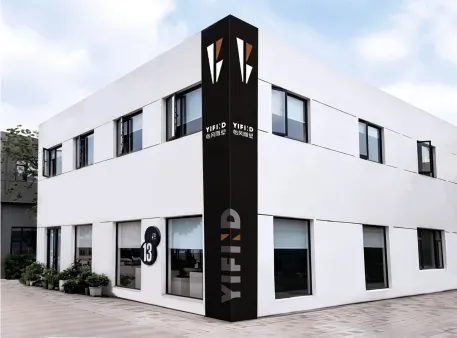
Yifeng Sculpture is a public art studio based in Ningbo, China, producing large-scale sculpture since 2003. We are one accountable team from first sketch to final bolt — creative planning, detailed design, engineering, fabrication and installation all happen in-house, so the artwork you approve is the artwork you receive. Our studio pairs sculptors with structural and mechanical engineers who calculate load, wind resistance and anchoring before a single panel is cut, and our founder is a Member of the Royal Society of Sculptors (UK).
We fabricate in stainless steel, bronze, aluminium, forged and cast metal, delivering monumental, kinetic, memorial and custom commissions for urban parks, commercial districts, transit hubs and campuses — from a single plaza piece to landmark works tens of metres in scale. For overseas clients we manage fully insured door-to-door logistics, send our own installation crew to site, and back every work with material certificates, a care guide and after-sales conservation.
What a Sculpture Manufacturer Is Responsible For
A serious manufacturer carries obligations that a general metal shop never sees, because public art is judged by architects, committees and the public rather than by a single client inspector. The scope we sign up for on a typical commission looks like this:
- Design integrity: protecting the proportions, sight lines and character of the approved concept through every engineering decision.
- Structural engineering: internal frames, base connections and wind-load checks so the piece stands safely in the worst weather the site records.
- Material systems: specifying grades, coatings and isolation details that match the site's exposure, from coastal salt to winter de-icing salt.
- Finish development: producing physical samples and approving them in daylight, because a finish agreed on a screen has been agreed by nobody.
- Export and logistics: sectioning for containers, engineered lifting points, packing, shipping documents and arrival coordination.
- Handover package: record drawings, material certificates and a maintenance schedule the owner's team can follow without calling us.
If a prospective manufacturer cannot describe most of this list without prompting, the missing items will surface later as site costs, delays and visible compromises on the finished piece.
Why One Roof Beats a Chain of Subcontractors
There is also an artistic argument that never appears in a specification. A sculptural form carries the hand of the people who made it: the transition of a curve, the depth of a brushed grain, the confidence of a joint line. When the same team models, forms and finishes the work, those decisions accumulate into coherence. Split across subcontractors, the same design arrives looking negotiated rather than authored — technically correct in every line, and somehow less than the maquette promised.
The classic failure pattern in our industry looks tidy on paper and fails in practice: an artist designs, a local engineer draws, a fabricator welds, a painter coats, a haulier ships, and a site crew installs. Each party did their job, yet nobody owned the whole. The polished sample that came back perfect was made by a different polisher than the one who finished the actual panels; the lifting lugs were positioned by someone who never saw the geometry; the drainage detail was "someone else's scope".
When design, engineering and fabrication live under one roof, the feedback loop is measured in hours instead of weeks. A weld detail that would distort a visible curve is caught before the plate is cut. A finish that will stain under a water feature is reconsidered while the sample bench is still set up. This is the strongest practical argument for choosing a studio that manufactures its own work rather than trading it out, and it is the reason our delivery record has held up across 23 countries of sites we almost never visit before shipping day.
Materials a Sculpture Manufacturer Works In
The material is chosen for the site and the concept, not for the workshop's convenience. The comparison below is how we frame the decision with clients during concept development.
| Material | Best suited to | Practical strengths | Things to manage |
|---|---|---|---|
| 316 stainless steel | Coastal landmarks, water-adjacent sites | Salt resistance, holds mirror and brushed finishes | Forming cost; weld tint removal |
| 304 stainless steel | Inland plazas, campuses, interiors | Proven durability, wide availability | Keep away from salt spray zones |
| Galvanized + coated steel | Large structural cores, painted forms | Strength and economy at scale | Coating adhesion and edge detailing |
| Aluminium | Large light volumes, kinetic elements | Low weight eases transport and lifting | Galvanic isolation from fittings |
| Corten / bronze | Memorials, heritage streetscapes | Living surface that ages with dignity | Runoff staining; drainage detailing |
A capable manufacturer will argue for the material that survives your site, even when it is not the material that photographs best. That argument, made early, is worth more than any discount negotiated later.
The Four-Step Process a Manufacturer Should Offer
Our process has stayed the same four steps since the studio was founded, because each step removes a category of risk that would otherwise land on the client:
- Consultation: site review, exposure analysis and an honest conversation about what the location and the committee's process will support.
- Concept development: maquettes, 3D models and finish samples, with materials and fixing strategy fixed while change is still inexpensive.
- Fabrication: engineering, forming, welding, finishing and full trial assembly in the workshop, with agreed checkpoints and stage photography for the client.
- Installation: packing, shipping, engineered lifting, on-site finishing and commissioning, run to a written sequence the local site team can plan around.
A project manager with a municipal client in North America once told us that what convinced the committee was not our portfolio but the trial assembly: they were shown photographs of their complete piece standing in our yard, with joint lines and access panels already resolved, weeks before it was packed. For a public procurement process, seeing the risk retired in advance was worth more than any promise made in a tender document.
Inside the Workshop: How a Commission Is Actually Built
It is worth understanding what happens physically inside a sculpture manufacturer's workshop, because the vocabulary helps clients ask better questions. Work usually begins with the 3D model being sliced into buildable plates and sections, each one nested onto sheet stock to use material honestly. Large curves are rolled, pressed over forming dies developed from the maquette, or hammered by hand where the geometry is genuinely sculptural. The sequence in which these pieces are joined is planned as carefully as the forms themselves, because a long weld on a thin panel will pull the surface out of shape if it runs uncontrolled.
Welding on visible artwork is its own discipline. Structural joints hidden inside the armature can be standard practice; the seams the public will see are tacked, checked against templates, then closed with controlled heat input so the plate stays fair. Every visible weld is afterwards dressed, the surface re-ground and the finish grain re-run to match its neighbours, until the metal reads as continuous rather than assembled. Heat tint is removed completely, not cosmetically darkened, because tinted zones are where corrosion begins its argument with the material.
The final third of the process belongs to finishing and inspection, and it is where a sculpture manufacturer either earns or loses its reputation. Surfaces are compared against the approved sample in daylight, not under workshop lamps; dimensions are checked against the surveyed site data, not against the model alone; fasteners are torqued to record; lifting points are verified by the people who will rig the piece. Only when the checklist is signed does the work move to packing — and a client is entitled to see that checklist, not just be told it exists.
Export, Shipping and Site Installation
Most of our clients buy from another country, so the logistics plan is part of the manufacturing scope, not an afterthought. Section lines are chosen so each piece travels inside standard container dimensions without starving the form; lifting lugs and spreader beams are engineered with the artwork; fasteners arrive in labelled kits; and the installation method statement is written for a crew that has never seen the piece before. On site, our team or a supervised local crew completes final joins, weld dressing and touch-up under a procedure agreed in advance.
Manufacturing Record at a Glance
Manufacturing public artwork since 2003
3000+ completed works delivered
Projects installed in 23 countries
Design, engineering and fabrication under one roof in Ningbo
Questions That Reveal a Capable Manufacturer
Distance also changes the definition of a problem. A dent discovered on site in another country cannot be driven back to the workshop, so the standards that prevent it — packing cradles built for the piece rather than bought for the container, photographing every crate before sealing, agreeing in advance who attends the opening of each one — are written into our process rather than left to goodwill. The best compliment an overseas client can pay a sculpture manufacturer is that the arrival was boring, and boring arrivals are manufactured deliberately, in the weeks before anything leaves the floor.
Ask who performs the finish work on the actual piece, not just on the sample. Ask for the survey method that confirms the real site dimensions. Ask who engineers the secondary structure and how wind loads are checked. Ask what is included in the handover package. A studio that answers these fluently has answered them before, on sites like yours; a studio that stalls is promising to learn on your budget.
Our four-step process from consultation to installation is described on the services page. A 20.8-metre stainless landmark built as a civic gateway is documented as Peach Blossom, and commissions across every material system in the table above are collected in the project gallery.
Bring us the concept, the site and the constraints you cannot move, and we will show you how our sculpture manufacturer team would engineer, build and deliver it — with the risks named in writing before anything is cut. A sculpture manufacturer is ultimately judged by the gap between the approved design and the installed artwork, and closing that gap completely is the standard we hold every commission to.
Featured Products
Collection about Us
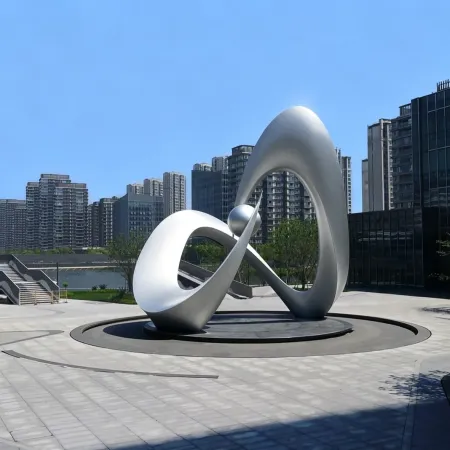
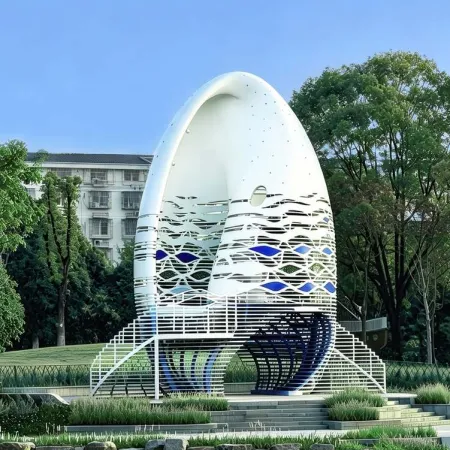
User Reviews
What users say about Us
Frequently Asked Question
Do you have any question?
That the workshop exists and does the work itself, that structural engineering is part of the offer, and that comparable built projects can be referenced. Photos of the actual fabrication in progress are worth more than any certificate.
Design, engineering, fabrication and finishing happen in our own facility in Ningbo, China. Since 2003, more than 3,000 works for clients in 23 countries have gone through this single workshop flow — design intent and fabrication craft under the same roof.
By what is included: engineering and connection design, finish samples, packing, shipping documentation, installation support and drawing deliverables. Two quotations rarely describe the same scope, so the comparison has to happen at the scope level, not the total.
As-built fabrication drawings, material certificates for the alloys used, structural calculation summaries, maintenance instructions and packing lists matched to section markings. That set is what allows the owner to maintain, inspect and extend the work for decades.