
Features
Why Choose Us?
Full In-House Control
Design, engineering, fabrication and installation under one roof — one team, one contact, no outsourcing gaps.
Verifiable Engineering
Engineers calculate load, wind and anchoring; every steel and alloy batch ships with mill certificates.
Any Scale, Any Material
Stainless steel, bronze, aluminium, forged and cast metal — from a single plaza piece to landmark scale.
Worldwide Installation
Fully insured door-to-door logistics, our own crew on site, and material certificates with a maintenance guide.
We Have The Best Solutions for Your Business
Yifeng Sculpture is a public art studio based in Ningbo, China, producing large-scale sculpture since 2003. We are one accountable team from first sketch to final bolt — creative planning, detailed design, engineering, fabrication and installation all happen in-house, so the artwork you approve is the artwork you receive. Our studio pairs sculptors with structural and mechanical engineers who calculate load, wind resistance and anchoring before a single panel is cut, and our founder is a Member of the Royal Society of Sculptors (UK).
We fabricate in stainless steel, bronze, aluminium, forged and cast metal, delivering monumental, kinetic, memorial and custom commissions for urban parks, commercial districts, transit hubs and campuses — from a single plaza piece to landmark works tens of metres in scale. For overseas clients we manage fully insured door-to-door logistics, send our own installation crew to site, and back every work with material certificates, a care guide and after-sales conservation.
Why Public Space Art Belongs in the Masterplan
The single most common mistake we see is art arriving after the paving, the planting and the lighting have already been fixed. At that point the artwork is asked to fit into leftover space, and it shows: a plinth stranded in a circulation route, a piece competing with an advertising screen, a lit object sitting in a pool of darkness because nobody reserved a power supply. None of these failures is about the artist. They are all about sequencing.
Brought into the masterplan stage, the same budget buys far more. Footing positions can be cast with the paving sub-base instead of cutting into finished stone. Lighting can share circuits and control zones. Circulation can be routed so the work is approached, not bumped into. Planting can be selected to frame the piece rather than hide its base within a few seasons. On our projects, early coordination has consistently been the difference between a piece that looks designed for its site and one that looks delivered to it.
What Public Space Art Is Expected to Do
Clients rarely buy an object; they buy outcomes and then describe them as an artwork. It helps to name those outcomes openly, because each one pushes the design in a specific technical direction.
- Orientation: a visible marker that helps people understand where they are and how to move through the district.
- Dwell time: something worth pausing for, which increases the time visitors spend in the surrounding retail and civic frontage.
- Social life: edges, seats and thresholds that make spontaneous gathering comfortable rather than awkward.
- Identity: a form that becomes the image used in leasing material, tourism listings and local conversation.
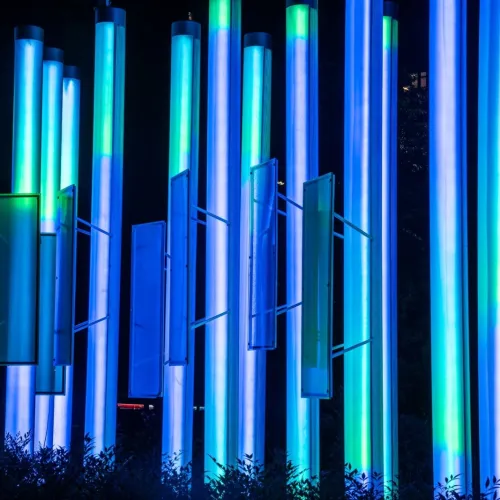
- Night presence: integrated light that keeps the space legible and safe after dark and creates a second composition.
When we write a brief with a client, we ask them to rank these five rather than treat them as equally important. A district gateway and a neighbourhood pocket park need different answers, and trying to satisfy every outcome at once usually produces a form with no clear gesture.
Siting and Safety Checks We Run Before Design
Public space brings an audience that is unfiltered: children, cyclists, delivery workers, people walking home at midnight. That is the design constraint that separates this work from gallery sculpture, and it is answered with a checklist.
- Clearance and flow: keeping primary pedestrian desire lines free so nobody is forced to walk around the artwork.
- Climbability and entrapment: shaping forms so they do not invite climbing to unsafe heights and cannot trap a head or hand.
- Sightlines: checking views from main approaches and from surrounding upper floors so the piece is visible where it counts.
- Wind and microclimate: testing whether a tall form will accelerate wind or create an uncomfortable downdraft across seating.
- Maintenance access: confirming that cleaning, lamp replacement and fastener checks can be done without closing the space.
Every one of these checks is cheap during design and disruptive afterwards. A form that reads beautifully in a render can produce a maintenance lift requirement that the operator cannot meet, and once the piece is installed the only remaining options are expensive or ugly. Better to remove two design ideas than to discover that problem after handover.
Materials, Lighting and the Ten-Year View
Public space art faces graffiti, salt, sand, irrigation overspray and constant touching. Grade 316 stainless is our baseline within roughly a kilometre of the sea, while 304 stainless or a properly specified coated steel works well inland. Aluminium serves large light forms but needs isolation at every steel connection, and bronze or copper belongs where a changing patina is part of the concept.
| Site condition | What it demands | Our typical response |
|---|---|---|
| Coastal promenade | Salt spray, strong wind, sand abrasion | 316 stainless, simplified joints, wind load verified on the open exposure |
| Dense city plaza | Pollution, contact wear, limited access windows | Brushed finishes, replaceable lighting components, cleanable geometry |
| Child play-adjacent zone | Impact, gripping, rounded profiles, no pinch points | Soft-edge detailing, encapsulated fixings, materials stable under repeated contact |
| Night-active public realm | Glare control, serviceability, dark-sky awareness | Concealed drivers with access hatches, shielded optics, designed night image |
| Heritage or temple precinct | Respectful scale, discreet fixings, no drilled masonry | Independent self-supporting frame, reversible anchors, restrained palette |
Lighting deserves its own line item rather than a late addition. We treat the night image as a design problem from the start: what should glow, what should stay in shadow, where the drivers live, and how a technician reaches them in five years. That foresight is what prevents a piece from becoming a dark shape in a bright plaza.
Programming and Activation Around Public Space Art
An installation that is simply delivered and left alone will always underperform the same piece in a space that is programmed. Activation does not require a large budget: a market that sets up around the piece once a week, a seasonal lighting moment, a school drawing session on the surrounding paving. Each of these gives people a reason to return rather than a reason to look once, and returning visitors are what turn a plaza from a through-route into a place.
Photography deserves deliberate attention because it is free distribution. We check where the sun will be at the hours people actually gather, whether the piece reads from the natural camera position at the main approach, and whether anything in the background will clutter an image in three years' time. A work that photographs well travels further online than any signboard, and the framing problems are almost always solved at the siting stage rather than after installation.
Wear is the other side of use. Where crowds gather, we anticipate the friction: the edge people lean on, the step that becomes a seat, the surfaces reached by thousands of hands. Those points get the more robust finish, the replaceable element or the sacrificial detail. Designing for wear is less romantic than designing for the gallery opening, but it is the difference between a space that looks cared for after five years and one that starts to look tired after two.
Seasonal conditions matter too. In cold climates we consider de-icing salt and freeze-thaw at fixings; in hot, dusty locations we consider cleaning intervals and how light-coloured surfaces hold heat. The literal answer changes with the climate, but the principle does not: the artwork and its surroundings are one system, and a group that plans only for the opening day is planning for the wrong day.
Good programming also protects the work itself. When a space has a steady rhythm of use, small problems are noticed early — a loosened fastener, a scuffed base, a lamp that has failed — and the operator deals with them while they are still minor. Where a piece sits in a quiet corner with no events and no regular presence, the same small faults go unseen for a year and turn into expensive repairs. Regular activity is therefore not only a marketing device; it is a maintenance strategy with an audience attached.
The Studio Behind the Work
Working with landscape architects and developers since 2003
More than 3000 completed works delivered
Projects installed in 23 countries
Design, engineering and fabrication under one roof
Delivering Public Space Art to Another Country
Most of our clients never stand in our workshop, so the delivery plan has to substitute for presence. We work in four steps — consultation, concept development, fabrication, installation — and we schedule the review points before fabrication begins, not after, so comments can still change the work without scrapping material. Physical finish samples travel to the client, and progress photographs arrive at every fabrication milestone.
Shipping and assembly are designed together with the artwork. Sections are sized for standard containers where the geometry allows, crated with edge protection and moisture control, and matched to assembly drawings so the receiving crew knows exactly what each pallet holds. For a riverside landscape scheme documented as The Flow of Fenghua River, that planning meant the installation sequence on site mirrored the trial assembly in our yard, which is the outcome we aim for on every overseas project.
What to Send Us for an Honest Assessment
Site plan or survey, photographs from the main approach, the experience you want visitors to have, and any constraints already fixed — paving, planting, power, heritage controls. With that we can say which forms will work at your coordinates, what the structure will need and how the piece should be maintained. You can review how our four-step process runs on our services page, and comparable installations sit in the project gallery.
Handled early, public space art stops being a decoration added at the end of a budget and becomes the reason the space is used. That is the outcome worth designing for: a place people choose to walk through, pause in and describe to someone else by referring to the artwork.
Featured Products
Collection about Us
User Reviews
What users say about Us
Frequently Asked Question
Do you have any question?
With impact-resistant materials at ground level, no fragile projections at touch height, tolerant finishes and fixtures that can be maintained with ordinary tools. High-traffic sites test a work every day, so durability is a design criterion, not a hope.
Lighting extends the artwork into the evening, which is when plazas are most used. We design illumination as part of the piece — washing the form, grazing surfaces or integrating fixtures into the sculpture itself — while keeping glare away from neighbors and pathways.
Interactive works respond to presence with light, sound or movement, and they consistently become the most photographed pieces in a space. The engineering behind them — sensors, controls and weatherproofing at appropriate IP ratings — is what keeps the magic running year after year.
The studio's built projects at comparable scale, the structural and wind-load basis, surface safety for public contact, and how the piece will be maintained. A landscape-integrated artwork succeeds only when its engineering is as considered as its planting plan.