Why 304 Stainless Steel Sculpture Works So Well Outdoors
A 304 stainless steel sculpture is the workhorse of outdoor public art, and it earns that role through a combination of corrosion resistance, strength and a surface that can be finished in almost any way a designer imagines. Grade 304 is the general purpose austenitic stainless steel, an alloy of iron with roughly 18 percent chromium and 8 percent nickel, and that chemistry creates the thin passive oxide layer that resists rust in most inland and urban atmospheres. For the majority of plazas, campuses, parks and streetscapes, it is the sensible default.
Yifeng Sculpture Studio has fabricated stainless steel work since 2003 and delivered more than 3000 pieces to 23 countries, and grade selection is one of the first conversations we have with every client. The question is never simply whether 304 is good enough, but what this particular site will do to this particular surface over thirty years. Answering that honestly is the difference between a work that still looks deliberate in its third decade and one that starts to tea stain in its third winter.
What Grade 304 Actually Gives You
The chromium in 304 does the protecting. When the surface is exposed to air it forms a chromium rich oxide film a few atoms thick, and if that film is scratched or abraded it reforms immediately, provided oxygen can reach the steel. This is why the material is called passive rather than coated: there is no paint to chip and no plating to wear through. It is also why the surface must be kept clean, because a film of dirt, oil or weld residue can starve the steel of oxygen and let corrosion begin underneath.
Where 304 falls short is chloride exposure. Salt from coastal air, from de-icing roads or from a chlorinated water feature will attack the passive film and produce pitting, the small dark pits that eventually bleed rust streaks down a polished panel. The higher molybdenum content of grade 316 is the usual answer in those locations. Choosing between the two is a site question, not a marketing question, and a 304 stainless steel sculpture specified for the wrong exposure will disappoint no matter how well it is made.
| Site condition | Chloride load | Grade 304 outlook |
|---|---|---|
| Inland park or campus | Very low | Excellent; routine cleaning is enough |
| Inland city plaza | Low, urban pollution | Very good with periodic washing |
| Cold climate with road salt | Moderate | Serviceable; higher grade is safer |
| Coastal within sight of surf | High | Risk of pitting; specify 316 instead |
| Chlorinated water feature | High and constant | Not recommended; upgrade the grade |
Fabricating a 304 Stainless Steel Sculpture Without Losing Its Protection
The most common reason a stainless work corrodes is not the grade but the workshop. Welding leaves a heat tinted zone beside every seam, and that oxide is chromium depleted, which means the area immediately next to a weld is the least corrosion resistant part of the whole piece. Grinding with carbon steel brushes or discs can embed iron particles in the surface, and those particles then rust and stain the panel around them. Neither fault is visible on the day of delivery; both appear in the first year or two.
Good practice is procedural rather than clever. Heat input is controlled to limit the tinted zone, the weld is cleaned mechanically and then chemically passivated so the passive film is restored, and stainless only tooling is kept separate from the carbon steel side of the shop. On a curved or sculptural form the sequence matters too, because heat pulls the geometry, so we balance welding around the section and check the profile against the digital model as we go.
- Controlled heat input: welding procedures written for the thickness and the alloy, with interpass temperatures respected.
- Passivation after welding: heat tint removed and the surface chemically treated so the passive film returns to full strength.
- Dedicated stainless tooling: no carbon steel brushes or grinding wheels that would leave iron to rust on the surface.
- Distortion control: balanced sequences and jigs so long seams do not pull the form out of its intended geometry.
- Protective handling: protective film and clean gloves from fabrication through packing, so the finished face arrives unmarked.
Grade 304 in One View
Roughly 18 percent chromium and 8 percent nickel
Passive film that self heals in the presence of oxygen
Best for inland, urban and low chloride environments
Corrosion resistance depends on fabrication as much as grade
Finishes and How They Age
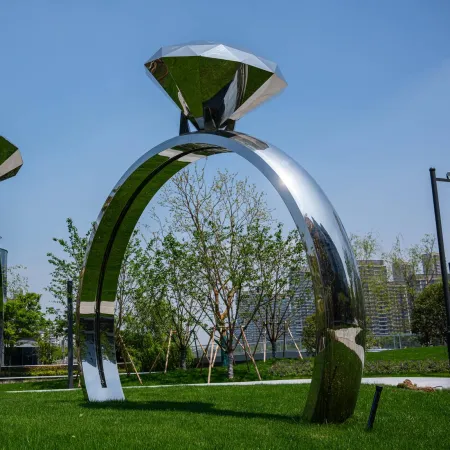
Grade 304 takes every finish in the stainless repertoire. A mirror polish makes the work dissolve into sky and surroundings and is spectacular when the panels are flat and the geometry is disciplined. A satin or brushed finish gives the surface a direction and a calm, even sheen that holds up better to fingerprints and to the small scratches that public contact inevitably leaves. A bead blasted or sandblasted surface is matt, soft to the eye and hides minor marks well. Colour can be added by electroplating or by a baked coating system, though both add a layer that must itself survive the weather.
The finish should always be approved as a physical sample viewed in the light of the site. A satin surface that looks refined in a workshop can look flat under a strong desert sun, and a mirror finish that looks astonishing in a showroom will show every joint in a plaza where the public walks close to it. We send clients samples of each candidate finish so the decision is made on a real surface rather than on a rendering, and we photograph the approved sample so the workshop has an unambiguous reference for the delivered work.
- Mirror polish: maximum reflectivity, demands flat panels and careful maintenance, hides nothing.
- Satin or brushed: directional sheen, forgiving of contact marks, the most popular public realm choice.
- Bead blasted: matt and uniform, reduces glare and reads as a solid mass rather than a reflection.
- Coloured systems: add graphic impact, but introduce a coating whose adhesion and UV stability must be specified.
- Combined finishes: polished faces against blasted edges, used deliberately to describe form and shadow.
Maintenance Expectations for Stainless Steel Outdoors
Stainless steel is low maintenance, not no maintenance. In a clean inland setting an occasional wash with fresh water and a mild detergent keeps the surface bright for decades. In an urban or coastal setting, where pollution and salt accumulate, a routine of more frequent washing prevents the deposits that would otherwise hold chlorides against the surface and start pitting. The owner should be given a simple written routine at handover, with the frequency tied to the environment rather than to a generic recommendation.
Two habits cause most of the avoidable damage we see in the field. The first is cleaning with abrasive pads or chloride containing household cleaners, which scratch the finish and leave the very ions that attack the steel. The second is allowing bird droppings, tree sap or fertiliser to sit on the surface for months. Neither is dramatic, and both are easy to prevent once the owner understands what the material needs. A 304 stainless steel sculpture that is washed sensibly will outlast the people who commissioned it.
Frequently Asked Questions About 304 Stainless Steel Sculpture
Is 304 stainless steel magnetic?
It is generally non magnetic in the annealed condition, but cold working such as bending or deep drawing can make parts of it slightly magnetic, so a magnet is not a reliable way to identify the grade on a finished sculpture.
How close to the sea can grade 304 be used?
There is no single distance, because wind, spray and shelter all matter, but where salt is regularly carried onto the surface the higher alloyed grades are the safer choice and the maintenance interval becomes short.
Will the surface ever rust?
The steel itself does not rust in the way carbon steel does, but surface contamination from iron particles or a breakdown of the passive film under chlorides can produce rust coloured staining that must be cleaned and passivated.
Can grade 304 be welded on site?
Yes, and site welding is common on large assemblies, but the weld must be shielded correctly, cleaned of heat tint afterwards and passivated so the joint is not left as a corrosion weak point.
Does a thicker section last longer?
Thickness helps with structural stiffness and with tolerance to abrasion, but it does not change corrosion behaviour, which is governed by the alloy, the surface condition and the environment.
Grade selection and fabrication quality are documented in our services overview, and a large scale example of stainless fabrication is shown in Peach Blossom. A kinetic work where stainless carries movement and light is described in Fish Swarm.
Tell us where the work will stand and how close it is to salt or chlorinated water, and we will recommend the grade with reasons. Specified and fabricated with care, a 304 stainless steel sculpture gives a client the rare combination of a material that is beautiful, strong and quietly dependable for decades.