What It Takes to Deliver a Mirror Polished Stainless Steel Sculpture
A mirror polished stainless steel sculpture is the most demanding finish in the workshop, because a mirror shows everything. Every weld, every flat spot, every subtle change in panel curvature and every mark left by handling will be reflected back at the viewer, magnified by the very surface that makes the piece spectacular. Clients are drawn to the effect, and rightly so, but the finish should be chosen with a clear understanding of what it takes to achieve and to keep.
Yifeng Sculpture Studio has produced polished stainless work since 2003 among more than 3000 delivered pieces in 23 countries, and we treat a mirror finish as an engineering problem as much as a finishing one. The polish is the last five percent of the work; the ninety five percent that makes it possible is the flatness of the panels, the quality of the welds and the discipline of the handling. A client who understands that sequence will make better decisions about where a mirror finish belongs.
Flatness Comes First in a Mirror Polished Stainless Steel Sculpture
A polished surface reflects whatever is in front of it, and a surface that is slightly dished or rippled will distort that reflection in a way the eye reads immediately as a defect. Achieving flatness starts with the material: a plate that is already out of flat cannot be polished into flatness, so the quality of the incoming sheet matters. It continues with the structure behind the panel, because a thin skin with insufficient stiffening will deflect under its own stresses and under the heat of welding.
Welding is where flatness is most often lost. A long seam shrinks as it cools and pulls the panels toward each other, creating a ridge or a hollow along the joint. The countermeasures are to design the joints so the weld is small and well supported, to balance the welding sequence so heat is distributed rather than concentrated, and to restrain the geometry in a jig until it is stable. After that, the weld is dressed carefully, working the metal back to the surrounding plane rather than grinding a hollow beside it.
| Stage | What it protects | Common failure if rushed |
|---|---|---|
| Plate selection | The flatness the polish will reveal | Dished sheets that cannot be corrected later |
| Stiffening | The plane under handling and welding stress | Oil canning and visible deflections |
| Weld sequence | Geometry against shrinkage distortion | Ridges and hollows along every seam |
| Dressing | A continuous surface across the joint | Ground hollows beside the weld |
| Polishing | Uniform reflectivity across the whole form | Patchy sheen and visible polish marks |
Polishing Without Destroying the Form
Polishing is a progressive process, working through finer abrasives until the surface reflects cleanly. Each stage must remove the marks of the previous one completely, and the whole surface must receive the same treatment, because a panel that is polished further than its neighbour will reflect differently. On a curved form the polishing must follow the curvature without flattening it, which is why the work is done by hand as much as by machine, with the operator reading the reflection as they go.
The final check is the reflection test. A straight edge or a grid placed in front of the surface reveals every deviation, and a walk around the work shows whether the reflections run continuously or break at the joints. This is the moment when a mirror polished stainless steel sculpture either proves itself or reveals work that must be redone, and it should be performed in the workshop where correction is possible rather than on site where it is not.
- Progressive abrasives: each stage removes the marks of the last, with no shortcuts between grits.
- Uniform treatment: the same sequence across every panel so the sheen matches at the joints.
- Curvature preserved: hand work on curved forms so the polishing does not flatten the modelled surface.
- Reflection testing: straight edges and grids used to reveal distortion before the work leaves the bench.
- Workshop sign off: the whole assembly viewed as one composition, not panel by panel.
The Mirror Finish Equation
Flat plate, stiff structure, balanced welding
Dressing that returns metal to the plane, not below it
A consistent abrasive sequence across every panel
Reflection checks before packing, not after installation
Living With a Mirror Finish
A mirror finish is beautiful and demanding in equal measure, and the owner should understand the trade before choosing it. Polished surfaces show fingerprints, water spots and dust clearly, so they need regular cleaning with a soft cloth and a mild detergent. They also show the early signs of corrosion more dramatically than a satin finish, because a pit breaks the reflection. In a location where maintenance will be infrequent, a brushed or blasted surface is often the wiser choice.
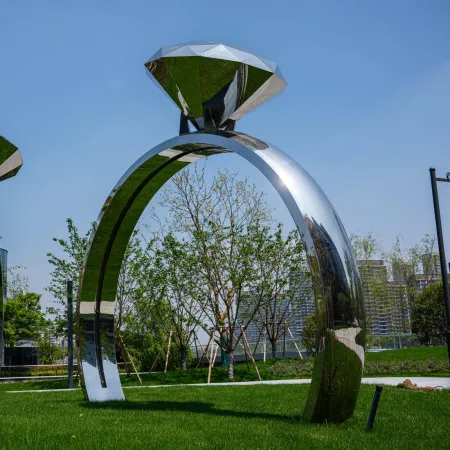
Where a mirror finish is right, it is unforgettable. A polished form that gathers the sky, the trees and the passing public becomes a different work every hour, and it gives a place a quality of light that no other material can supply. The decision should be made with the site and the maintenance regime in view, and once it is made, the discipline of the workshop determines whether the result lives up to the intention.
- Clean gently and often: a soft cloth, mild detergent and fresh water keep the reflection even.
- Avoid abrasives entirely: a scouring pad will scratch a polished surface permanently.
- Deal with water spots: drying after rain or cleaning prevents mineral marks from etching the surface.
- Watch for early pitting: a pit shows clearly in a mirror, so problems are caught while they are small.
- Keep the specification: record the polish grade so any future repair can match it exactly.
Handling and Installing a Mirror Polished Stainless Steel Sculpture
A mirror polished surface is the most vulnerable to handling, and the discipline of protection starts in the workshop. Panels are filmed as soon as they are polished, stored so finished faces never touch each other and packed with soft separation that prevents movement in transit. The same rules apply at every transfer, because a single careless lift can produce a mark that requires the panel to return to the workshop.
Installation needs a method statement that treats the surface as the most important thing on site. Rigging is arranged so slings and shackles never contact a finished face, temporary protection remains in place until the final fixings are complete, and the crew is briefed on which surfaces can be touched and how. Where the work is assembled in stages, the sequence is planned so finished panels are not exposed to work above them.
Cleaning after installation is part of the handover. Construction dust, fingerprints and adhesive residue from protective film all need to be removed with materials that will not scratch, and the owner's team should be shown how to do it. A mirror polished stainless steel sculpture cleaned with an abrasive pad on its first day will carry that damage for the rest of its life, which is a costly way to save a few minutes.
Finally, the client should receive the specification that makes future care possible. The polishing grade, the materials used and the cleaning method should all be recorded, along with a contact for repairs. A mirror polished stainless steel sculpture is a long term commitment to a careful routine, and the projects that look spectacular in their tenth year are the ones where that routine was established at handover.
Frequently Asked Questions About a Mirror Polished Stainless Steel Sculpture
Can a mirror finish be achieved on a curved form?
Yes, and it is common on sculptural work, but the polishing must follow the curvature carefully so that the form is not flattened in the process.
How visible will the panel joints be?
On a well made work they can be almost invisible, because the joints are welded, dressed and polished as part of the surface, but they should still be planned so they fall in sensible places.
Does polish affect corrosion resistance?
A smooth polished surface sheds water and dirt well, which helps, but it also reveals any pitting immediately, so the grade and the maintenance routine still decide the long term outcome.
Is it suitable for a busy public space?
It can be, but where the public will touch the work constantly a brushed finish is usually more practical, because it hides the marks that contact inevitably leaves.
Can a polished surface be repaired?
Local repairs are the hardest of all finishes to disguise, so we keep a matching polishing procedure and, where possible, a spare panel from the original production.
How we control flatness and finishing is described in the services overview, and a work where reflection is the entire subject is The Radiant Galaxy. Other polished stainless projects appear in the project gallery.
Send us your geometry and the level of reflection you want, and we will tell you what the surface can achieve. Delivered with the right discipline, a mirror polished stainless steel sculpture becomes the most responsive object in its setting, changing with every hour of light.