What Public Monument Fabrication Demands of a Workshop and Its Client
Public monument fabrication is where a community's approved vision meets the reality of steel, bronze, stone and welding, and it is the phase where quality is either built in or lost forever. The workshop that fabricates a monument carries an unusual responsibility: the work is permanent, public and loaded with meaning, and its failures cannot be quietly returned and replaced like a defective product.
This guide explains what serious public monument fabrication involves, from engineering and sectioning to welding, finishing and inspection, and what a client should demand, audit and approve so that the monument that arrives on site is the monument that was designed. Our studio has fabricated monuments and landmarks across 23 countries since 2003, and the standards below are the ones we hold our own workshop to.
See complex fabrication in the project gallery, the workshop capabilities in our services overview and a demanding metal fabrication such as Eye of the Phoenix.
Why Fabrication Is Where Monuments Succeed or Fail
The gap between an approved design and a finished public monument is filled with thousands of decisions, and public monument fabrication is the craft of making those decisions well. The material must be cut, formed, welded and finished to a standard that the naked eye will judge from every distance for decades; the geometry must hold tolerances measured in millimetres across forms that may be ten metres tall; and the surfaces must be protected through handling, transport and installation so that the work arrives as it left the workshop. Every one of these steps is invisible in the final photograph and visible in the final result.
Monument fabrication is also unforgiving of shortcuts in ways that commercial fabrication is not. A commercial product that develops a weld crack is recalled; a monument that develops one is a public hazard and a public shame. A painted industrial structure that stains is repainted; a monument that stains is photographed, criticised and lived with for years before the budget for correction appears. The client therefore needs a fabricator that treats the work with the gravity it deserves, and that gravity is visible in the workshop's processes, its records and its attitude to inspection.
Engineering and Sectioning Before the First Cut
Serious public monument fabrication begins with engineering that converts the approved form into a buildable structure. The workshop or its engineers must determine how the design will be supported internally, how the loads flow to the foundation, how the work will be sectioned for transport and re-joined on site, and how the tolerances will be controlled across the sections. Each of these decisions shapes the design itself, which is why the fabricator should be engaged early enough to influence the concept rather than late enough to fight it.
The sectioning plan deserves particular attention, because it decides whether the monument can physically reach its site. Each section must fit the workshop doors, the truck, the port, the road and the crane that will carry it, and the joints must fall where they can be made invisible or where they suit the composition. A fabricator that will also install the work designs the sections around the actual route and the actual crane, and that knowledge prevents the classic monument failure of a beautiful form that cannot be delivered or lifted into place.
| Fabrication control | What it protects | Client action |
|---|---|---|
| Material verification | The grade specified is the grade used | Request mill certificates |
| Weld quality | Strength and invisible seams | Audit welder qualification and records |
| Dimensional control | Sections meet within tolerance | Review survey reports at milestones |
| Surface and finish | The approved look survives the build | Approve finish on full samples |
| Packing and transport | The work arrives undamaged | Inspect the crate before shipment |
Welding, Forming and the Craft of Invisible Joints
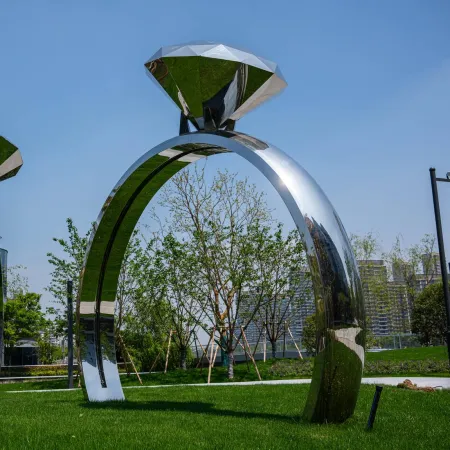
The heart of public monument fabrication is the craft of making complex forms look inevitable. Plates must be rolled, pressed or formed to the required curvature without buckling; sections must be welded by qualified welders using procedures that control distortion; and the welds themselves must be ground, blended and finished until the joint disappears into the surface. In a mirror-polished stainless monument the weld is invisible only if the gas shielding, the filler and the grinding are all right, and in a bronze the seam disappears only through the chasing that follows the weld.
The client should audit this craft in action, not only in photographs. Visit the workshop while the work is in progress and look at the pieces being made, the jigs built for one-off forms, the weld quality on current sections and the samples on the wall; ask which welders would work on your monument and what qualifications they hold; and require that the fabricator controls distortion by measuring the growing form against the model at defined stages. A workshop that is busy with real monumental work and opens its floor to scrutiny is showing its normal state, and that state is what your monument will receive.
Finishing, Protection and the Journey to the Site
The finishing of a public monument is its first impression and its longest-lived feature, and public monument fabrication should protect the finish as carefully as it creates it. A stainless surface must be finished to the approved standard, then protected from the contamination of steel grinding and the damage of handling; a painted or powder-coated surface must be applied over the specified preparation and cured properly; a bronze patina must be controlled, sealed and protected; and weathering steel must be allowed to develop its protective layer without interference. The finish samples approved by the client are the standard, and the finished work should be matched to them in the light of day.
Packing for transport is the last fabrication act and the first test of the work's journey. Monumental sections travel in steel or timber crates engineered for the specific load, with the surfaces isolated from any contact that could mark them, the sections braced against movement and the crates marked for handling and orientation. The pre-shipment inspection, whether by the client, an independent agency or a trusted representative, verifies the finished work, the dimensions, the finish and the packing before the container is sealed, and the photographs and records of that inspection become the evidence that the work left in perfect condition and the baseline for any claim in transit.
Inspection and Quality Records the Client Should Keep
The quality of public monument fabrication should be proven by records, not asserted by assurances. The client should receive the material certificates, the weld procedures and inspection reports, the dimensional survey results, the finish approvals and the inspection sign-offs, and should keep them with the monument's other documentation, because the engineers and conservators of the future will need them to assess, maintain and repair the work. A fabricator that documents its quality is a fabricator that can be held to it, and that accountability is the client's real protection.
Third-party inspection is a reasonable demand on monumental commissions and a useful discipline on any commission. An independent inspector at defined milestones, material arrival, welding stages, dimensional control, finishing and pre-shipment, provides verification that the client can trust and that the fabricator can learn from, and the fabricator's welcome of that inspection is itself a signal of confidence. Where the budget does not allow a third party, the client or its representative should hold the same gates, because a monument is permanent and the inspection that finds a problem in the workshop is worth a hundred that find it after installation.
- Engage the fabricator early, before the design is locked.
- Audit the live workshop while your work is in progress.
- Approve finishes on samples and match the work to them.
- Hold inspection gates at materials, welding, survey and finish.
- Keep every record for the monument's future carers.
What Disciplined Fabrication Guarantees in Practice
The approved design, not an approximation of it
Joints and surfaces that pass every public eye
Sections that ship, meet and align without drama
Records that protect the monument for its lifetime
Frequently Asked Questions About Public Monument Fabrication
When should the fabricator join the project?
Early enough to shape the design, because sectioning, engineering and material realities must influence the concept rather than fight it after the design is locked.
How do I verify weld quality on a monument?
Audit welder qualifications and procedures, inspect welds on current pieces in the live workshop and require weld inspection records at defined fabrication milestones.
Why does a monument need to be sectioned?
No monumental work travels in one piece, so the design is cut into sections that fit the route and the crane, then re-joined on site with controlled tolerances.
Is third-party inspection worth the cost?
Yes, at the defined milestones it verifies materials, welds, dimensions, finish and packing independently, and finding a problem in the workshop costs a fraction of finding it on the site.
What records should I keep after fabrication?
Material certificates, weld and survey reports, finish approvals and inspection sign-offs, kept with the structural documentation for the engineers and conservators of the future.
Public monument fabrication is the phase where intention becomes permanence, and its quality will be visible on the plaza for generations after the design meetings are forgotten. Engage the fabricator early, audit the workshop in action, approve finishes on samples and hold the inspection gates, and the monument will arrive as the work you approved.
If you are preparing a public monument fabrication and want to audit a workshop that has built monuments for clients in 23 countries, we will open our floor, show you works in progress and walk you through our inspection records.