How Landmark Sculpture Fabrication Makes a Place Unmistakable
A landmark is a sculpture that has become a way of describing a place. People say meet me by the sculpture, and the city's visitors photograph it without being told to. Landmark sculpture fabrication is therefore about more than scale; it is about making a form that is legible from a distance, memorable in a photograph and strong enough to carry a community's identity for fifty years.
Yifeng Sculpture Studio has fabricated landmark works since 2003, from gateways and portals to kinetic icons, and our delivered total of more than 3000 pieces spans 23 countries. Our designers and engineers share one building, so a landmark is proven in the model, the wind tunnel calculation and the full-scale sample before it is committed to production. That is what landmark sculpture fabrication should be.
What Makes a Form Read as a Landmark
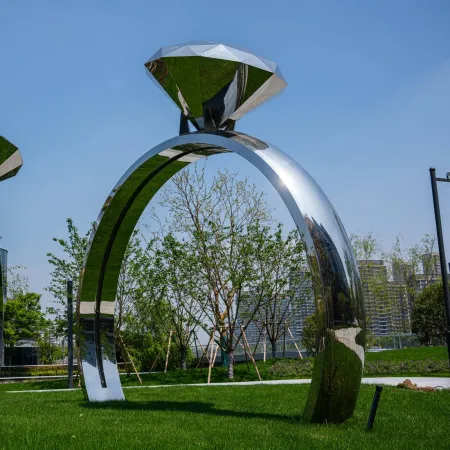
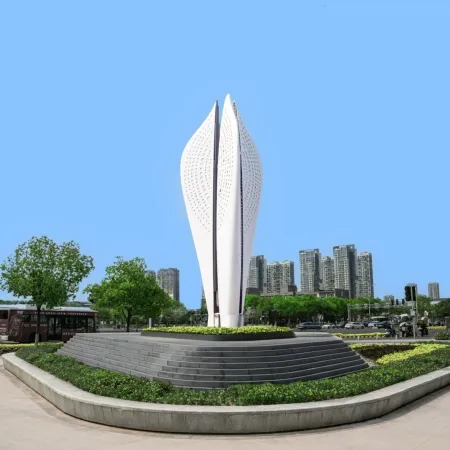
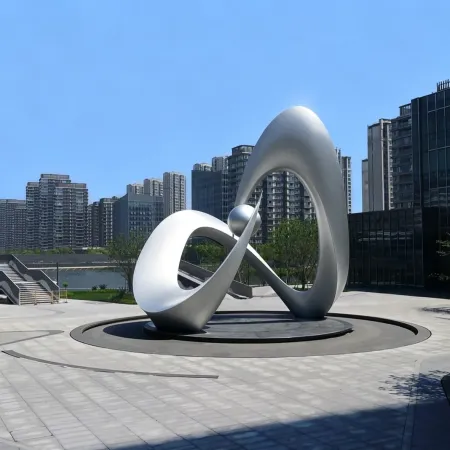
Legibility at distance is the first requirement. A landmark must be recognisable as a silhouette from three hundred metres, which means a strong, simple outline rather than fine detail that dissolves with distance. The best landmark forms are almost diagrams: a curve, a portal, a sail, a lifted ring. Complexity can be added for the close view, but the distant reading must be settled first, and a fabricator who understands that will build the simple gesture at full size rather than a detailed model that only works on paper.
Photogenicity is the second requirement, because a landmark's reputation is spread through images. The form must offer a clear view from the main approach, a scale that makes people look small and proud, and a surface that holds light well in both sunshine and grey weather. We test the design from the routes people actually take, and we adjust the proportions until the work is as strong in a phone photograph as it is in the architect's render. A landmark that only works in a rendering has been designed for the wrong audience.
| Landmark quality | How fabrication delivers it | What the client gains |
|---|---|---|
| Distant legibility | A bold silhouette built at true scale | A place people can name and navigate by |
| Structural courage | Site-specific wind analysis and hidden structure | A form that can be as bold as the idea requires |
| Night presence | Lighting designed with the structure | An icon that works after dark as well as by day |
| Fifty-year life | Marine-grade alloy and a documented finish system | An asset that outlasts the politicians who approved it |
Engineering a Landmark for Wind and Weight
A landmark is usually the tallest and most exposed object in its setting, which makes it a wind structure as much as a sculpture. We analyse the local wind climate, model the pressure distribution across the form and size the anchor system for the loads that result, and where a form is unusual we test it rather than assume. The engineering must be invisible, because a landmark that needs visible bracing has already lost its confidence, so the structure is designed to sit inside the form and to use the base as part of its strength.
Weight and lifting are the other structural realities. A landmark form is heavy, and the fabricator must plan how it will be lifted, how it will be held while fixings are made and how it will behave if a lifting point fails. We design the lifting points into the work and we provide a rigging plan with the drawings, because the crew that installs the sculpture should not be improvising around a load they do not understand. Landmark sculpture fabrication ends with a safe lift, not with a finished surface.
The Community Side of a Landmark
A landmark belongs to the people who pass it, and the best ones are designed with a story that the community can adopt. That story might come from local history, the geography of the place, a trade that shaped the town or a natural feature that residents are proud of. When the form carries that meaning, the community defends the work, and a defended sculpture survives budget cuts, vandalism and fashion in a way that a decorative object never will.
We encourage clients to involve the community early, through presentations, model displays and public comment, because a landmark that arrives as a surprise is a landmark that will be argued about. The process costs a little time and saves a great deal of trouble, and it often improves the design, because local people know things about a site that no consultant will discover. A landmark that the public helped to choose is a landmark that the public will keep.
What a Landmark Must Carry
A silhouette that reads clearly from three hundred metres
Structure hidden inside a form bold enough to be remembered
A night presence that doubles the hours it works
A story the community recognises as its own
Maintaining an Icon for Decades
A landmark must be maintainable by the city that owns it, because an icon that falls into disrepair damages the reputation of the place rather than enhancing it. We specify finishes that can be cleaned with standard equipment, provide access points for inspection and design the lighting so that lamps can be changed without a scaffold. A landmark should be easy to look after, because the people looking after it will not be the people who commissioned it.
We also supply a full documentation pack, including the structural drawings, the finish specification, the maintenance schedule and the lifting plan, so that future engineers can work on the sculpture without guessing. Cities change staff and contractors, and the only thing that survives that turnover is good documentation. Handing over a landmark properly is the last act of landmark sculpture fabrication, and it is the act that determines how the work looks in thirty years.
Lighting a Landmark for Day and Night
A landmark works two shifts, and the night shift is often the one that matters most. In winter, in a northern city, the sculpture may be lit for more hours than it is seen in daylight, and a form that is beautiful at noon can be a dark mass by six o'clock. Lighting must therefore be designed with the structure from the beginning, with fixtures concealed inside the form, in the base or in the paving, and with the beam angles chosen so that the shape reads rather than merely glows.
The colour of the light is as important as its quantity. A warm white flatters bronze and stone, a cooler white suits stainless steel and glass, and a programmable system can shift the tone for festivals and seasons. Whatever the choice, the installation must be serviceable: lamps fail, drivers fail and water finds its way into fittings, so every component should be reachable without scaffolding. A landmark whose lighting cannot be maintained becomes a dark object within a few years, however impressive it was on the opening night.
We also plan the electrical infrastructure with the engineers of the client, because a landmark often draws more power than a client expects and the supply must be sized before the ground is closed. Cable routes are agreed with the landscape and paving trades, and the control system is configured so that a single switch can bring the work to life each evening. When all of that is designed together, the landmark simply appears to glow as darkness falls, and the visitor never sees the machinery behind the moment.
The final consideration is light pollution. A landmark should illuminate itself rather than the neighbourhood, so we use shielded fixtures, direct the beams onto the form and avoid spill that would annoy residents or waste energy. A work that respects its neighbours keeps its licence to shine, and a city that has been treated considerately is far more likely to support the next commission. Good lighting design is a courtesy as well as a craft, and it is part of what a landmark owes the place it stands in.
Frequently Asked Questions About Landmark Sculpture Fabrication
What makes a sculpture a landmark rather than just a large artwork?
A landmark is legible at distance, memorable in photographs and adopted by the community as a way of describing the place.
How is a landmark engineered against wind?
With an analysis of the local wind climate, modelling of pressure across the form and an anchor system sized for the resulting loads.
Should the community be involved in the design?
Yes, because a landmark that the public helps to choose is a landmark the public will defend, and local knowledge often improves the design.
How long should a landmark last?
A landmark should be designed for at least fifty years, with a marine-grade alloy, a documented finish and a maintenance schedule a city can follow.
What documentation should a city receive?
Structural drawings, the finish specification, the maintenance schedule and the lifting plan, so future engineers can work on the sculpture without guessing.
A landmark is a promise a city makes to its future, and the fabrication has to be good enough to keep that promise. Bold forms are easy to draw and hard to build, and the difference is entirely in the engineering and the finish.
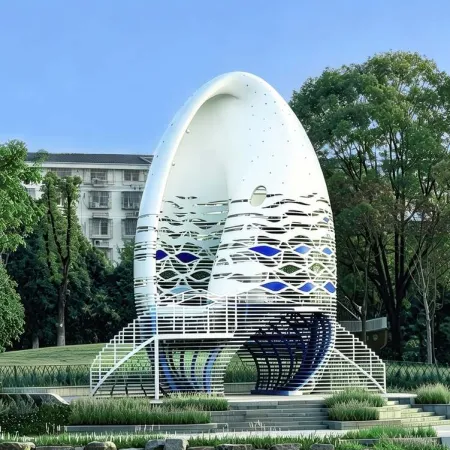
If your city or development needs a form people will navigate by, let us look at the site and the brief. See the landmarks we have delivered in our project gallery, review everything we handle from concept to installation on the services overview, and study Hello Conch, a 12.8-metre interactive landmark built to be seen, touched and photographed every day.
A landmark is a promise a city makes to its future, and the fabrication has to be good enough to keep it. Bold forms are easy to draw and hard to build, and that difference lives entirely in the engineering, the lighting and the finish of landmark sculpture fabrication.