What Makes an Art Installation Sculpture Different From a Monument
The term art installation sculpture describes a hybrid that has quietly become the dominant language of contemporary public art: a work that has the material permanence of sculpture but the spatial, environmental ambition of an installation. It does not merely occupy a point — it organizes a space, a light condition, a movement of air or a behavior of crowds. At Yifeng Sculpture Studio, this hybrid is our home territory: since 2003 we have fabricated works that are simultaneously objects to admire and environments to walk into.
This guide draws the boundary lines — what separates an installation sculpture from a monument, from decoration and from pure installation art — and explains how the hybrid is designed and built.
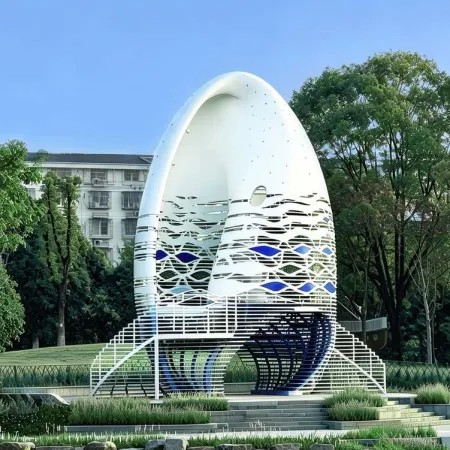
Browse the project archive to see the hybrid in built form, the services overview for how such works are commissioned, and the Honeycomb Pavilion for a work you enter rather than merely view.
The Boundary Lines, Drawn Precisely
A monument commemorates; it points backward, fixing a person or event in stable material. A decorative object adorns; it defers to the space around it. Pure installation art often floods a space temporarily and leaves no object behind. An art installation sculpture does something else: it creates a durable environment with its own center of gravity. You can meet under it, photograph through it, feel its shadow move across an afternoon. It is sculptural in substance and architectural in ambition — and because it must survive outdoors and in public hands, it demands the engineering of both disciplines.
Four Traits That Define the Hybrid
- Spatial command: the work defines a zone — canopy, corridor, frame — rather than sitting inside one
- Permeability: people pass through, under or around it as part of the composition
- Material permanence: engineered metals and finishes built for decades of weather and touch
- Behavioral invitation: the form suggests what to do — gather, rest, play, photograph — without a sign
Designing the Environment, Not Just the Object
When we design an installation sculpture, the first drawings are of the space, not the object. Where will the shadow fall at four in the afternoon? From which approach does the work frame the skyline, and from which does it frame the trees? Where do people naturally slow down, and can the work deepen that slow-down into a stop? Only after the spatial behavior is mapped do we sculpt the object that produces it. This order — environment first, object second — is the fundamental difference between an installation sculpture and a statue placed on a plinth, and it is why the same brief given to both approaches produces entirely different works.
| Design Question | Monument Thinking | Installation Sculpture Thinking |
|---|---|---|
| What does it do? | Commemorates a subject | Organizes space and behavior |
| How is it seen? | Frontally, from a fixed point | In motion, from many paths |
| What is the base? | A plinth, separating art from life | The ground itself, shared with the visitor |
| What is success? | Reverence and correctness | Use, affection and daily presence |
Fabrication: Where the Hybrid Gets Hard
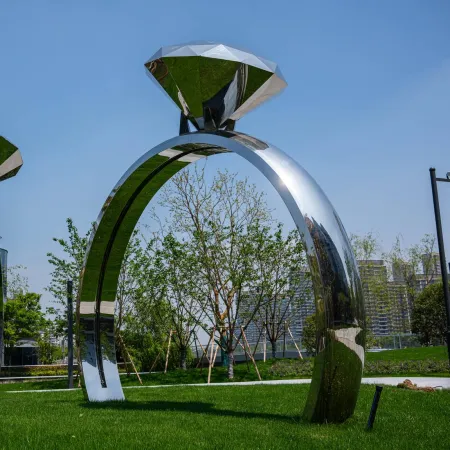
An installation sculpture must satisfy structural engineers and photographers at the same time, and fabrication is where those demands meet. Large spans — a canopy, an arch, a floating ring — require structural calculation every bit as serious as a small building, yet the surfaces must remain seamless and photogenic from every angle. Our fabrication process resolves this: the internal skeleton is engineered with redundancy and drainage; the skin is formed in stainless steel, aluminum or composite with joints detailed to disappear; and every weld line, fastener and access panel is placed where cameras do not look. The result is a work that reads as effortless but carries its effort invisibly.
Quality control in this format is a full-time discipline of its own. Before anything leaves our workshop, the assembly is trial-built in sections, checked against the engineering model, and photographed from the positions a visitor will actually occupy. Tolerances that a hidden structure would forgive become visible the moment two curved surfaces meet under daylight, so we hold tighter margins on skin alignment than on structure itself. Weather testing, finish sample panels kept from the production batch, and a documented torque log for every structural bolt complete the file. This is the unglamorous half of the art installation sculpture discipline — and it is precisely the half that determines whether the glamorous half survives its first decade outdoors.
- Structural engineering — spans, cantilevers and wind loads calculated to building standards
- Skin development — full-size surface studies so curves and joints read as one continuous gesture
- Concealment discipline — fixings, lighting and drainage integrated where they can never be photographed
- Modular assembly — the work travels in sections and closes its own seams on site
What Clients Gain From the Hybrid Approach
A work that earns space rather than consuming it — usable square meters underneath
Photogenic presence from day one, with professional documentation included
One studio accountable for sculpture, structure and site installation together
Where an Art Installation Sculpture Belongs
The art installation sculpture format excels wherever a site needs more than an object: plazas that lack shade and identity at once, waterfronts that need a threshold, campuses that need a meeting point, commercial districts that need a photograph with a name. Because the work gives usable space back — canopy, arch, pavilion — it often wins approvals that a conventional statue would not: planners see amenity, developers see dwell time, and the public simply sees a place they like. Our portfolio across more than twenty countries keeps confirming the pattern: the works people love most are the ones they can stand inside.
The format also proves itself in retrofit situations where nothing can be built conventionally. A service-heavy plaza cannot take a pavilion; a heritage street cannot take a billboard; but an art installation sculpture, with its shallow foundations and its single coordinated trench, often fits where architecture cannot go. We have suspended works from existing structures, wedged pavilions into leftover corners and turned disused ventilation requirements into sculptural chimneys. The hybrid format is, in practice, the most negotiable form of large public art — and negotiation is what most real sites are made of.
Frequently Asked Questions About Installation Sculpture
Is an installation sculpture more expensive than a statue?
It is usually larger in scope, since it is engineered like a small structure, but it also replaces other site elements — shade structures, canopies, pavilions — that would otherwise be bought separately. Judged as identity plus amenity in one purchase, the hybrid is frequently the more efficient line in the budget.
Can people walk through or climb on it?
Yes — that is the point of the format. Permeability is designed deliberately: loads, clearances, handrails where needed and safe surfaces are all engineered from the concept stage, so the invitation to enter is backed by real structural certainty.
How long does the fabrication take?
Design development typically takes several weeks, fabrication one to a few months depending on span and complexity, and site assembly days to weeks. We publish a milestone schedule at contract stage so the opening date is never a guess.
What materials work best for the format?
Stainless steel for slender strength and mirror presence, aluminum for lighter spans and color, corten for earthy mass, and composites where organic geometry needs low weight. The material follows the spatial role, not the fashion of the season.
Does the work need special maintenance?
A scheduled wash, periodic inspection of structure and finishes, and care for any integrated lighting — all documented in a maintenance manual written for site crews. The format's engineering is invisible; its upkeep should be equally unremarkable.
The distinction matters because spaces deserve more than objects dropped into them. If your site calls for a work that gives shelter, identity and photographs all at once, we would like to show you what two decades of practice can do. Talk to our studio about your next art installation sculpture, and let us design the environment before we sculpt the object — send the site drawings, and we will return the first spatial studies.
The most persuasive argument for the hybrid format is standing outside our workshop gates: forms you can enter, structures you can trust and finishes that shrug off a decade of weather.
For teams weighing formats, we offer a simple exercise: place three boxes on your site plan — one for a monument, one for a decorative feature, one for an art installation sculpture — and ask which box, filled, changes the daily life of the space most. In our experience the third box wins whenever the brief mentions gathering, photographing or shade. When it does, the hybrid format is not a stylistic preference but the correct engineering answer, and our studio is ready to build it. Two decades and thousands of delivered works stand behind that readiness, and the first spatial study for your site costs nothing but a conversation — send us the drawings, tell us the story your site should tell, and judge the hybrid approach on paper before a single sheet of steel is cut — because that is the standard of care an art installation sculpture deserves, and the standard our studio has kept since 2003.