Why a Geometric Art Installation Brings Order and Wonder to Public Space
A geometric art installation speaks a visual language everyone already understands — the circle, the arc, the grid, the polyhedron — yet in public space those familiar forms can feel startlingly new when their scale, material and rhythm are composed with intention. Geometry gives sculpture a rigor that organic form rarely offers: it can be engineered precisely, repeated rhythmically, read instantly from a moving car and still reward the visitor who walks around it for half an hour. Yifeng Sculpture Studio has built geometric works across parks, plazas and waterfronts since 2003, and this guide explains how abstract geometry becomes a durable, meaningful public landmark.
The sections below cover the design logic of geometric form, material expression, engineering honesty, spatial composition and the maintenance realities that keep crisp geometry crisp for decades.
Geometry is often dismissed as cold — the exact opposite is true in practice. The most beloved geometric installations in our portfolio are the ones children touch, photographers frame and commuters navigate by, because pure form leaves room for every viewer's own story.
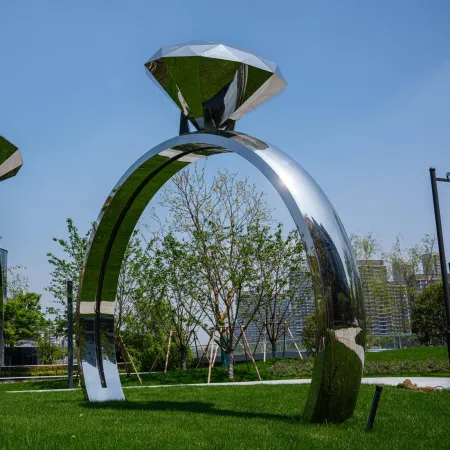
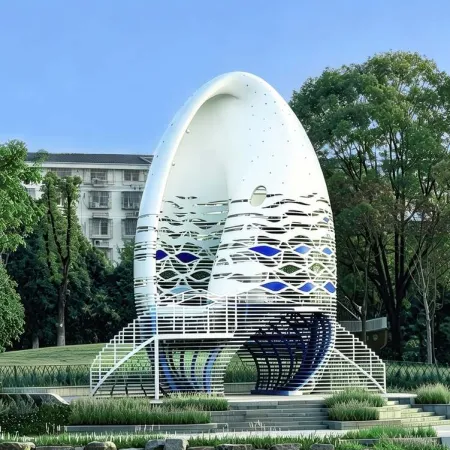
See how ordered form reads at built scale in the Honeycomb Pavilion, how repeated rings create a gateway in The Diamond Rings, and how the services overview fits geometric commissions into the full studio pipeline.
The Design Logic Behind a Geometric Art Installation
Good geometric public art is never decoration for its own sake; it is a decision about how a space should feel. A circle says gathering, a long arc says passage, a grid says order, a tilted polyhedron says tension resolved. The designer's first task is therefore site reading, not shape-making: where do people cross, where do they pause, what silhouette does the site already own, and which geometric figure organizes those observations into one clear statement. When the form answers the site, the installation feels inevitable; when the form ignores the site, no amount of polished steel can save it.
Material Is the Second Language of Geometric Form
The same octahedron changes meaning completely in mirror-polished stainless, in matte black painted steel, in weathering steel or in illuminated white tubing. Material choice is where a geometric art installation moves from abstract exercise to site-specific artwork. Mirror finishes double the surrounding architecture and change with weather and time of day; painted steel delivers flat, graphic color that photographs like a drawing; perforated metal adds pattern and interior light; and light itself can become the defining edge of a geometric form after dark. We advise clients by showing physical samples and mature reference works, because the geometry stays constant while the material completely rewrites the emotional register.
Material Expression at a Glance
| Material | Geometric Character | Best Suited To |
|---|---|---|
| Mirror stainless | Crisp, reflective, ever-changing | Gateways, urban landmarks, plazas |
| Painted steel | Flat, graphic, color-led | Playgrounds, parks, brand-color identities |
| Weathering steel | Earthy, monumental, aged | Landscapes, heritage settings, trails |
| Illuminated elements | Luminous, programmable after dark | Nighttime identities, waterfronts, entries |
Engineering: Where Perfect Geometry Meets Real Physics
Geometry is unforgiving in one specific way: every deviation is visible. A curved organic form can absorb a millimeter of distortion; a twelve-meter arc cannot. This makes engineering discipline the quiet hero of geometric public art. Fabrication must hold tolerances that a building rarely demands, joints must be detailed so the line of the form is never interrupted, and structural calculations must account for wind on flat faces that catch air like sails. The good news is that geometric forms are also the most predictable to engineer — the math is exact, the loads are calculable and the fabrication can be verified against the model with precision. What looks like an advantage for sculpture is actually an advantage for engineering, and studios that exploit it deliver geometry that stays true for decades.
Verification is where precision is won or lost. In our workshop every geometric module is cut and formed against the digital model, dry-fitted in a full trial assembly, and measured at the joints that define the form's silhouette before any finish is applied. This discipline catches the mismatches that photographs hide — a subtle twist in a long member, a junction where two radii do not quite meet, a panel that reads true in the model but sags under its own weight in the shop. Because geometry tolerates no camouflage, the trial assembly is not an optional extra for complex works; it is the moment where the sculpture's perfect lines are proven or corrected, and it is why our geometric pieces arrive on site looking exactly as they did in the approved renders.
What Our Studio Delivers With Every Geometric Commission
Tolerance-controlled fabrication so every edge and junction stays true to the model
Wind and structural engineering matched to large flat and curved faces
Finish direction and reflection studies before production begins
Composing Geometry in the Landscape
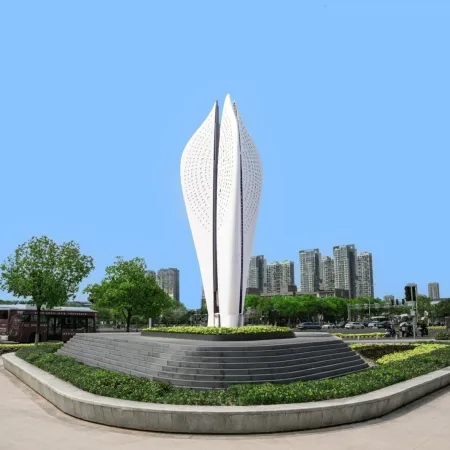
A single geometric object is a statement; a composition of geometric elements is a conversation. Scale, spacing and sightlines decide which one you get. We test every geometric art installation against the three distances that matter in public space: the distant view where the work must read as a confident silhouette against buildings or sky, the approach where its rhythm unfolds, and the intimate scale where a child's hand can follow a seam or a curve. Axis alignment with paths and entries, framing against planting and furniture, and nighttime presence through lighting all belong to the same composition study — geometry that is composed with its context becomes a place marker, not just an object.
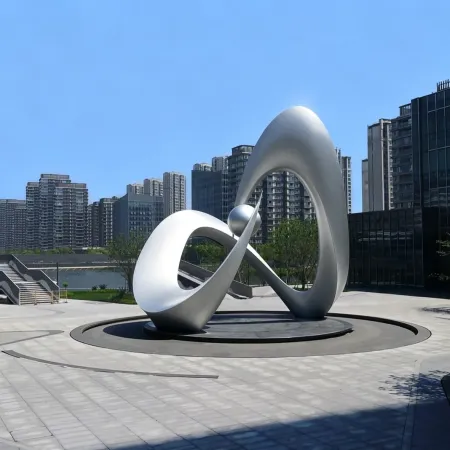
The most useful tool in this phase is the negative space, not the positive form. When we study a geometric art installation in its site, we draw the spaces between and around the elements as carefully as the elements themselves — the room a circle creates inside its ring, the corridor an arc opens toward a building entrance, the gap between two tall forms that frames a distant tower. Visitors experience those voids as much as the steel, and a composition that ignores them produces a cluster of objects while one that designs them produces a place. Scale studies presented as full-width silhouette drawings, tested against the actual sightlines of the site, are how we let a client feel this difference before committing to fabrication.
Crispness Is a Maintenance Commitment
Geometric work advertises its own condition: a smudged mirror, a chipped edge or a dulled finish is immediately visible against the form's perfect order. The flip side is that maintenance is simple and predictable. Mirrored stainless needs regular washing and, in harsh environments, periodic polishing; painted geometry needs a recoat cycle tied to ultraviolet exposure; weathering steel needs only drainage care after its patina matures. We specify these programs per material in the care manual we deliver, and we design joints and access so that every surface can actually be reached by the maintenance crew — a detail that geometry makes easy to overlook and expensive to omit.
- Mirror surfaces: scheduled washing; polish where climate demands
- Painted forms: touch-up kits with the production color code, recoat by exposure
- Lighting elements: lamp replacement access without scaffold where possible
- Structural checks: annual anchor and joint inspection, documented per year
Frequently Asked Questions About Geometric Art Installation Projects
Does geometric art feel cold or unwelcoming?
Only when it ignores its site. Geometry composed around human gathering, seating, play and light becomes warm precisely because it leaves interpretive space. In our experience children and commuters adopt geometric works faster than almost any figurative sculpture.
Can geometric forms be combined with lighting or motion?
Very effectively. Illuminated edges, kinetic elements and reflective surfaces all extend geometry's vocabulary, and we routinely integrate them — from light that traces a form's outline to moving parts that transform a static figure into a living composition.
How accurate does fabrication need to be?
More accurate than most clients expect. Because geometric error is visually loud, we hold tolerances that would be excessive for organic sculpture and verify every module against the 3D model during trial assembly.
What scale of geometric installation is practical?
From intimate courtyard objects of a few meters to landmark compositions over twenty meters, geometry scales exceptionally well because modules repeat and engineering is predictable. We have delivered the full range since 2003.
Can we start from a simple sketch?
Yes — some of our strongest geometric commissions began as napkin sketches. We develop the figure digitally, test it against site photos and sightlines, and return with scale studies that let your team react to the form before engineering begins.
A geometric art installation earns its place when its order gives a space identity it lacked — a place to gather, a line to follow, a form children remember by name. The discipline that makes geometry beautiful is the same discipline that makes it durable: precise design, honest engineering and materials chosen for the site. If your project is at the stage where the space is defined but its character is still open, that is exactly the moment to bring geometry into the conversation — our studio will show you what a geometric art installation can do for your site, from first sketch to the day it stands.