Why a Large-Scale Public Art Sculpture Studio Handles Monumental Work Better
A large-scale public art sculpture studio earns its name not by making everything big, but by having the depth of team, facility and experience that monumental work demands, and the difference becomes visible the moment a project outgrows a small workshop. When a sculpture must be engineered like a bridge, fabricated in sections that span continents and installed with a choreographed lift, the studio behind it needs capabilities that talent alone cannot supply.
This guide explains what separates a large-scale public art sculpture studio from a gifted small shop, why scale of operation matters to the quality and reliability of monumental commissions and what to verify before you trust a major work to any studio. Ours has delivered more than 3,000 installed works across 23 countries since 2003, including structures up to 47 metres across, and we know exactly where size becomes an advantage and where it can become a weakness.
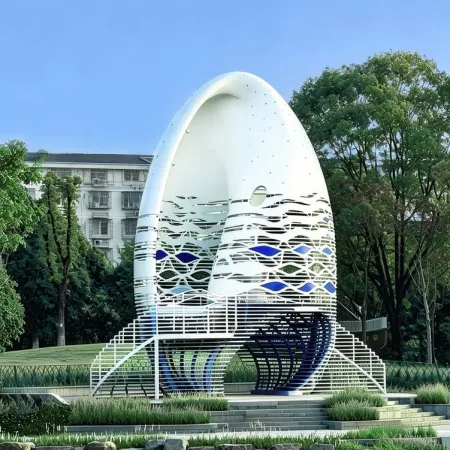
See the full studio capability in our services, the monumental portfolio in the project gallery and a complex engineered work like Hello Conch.
What Scale of Studio Actually Buys
A large-scale public art sculpture studio brings resources that become essential exactly when a project turns monumental. It holds the fabrication floor area for works measured in tens of metres, the heavy lifting and positioning equipment that smaller shops must rent at the last minute and the engineering bench where structural analysis, wind studies and section planning happen in-house. It also carries the buffer capacity that absorbs schedule pressure without sacrificing the quality of your project.
Just as important is the depth of people. A major commission needs sculptors, modellers, structural engineers, welders, finishers, project managers and logistics coordinators, and while a small studio can assemble some of these as contractors, a large studio keeps them as a team that has worked together across many projects. That shared history is invisible in a brochure and unmistakable in the workshop, where the rhythm of a team that has built landmarks together simply feels different.
| Capability | Small studio | Large-scale public art sculpture studio |
|---|---|---|
| Floor capacity | Limited by rented space | Built for tens of metres |
| Engineering | Outsourced per project | In-house structural bench |
| Team depth | Assembled ad hoc | A team built across projects |
| Logistics | Learned project by project | Routines from 23 countries |
| Schedule buffer | Thin, fragile | Capacity to absorb pressure |
The Engineering Bench That Monumental Work Requires
Monumental sculpture is structural engineering with an artistic surface, and a large-scale public art sculpture studio carries the engineering depth to prove it. Wind loading on a tall open form, the transfer of forces through slender members, the foundations that couple the work to the ground and the dynamic behaviour of kinetic elements all need analysis that a sculpture shop cannot improvise. When the engineering lives in-house, it matures with the design instead of arriving as a verdict after it.
The engineering bench also protects the design language. An external engineer who does not live with sculpture tends to solve structural problems with visible bracing and heavy members that betray the art, while an in-house team finds the elegant solution, the hidden spine, the section shape that carries the load and the silhouette at once. We treat engineering as a creative partner precisely because we have seen what happens when it is treated as an afterthought: works that stand, and works that should not have been built.
Fabrication Muscle and the Quality It Enables
Fabrication capacity determines what a studio can honestly promise. A large-scale public art sculpture studio can run the heavy plate rollers, the large-format cutting tables and the dedicated finishing bays that monumental sections require, and it can fabricate several sections in parallel when the schedule demands. That muscle shortens the critical path and, more importantly, lets the studio control quality in its own bays rather than depending on a chain of subcontractors.
Control is the quiet benefit of scale. When welding, finishing and assembly happen under one roof, the quality system is one system, the inspection points are consistent and the client's progressive documentation comes from a single accountable source. We welcome clients and third-party inspectors into the workshop at agreed milestones, and that openness is easier for a studio that owns its process end to end than for one that must gather its subcontractors to answer for their separate work.
- In-house engineering that matures with the design language.
- Heavy fabrication bays built for monumental sections.
- One quality system from weld to final finish.
- Proven logistics across borders and continents.
- Open inspection at milestones you choose.
What Studio Scale Secures
Room and rig for works of tens of metres
Engineering that serves the design
A team that has built landmarks together
Capacity that protects your schedule
Where a Large Studio Must Stay Humble
Scale has a weakness that honest studios acknowledge: the risk of treating every commission as a production problem when some works need the intimacy of a small atelier. A large-scale public art sculpture studio must therefore protect the creative core of each project, giving the concept the individual attention of a studio piece even when the fabrication runs on industrial discipline. The best large studios behave like small ones in the design room and like large ones in the workshop.
The client should test for that balance before committing. Ask how many projects run through the studio at once and how your project lead is protected from being spread too thin. Ask to see the actual team who would build your work, not only the sales staff, and ask how the studio handles a design that needs the obsessive attention of a single maker. The right answer is a studio large enough to deliver monumental work and wise enough to treat your sculpture as the only one that matters.
What a Monumental Track Record Actually Shows
A large-scale public art sculpture studio's track record is evidence only when it can be examined, so the client should ask for the kind of detail that separates real experience from assembled marketing. A genuine record names the delivered works, their locations and their dates; it spans types, from gateways and canopies to kinetic and interactive pieces; and it crosses climates and regulatory environments, because a studio that has engineered for coastal salt, high wind and freezing winters has learned lessons that apply to any new site. The client should be able to verify the record by visiting works, speaking to owners or reviewing the engineering files.
The most revealing evidence of a strong record is quieter: the work that comes back. Studios with genuine monumental experience are re-commissioned by the clients and the communities who lived with their earlier works, and they are called back to maintain, to repair and to extend pieces they installed years before. That return business says what no portfolio can, that the work stood well, that the owner was supported and that the relationship survived the delivery. When you evaluate a large-scale public art sculpture studio, ask how much of their current production comes from previous clients, and listen to the answer, because repetition by satisfied clients is the track record that matters most.
The strongest verification of a monumental record is to visit the works and speak to the people who live with them, and a studio confident in its history will help arrange it. Ask for works near your own city, visit them at a busy hour and notice not only the sculpture but its condition, its base, its finish and the way the public treats it, and ask the owner or the maintenance team how the studio behaved after delivery, whether they responded to questions, supplied documentation and supported the annual care. That evidence, gathered from the field rather than from the brochure, is the most honest measure of a large-scale public art sculpture studio, because a record of monumental work is finally a record of relationships, and relationships are verified by talking to the other party.
Frequently Asked Questions About Choosing a Large-Scale Public Art Sculpture Studio
Why does studio size matter for monumental art?
Monumental work needs floor capacity, heavy equipment, in-house engineering and team depth, resources that a large studio keeps ready and a small shop must assemble ad hoc.
Is in-house engineering really necessary?
For large engineered works it protects both safety and design, letting structural solutions mature with the form instead of arriving as late and heavy verdicts.
Does a bigger studio mean less creative attention?
Only if poorly managed; the best large studios give each concept individual creative attention while applying industrial discipline to the fabrication.
How do I verify a studio's real capability?
Walk or video-walk the workshop, meet the actual project team, review delivered monumental works and confirm the engineering and logistics resources that back the promises.
Can a large studio still deliver small commissions?
Yes, and many do, applying the same engineering and quality system to smaller works at a value that small shops struggle to match.
A large-scale public art sculpture studio earns trust when its size serves the work: engineering that lives in-house, fabrication muscle under one quality system, logistics proven across borders and enough humility to give every concept individual attention. Verify the floor, the team and the record before you commit a monumental vision to anyone.
If you are trusting a large-scale public art sculpture studio with a major commission, come and see our workshop, meet the team that would build your work and judge the capability for yourself.