Garden Sculpture Fabrication for Spaces People Live In
A garden is the most intimate setting a sculpture will ever occupy, and garden sculpture fabrication must answer to a standard that plazas and roundabouts never impose. The work will be seen from a metre away, walked around on soft ground, lit by dappled light and left to weather among plants. It must be beautiful up close, safe for children and gentle on the people who live beside it.
Yifeng Sculpture Studio has fabricated garden works since 2003 within a wider output of more than 3000 pieces delivered to 23 countries. Our craftsmen work in one building with the designers and engineers, so a garden commission is resolved in the model and the sample before it is trusted to the outdoor season. That care is what garden sculpture fabrication should mean.
What Makes a Garden Different From a Public Square
Distance is the first difference. A garden sculpture is encountered at conversational range, so a finish that would read as crisp from twenty metres can look coarse from one, and a weld that would be invisible in a plaza becomes a scar in a flowerbed. The maker must work to a finer standard of surface and joint, and the client should expect to approve the finish on a sample rather than on a photograph.
The second difference is the setting itself. Plants change through the year, so a garden sculpture must look good in bare winter branches and in dense summer foliage, in morning shade and evening sun. It must also sit correctly among textures, softening next to grass and crisp next to stone, and it must not shade out the planting or crowd the path. We ask clients for photographs of the garden through the seasons, because designing for one moment in one light is how garden sculptures end up disappointing their owners.
| Garden factor | Fabrication response | What it protects |
|---|---|---|
| Close viewing distance | Fine surface preparation and invisible joints | A work that rewards a close look |
| Seasonal light and foliage | Form and colour tested across the year | A work that looks good in every season |
| Children and pets | Rounded edges, stable base and non-toxic finishes | Safety in a family space |
| Soft ground and planting | A footing designed for soil rather than paving | A work that stays level and does not sink |
Materials and Finishes for Garden Settings
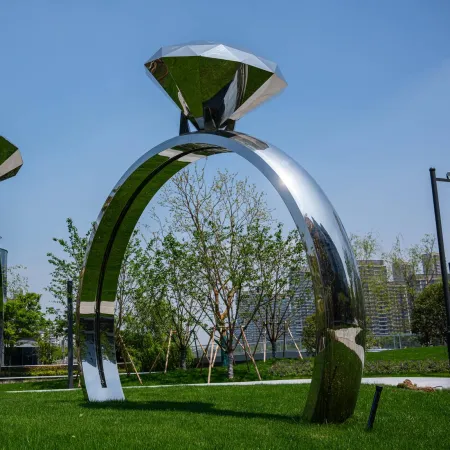
Bronze is the classic garden material because it ages gracefully and its warm tone sits well among plants, and a modest bronze will improve as it weathers. Stainless steel offers a bright, contemporary presence and reflects the garden around it, though a highly polished surface can be too assertive in a small space and a satin finish often suits better. Stone and cast stone give weight and calm, and coated steel or composite allow colour for playful or modern gardens.
The finish should follow the light. A garden in the northern hemisphere is often lit from a low angle, which flatters a textured surface and punishes a flat one; a shaded courtyard needs a lighter tone to avoid disappearing into the gloom. We produce finish samples and place them in the client's own garden if possible, because a colour chosen in a workshop can behave completely differently among wet leaves and grey skies. That small extra step is the difference between a garden sculpture that belongs and one that merely stands there.
Foundations, Irrigation and Practical Detail
A garden sculpture needs a footing designed for soil, which behaves very differently from a paved plaza. The base must reach below the frost line where winters are cold, spread its load where the ground is soft and drain so that water does not stand against the metal. Irrigation lines and planting beds must be considered too, because a sculpture placed after the garden is mature will damage roots and be damaged by them.
Practical details also include access. A large work may need a crane or a narrow machine to reach the site, and a garden with a low gate or a delicate path may not allow it. We ask clients to measure the route from the road to the position, because discovering that a sculpture cannot reach its spot on the day of installation is an expensive surprise. Planning the access at the design stage is part of garden sculpture fabrication, and it costs nothing compared with solving it later.
What a Garden Work Needs
Surface quality that survives being seen from a metre away
A form that reads well in every season and every light
A footing designed for soil, frost and drainage
An installation route checked before the work is built
Care and Longevity in a Domestic Setting
A garden sculpture is maintained by its owner rather than by a facilities team, so the care plan must be simple enough for a household to follow. We supply plain instructions for cleaning, for the seasonal checks that matter and for the signs that a coating needs attention, and we avoid finishes that demand specialist equipment. A bronze that needs a wax once a year is a reasonable request; a finish that requires a contractor is not.
Longevity in a garden is also about placement. A work under a tree will collect sap and leaf litter; one beside the sea will need a more resistant alloy; one beneath a sprinkler will be washed constantly with water that may leave deposits. We discuss all of those conditions with the client and adjust the material and the finish accordingly, because a garden sculpture that is well placed and well specified will outlive the planting around it. That is the quiet promise of good garden sculpture fabrication.
Choosing Scale and Placement in a Garden
Scale is the most common mistake in garden commissions, because a work that would be modest in a park can overwhelm a courtyard. The right size depends on the distance from which the piece will usually be seen and the mass of the planting around it, and a sculpture that is slightly too large will make a small garden feel cramped rather than enriched. We test scale with a simple mock-up on site, using a board or a temporary frame to show the client what the finished height will look like in place.
Placement matters as much as size. A work should be discovered rather than announced, so the approach matters: a piece seen at the end of a path has more presence than one standing in the middle of a lawn, and a form framed by a doorway gains a theatrical quality it would not have in the open. We walk the garden with the client at different times of day and mark candidate positions, because placement is the cheapest and most powerful design decision available in a garden.
The material should also suit the character of the garden. A formal garden rewards a crisp geometric form in stone or polished metal, while a wilder planting scheme suits a textured or weathered surface that sits easily among leaves and grass. Colour is a further decision: a bright piece will hold attention through the winter, while a quieter tone will let the planting lead for most of the year. None of those choices has a single right answer, and the job of the studio is to help the client see the consequences of each.
Finally, a garden sculpture should be chosen for the life the client actually lives. A household with young children needs safe edges and stable bases; a household that travels needs a finish that tolerates long neglect; a household that entertains needs a work that looks good under evening lighting. Those practical realities shape the specification as much as any aesthetic preference, and a studio that asks about them will propose something the client still loves in ten years. That is what garden sculpture fabrication is really for.
Frequently Asked Questions About Garden Sculpture Fabrication
Which material is best for a garden sculpture?
Bronze ages most gracefully among plants, stainless steel gives a bright contemporary presence, and stone or coated materials suit calm or colourful settings.
How should a garden sculpture be anchored?
On a footing designed for soil, reaching below the frost line where needed, spreading its load and draining so water does not sit against the metal.
Will a sculpture damage my planting?
Not if it is planned with the garden, which is why we ask for seasonal photographs and consider irrigation and root zones before the design is fixed.
How much maintenance does a garden sculpture need?
Usually very little, such as gentle washing and an annual wax or a coating check, and we choose finishes a household can look after without specialists.
Can a large sculpture be installed in a small garden?
Often yes, provided the access route is measured and the sections are designed to pass through the gate and along the path to the final position.
A garden sculpture is lived with rather than visited, and that changes everything about how it should be made. It must be beautiful from close range, honest about its materials and easy for its owner to care for, or it will quietly become a burden instead of a pleasure.
If you are choosing a work for a garden, we would be glad to look at the space with you. Browse the range of scales we build in our project gallery, review the whole service chain on the services overview, and study Rainbow Windmills, a work whose colour and movement reward exactly the close, seasonal viewing a garden provides.
A garden sculpture is lived with rather than visited. Choose a scale that fits, a place that rewards discovery and a material that suits the household, and garden sculpture fabrication will give you something you enjoy every single day.