How an Abstract Stainless Steel Sculpture Reads in Public Space
An abstract stainless steel sculpture communicates through form, proportion, reflection and movement rather than through a recognisable subject, and that makes the brief harder to write than a figurative one. A client who can say exactly what a portrait should look like often struggles to describe what an abstract work should feel like. The solution is to define the experience in plain language: the mood, the scale in relation to people, the way light should fall on it and the kind of attention it should invite.
Yifeng Sculpture Studio has designed abstract and semi abstract stainless work since 2003, with more than 3000 delivered pieces across 23 countries, and the projects that succeed are almost always the ones where the client invested in that early conversation. Abstract art is not vague art. It is precise art about things that cannot be photographed, and the maker's job is to translate a feeling into geometry, surface and scale that a whole community can stand beside.
Why Stainless Steel Suits Abstract Form
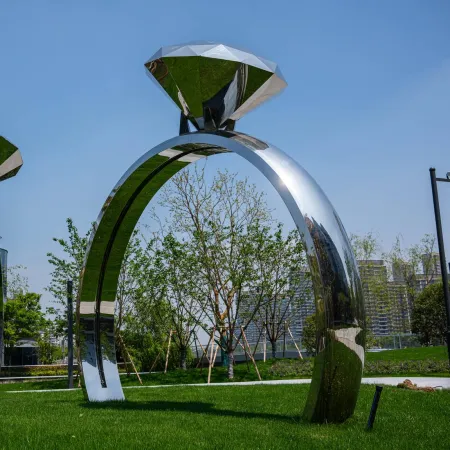
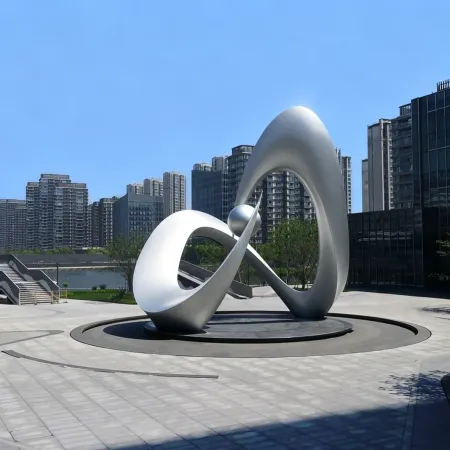
Stainless steel is unusually well matched to abstraction because it can be formed into continuous, seamless surfaces with tight radii and long sweeping curves, and because its reflectivity dissolves the boundary between the object and its surroundings. A polished abstract form becomes partly a mirror of the sky, the trees and the people around it, which means the work changes through the day and through the seasons without moving at all. That behaviour is difficult to achieve in most other materials.
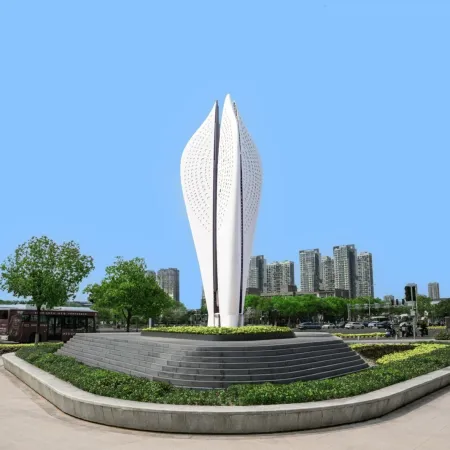
The material also supports the scale that abstraction usually needs. Because stainless can be fabricated in sections and welded into large continuous shells, an abstract stainless steel sculpture can reach eight, twelve or twenty metres without looking like a scaled up model. The joinery can be made invisible on a polished surface or expressed deliberately as a rhythm of seams on a brushed one, and both approaches are legitimate provided the decision is made at the design stage rather than discovered in the workshop.
| Abstract intent | Surface that serves it | What the public experiences |
|---|---|---|
| Lightness and disappearance | Mirror polish | The work dissolves into sky and surroundings |
| Mass and quiet presence | Bead blasted matt | A calm, solid form that holds its shape in any light |
| Movement and direction | Directional satin brush | A sheen that travels across the surface as the viewer walks |
| Rhythm and repetition | Expressed seams and ribs | A pattern that reads as structure and as ornament |
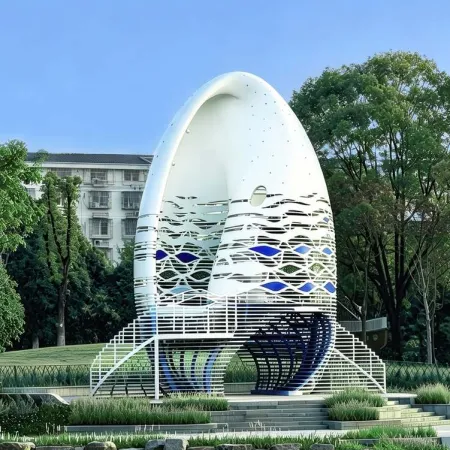
| Colour and graphic energy | Coloured or coated stainless | A vivid landmark that photographs instantly |
Writing a Brief for an Abstract Work
A useful brief for an abstract stainless steel sculpture describes conditions rather than subjects. Instead of asking for a wave, the client might describe the feeling of a harbour on a still morning, the way the site is crossed by pedestrians, the direction of the strongest light and the mood the place should carry at night. These are designable qualities. They give the studio something to measure a proposal against, and they give the client a basis for judging options that look completely different from one another.
Practical constraints belong in the brief alongside the poetry. The footprint the site can spare, the height limits imposed by planning or by sightlines, the crane access, the ground conditions and the budget range all shape what is possible. We ask for these early because an abstract concept that cannot be built or permitted is not a concept but a sketch. The best briefs are short, specific and honest, and they leave the studio genuinely free to invent within a clearly defined world.
- Describe the mood: words like calm, restless, generous or weightless give a designer something real to work with.
- State the audience: children crossing a schoolyard and commuters crossing a station forecourt need different scales and different invitations.
- Name the viewpoints: the approach on foot, the view from a passing road and the view from an upper window are three different compositions.
- Give the hard limits: footprint, height, access, ground conditions and the budget band, so the concept is buildable from the start.
- Say what to avoid: a short list of references, cliches or colours the client does not want is as useful as a list of what they do.
What Abstraction Asks of a Client
A brief written in feelings, not in pictures
Trust in proportion and surface as the carriers of meaning
Willingness to review a physical model before committing
Patience while a form is tuned rather than copied
From Maquette to Monument
Abstraction is developed in the hand as much as on the screen. We build maquettes at a small scale so the client can walk around a real object and feel how the mass changes as they move, and we use digital models in parallel to test structure, panel layout and fabrication sequence. The two tools answer different questions: the model answers how it feels, the digital file answers how it can be made, and a serious project needs both before the full size work begins.
Enlarging a small form to monumental scale is where many abstract projects go wrong, because a curve that is gentle at thirty centimetres can look slack at twelve metres, and a thickness that feels solid in the hand can look flimsy in a plaza. We correct for this by building full size mock ups of critical details and by adjusting the profile for the viewing distance. An abstract stainless steel sculpture should look deliberate from every angle the public will use, and that is achieved by testing, not by hoping.
- Small scale maquettes: several variants so the client can compare forms as objects rather than as images.
- Digital development: surface modelling and structural analysis to prove the form can be built and will stand.
- Scale mock ups: full size sections of the critical curves, checked on site in the real light.
- Profile adjustment: refining radii and thickness for the distance from which most people will actually see it.
- Sample approval: the final finish agreed on a physical plate before any visible surface is produced.
Judging an Abstract Stainless Steel Sculpture Proposal
Comparing abstract proposals is difficult because they cannot be measured against a familiar subject. The useful test is not whether a proposal looks like something but whether it answers the brief, and the brief should therefore state the conditions the client cares about: the mood, the scale in relation to people, the way the work should meet its surroundings and the level of maintenance the site can support. With those conditions written down, proposals can be compared on substance rather than on taste.
Physical models are the most reliable way to make that comparison. An abstract stainless steel sculpture that looks compelling in a rendering can feel heavy, thin or awkward as an object, and the only way to know is to walk around a maquette and watch how the form changes. We present models at a consistent scale so the client can hold them, place them against a photograph of the site and feel the proportions before committing to a direction.
The second test is the studio's reasoning. A serious proposal will explain why the form is shaped as it is, how the surface was chosen and how the scale relates to the site, and that explanation should be specific enough to argue with. Where a proposal offers only a mood board and a promise, the client has no basis for a decision and no protection if the delivered work disappoints. Reasoning is the part of a design submission that survives contact with reality.
Finally, the client should ask what happens after the choice is made. An abstract stainless steel sculpture is developed, not simply enlarged, and the studio should describe how the form will be refined, how the structure will be proved and how the finish will be sampled. The best submissions are the ones that make the next stage visible, because they show that the studio has a method rather than a single idea it hopes to defend.
Frequently Asked Questions About Abstract Stainless Steel Sculpture
Will the public understand an abstract work?
Understanding is the wrong test. People respond to scale, light and material long before they interpret meaning, and a well proportioned abstract form is usually accepted quickly even when its concept is never explained.
Does a polished surface make an abstract work harder to maintain?
It shows marks more readily than a satin or blasted finish, so it demands a slightly more attentive cleaning routine, but it also offers the least places for dirt and chlorides to cling.
Can an abstract sculpture carry a specific message?
It can suggest a theme through form, colour and movement, and the story can be told through interpretation panels, but abstraction persuades through feeling rather than through literal reading.
How many concepts will we see?
Typically two or three distinct directions developed to a comparable level, so the choice is between real alternatives rather than between one finished idea and two sketches.
Is stainless the only option for abstract form?
No, and part of the design conversation is weighing stainless against painted steel, aluminium or bronze, each of which changes how the form reads and how it weathers.
Examples of abstract and semi abstract work are collected in our project gallery, and a piece where reflection is the whole subject is The Radiant Galaxy. A large scale work that turns light into an abstract surface is described in Butterfly Dance.
Tell us how the place should feel and we will show you forms that answer it. Approached with a clear brief and a rigorous development process, an abstract stainless steel sculpture becomes the most articulate thing in the square, even though it depicts nothing at all.