How Light Installation Art Turns Space Into Experience
Light installation art is the branch of public art where the medium is experience itself: light sculpts volume, color rewrites mood, and darkness becomes the raw material that the work carves into meaning. Unlike a conventional monument that stands apart from the viewer, a light installation wraps the visitor in its world — you walk through it, stand inside it, cast shadows into it and carry its memory home. Yifeng Sculpture Studio has created light installation art for urban plazas, waterfronts and landmark programs since 2003, and this guide explores how artists and studios turn beams, pixels and darkness into places people feel rather than merely see.
The sections below cover the artistic language of light, how installations are composed as environments, the role of participation, the engineering of immersive experiences, and the care that keeps a light work alive.
The most powerful light works share a quiet secret: they are designed in darkness as much as in light. The shadows, the gaps, the pools of unlit space are not leftovers of the design — they are half of its vocabulary, and the artist who ignores them has thrown away the deeper half of the material.
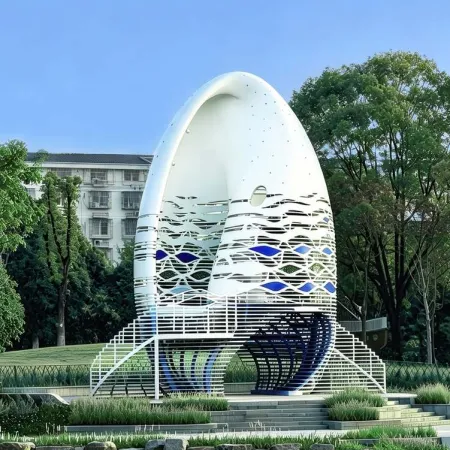
Our project archive shows light-led works in their real settings, Wisdom Tree demonstrates an illuminated installation that invites participation after dark, and Hello Conch shows how light and interaction turn a landmark into a shared experience.
The Artistic Language of Light Installation Art
Light installation art has its own grammar, distinct from sculpture, painting or architecture. Color carries emotion that bypasses language; intensity sets the energy of a space; movement of light creates time and narrative; and the direction of light sculpts everything it touches. A beam can draw a line across a plaza where no physical line exists; a wash of warm color can make concrete feel intimate; a slow pulse can give a space a heartbeat. The artist composing in light thinks in these terms the way a composer thinks in notes, and the strongest installations are those where every choice of color, brightness, rhythm and darkness serves one emotional argument rather than showing off every effect available.
Composing Space: Designing What the Visitor Feels
A light installation is an environment before it is an object, and its design starts with the visitor's journey. Where does the experience begin — from a distance where the glow first appears, or at a threshold where the visitor steps from darkness into color? How does the work guide movement, offering moments of gathering, passage and pause? What does the visitor see approaching, feel standing inside and remember walking away? These questions produce a storyboard of the experience, and the physical work — the forms, fixtures and surfaces — is built to serve that storyboard. This is why light installation art so often succeeds where a purely decorative lighting scheme fails: it is designed backwards from the human moment, not forwards from the hardware.
| Experience Stage | Design Question | Lighting Tool |
|---|---|---|
| Approach | How is the work first discovered? | A distant glow, a visible silhouette, a color signature |
| Threshold | Where does the visitor enter the experience? | A change of color, a corridor of light, a gateway |
| Immersion | What is felt while standing inside? | Surrounding color fields, overhead light, interaction |
| Departure | What memory does the visitor carry away? | A signature color, a final glow, a place to look back at |
Participation: Light That Responds to People
Some of the most memorable light installation art is participatory: a surface that changes color as people approach, a tree whose glow follows a visitor's touch, a field of light that responds to sound or movement. Participation transforms the audience from spectators into co-authors, and it gives the installation a social life — people return to show friends what they discovered, and the work becomes a place of meeting rather than merely viewing. The interactive layer must be engineered with the same robustness as the light itself, with sensors that survive weather and crowds and responses that feel immediate and magical rather than laggy and random. When interaction and light are designed together from the start, the result is a work that is different every night and beloved every year.
What Our Studio Delivers With Every Light Installation
An experience storyboard designed before the hardware is specified
Darkness composed as deliberately as light, with shadows given a role
Content and interaction systems the owner can refresh for years
Engineering the Immersive Experience
Immersion demands a level of engineering that conventional lighting rarely requires, because the visitor is inside the work rather than in front of it. Color consistency across a large field must be verified so the experience does not break into patches; brightness must be calibrated so the eye moves where the artist intends; power and data must reach every node reliably; and the control system must run scenes smoothly for years. Structural elements that carry light — frames, skins, towers — are engineered to public-sculpture standards, because the visitor standing beneath them must be as safe as the visitor standing in front of a monument. The invisible engineering is what makes the visible magic dependable night after night.
Responsibility: Light That Respects Its Neighbors
Artistic freedom with light is earned through responsibility. A light installation that dazzles drivers, blazes into bedroom windows or floods the sky with wasted lumens will quickly lose the community support it needs to survive. Responsible design aims light where it belongs, keeps brightness proportionate to its surroundings, and programs the night so the work rests when the city rests — a curfew that dims rather than extinguishes, preserving a quiet landmark presence without stealing anyone's sleep. This discipline is not the enemy of wonder; it is what keeps wonder welcome. The most respected light art in any city is the work that is spectacular at nine and courteous at two, and that courtesy is designed in from the first scene.
Caring for a Light Installation Across the Years
Light art ages differently from steel or stone: LEDs dim over years, drivers fail, lenses gather grime and content grows stale. The works that stay magical are the ones whose care was designed in — replaceable modules with access routes, spare-part kits delivered at handover, cleaning schedules matched to the environment, and content libraries that a site team can update without summoning a specialist. We write the care story honestly in every proposal, because a light installation that outlives its novelty is a gift to its city, and one that dies in year three is a lesson in deferred planning. With the right design and a kept schedule, a light installation can enchant for decades — and the maintenance manual we deliver is the first page of that long story.
Frequently Asked Questions About Light Installation Art
Is light installation art only for nighttime?
The experience peaks after dark, but the strongest works are designed to hold their own by day as sculptural forms. The two lives are composed together, so the installation earns its place around the clock rather than waiting for sunset.
What makes a light installation feel immersive rather than decorative?
Immersion comes from composing darkness, color and scale around the visitor's body — standing inside color fields, being surrounded rather than faced, and feeling that the light responds to your presence. Decoration is seen; installation is experienced.
Can a light installation be permanent rather than temporary?
Yes — permanent light art is a growing category of civic investment, engineered with the same structural and electrical longevity as any landmark. Permanent works trade the freedom of the temporary for the responsibility of the durable, and we design them accordingly, with replacement paths for every component built into the first drawings.
How do artists and engineers collaborate on light works?
Through shared ownership of the experience: the artist defines the emotional journey and the engineer makes it dependable, and the two disciplines meet continuously rather than sequentially. Our studio keeps both under one roof so the vision and the physics improve each other.
Where should we start if we want a light installation?
Start with the experience you want people to have — the feeling, the story, the moment you want them to remember. Bring that vision together with the site and its constraints, and we will help you translate it into an installation that can be engineered, built and loved for years.
Light installation art is where public art becomes experiential — where a plaza, waterfront or campus stops being a place you pass through and becomes a world you step into. The works that achieve this are designed as complete experiences, composed in darkness as carefully as in light, engineered for dependability and cared for across the years. If you are imagining a place people will come to feel rather than merely see, our studio would be honored to build it — tell us about the space and the feeling you want it to hold, and we will shape a light installation art experience that your city will remember long after the lights go down.