What a Creative Stainless Steel Sculpture Studio Actually Does
A creative stainless steel sculpture studio does more than execute a drawing, because the drawing is usually the least resolved part of the project. The studio's real work is to take a site, a budget and a half formed ambition and turn them into a form that can be built, permitted, transported and installed without losing the idea. That translation between intention and fabrication is the craft, and it is the reason a studio with genuine design depth produces better results than a workshop that only quotes from drawings.
Yifeng Sculpture Studio has worked this way since 2003, delivering more than 3000 pieces to 23 countries, and our studio carries an academic background through institutions such as the China Academy of Art and Tsinghua University's Academy of Arts and Design, alongside a connection to the Royal Society of Sculptors. That background matters commercially: it means the design conversation is grounded in sculpture as a discipline, not in decoration as a service.
The Work Before the Work
The first phase of a project is almost invisible to a client who has not commissioned sculpture before. We read the site: how people move through it, where the sun falls at different hours, what the prevailing wind does, how the ground is built and where the eye naturally rests. We ask what the place is for and what it should feel like. None of this appears in the final sculpture directly, yet every one of these facts shapes the form, and a studio that skips this stage usually produces something that looks imported rather than grown.
The second phase is invention, and it should produce genuinely different options rather than variations on one idea. We develop two or three directions in parallel, each with its own logic, and we test them as physical maquettes so the client can walk around real objects. This is where a creative stainless steel sculpture studio earns its name: not in generating a large number of images, but in offering a small number of distinct, defensible concepts that the client can compare honestly.
| Stage | What the studio does | What the client decides |
|---|---|---|
| Site reading | Movement, light, wind, ground and context analysis | The purpose and mood the place should carry |
| Concept | Two or three distinct directions with maquettes | The direction to develop |
| Development | Refined form, materials, finish and lighting study | Approval of the resolved design |
| Engineering | Structure, foundation loads, wind and fatigue analysis | Sign off with the project engineer |
| Samples | Material and finish plates in the real light | Final surface approval before production |
Where Creativity Meets the Workshop
A studio that also fabricates has an advantage that a design only practice cannot match: the designer knows what the material will do. When the person shaping the concept has spent years watching stainless steel move under heat, they design radii that can actually be rolled, seams that can be welded and dressed, and surfaces that can be finished consistently. That knowledge does not limit creativity; it directs it into forms that survive the journey from drawing to plaza without losing their sharpness.
It also means problems are solved in the design room rather than in the workshop. A joint that cannot be made cleanly is redesigned, not hidden. A curve that will distort under welding is stiffened or re sequenced on the drawing. A finish that would look patchy across many panels is re planned before any steel is cut. Clients who work with an integrated studio benefit from a design that was made for the material, not merely applied to it.
- Material informed design: forms and radii shaped around what stainless can actually do when rolled and welded.
- Buildable detailing: joints, seams and fixings resolved on paper rather than improvised on the shop floor.
- Early risk removal: distortion, access and finishing problems identified before production begins.
- One accountable team: the people who conceived the form also answer for how it is made and installed.
- Creative confidence: bold ideas proposed by a team that knows how far the material can be pushed.
What a Studio Brings
Design judgement rooted in sculpture, not decoration
Physical maquettes the client can walk around
Engineering and making under one roof
Continuity from first sketch to final bolt
How to Judge a Studio You Are Considering
Ask to see the process, not only the portfolio. A serious studio can show maquettes, development drawings, engineering calculations and finish samples from a past project, and that evidence tells you far more than finished photographs. Ask how many concepts a client typically reviews, how the studio handles a disagreement over form, and what happens when the budget will not stretch to the first idea. The answers reveal whether the studio is a partner or an order taker.
Also ask about the people. Creativity in this field is not a single genius in a room; it is a team of designers, engineers and makers who trust each other enough to argue. A studio that can name the individuals who will work on your project, and keep them on it, is offering something more valuable than a style. It is offering continuity, and continuity is what allows a complex work to arrive looking exactly as it was imagined.
- Review the process: maquettes, drawings, calculations and samples from a completed commission.
- Ask how concepts are chosen: the number offered and the depth each is developed to before a decision.
- Test the budget conversation: how the studio responds when the ambition exceeds the available funds.
- Meet the team: the designers, engineers and makers who will actually deliver your work.
- Check continuity: whether the same people stay with the project from concept through installation.
Collaborating With a Creative Stainless Steel Sculpture Studio
The best collaborations begin with a briefing session rather than a brief. Sitting down with a creative stainless steel sculpture studio and talking through the site, the users and the ambition allows the studio to ask questions a written brief never covers: what the place is like at different times of day, what the client secretly hopes people will say about it and what has been tried before. That conversation often changes the direction of the project before any drawing is made.
Feedback should be specific to be useful. Telling a studio that a proposal feels wrong is honest but difficult to act on; explaining that it feels too heavy for the planting, too tall for the sightline or too quiet for the entrance gives the designer something to work with. We encourage clients to respond in those terms, and we use the comments to refine the direction rather than to defend the original proposal.
Timelines should be built around the stages rather than around a single delivery date. Concept, development, engineering, sampling, fabrication and installation each need their own period, and compressing the early stages to protect the later ones is the most common way projects get into trouble. A studio that sets out those stages clearly, with the client's decision points named, gives everyone a realistic basis for planning.
Finally, the relationship works best when the studio is treated as a partner rather than a supplier. That means involving it in conversations with the architect, the landscape designer and the main contractor, sharing information about the site and the programme, and taking its warnings seriously when it flags a risk. A creative stainless steel sculpture studio that is trusted with the full picture will design a better work than one handed a drawing and asked to execute it.
Frequently Asked Questions About a Creative Stainless Steel Sculpture Studio
Do you work from a client's own design?
Yes. We can fabricate a design produced by the client or their architect, and we will flag any detail that cannot be built as drawn so it is resolved before production rather than during it.
How long does the concept stage take?
It varies with the scale of the work and the number of decision makers involved, but the concept stage should never be rushed, because every hour spent there saves many more in the workshop.
Can you collaborate with our architect or landscape designer?
We prefer it. Early coordination with the wider design team means foundations, lighting and access are planned around the sculpture instead of being retrofitted to it later.
What if we do not like any of the concepts?
That is useful information, and a good studio will interrogate why. Rejection usually reveals an unstated constraint or a mismatch in mood, and clarifying that is faster than generating more options.
Do you take on small commissions?
We do. A private garden work and a city landmark are different in scale but not in the care they deserve, and the same design discipline applies to both.
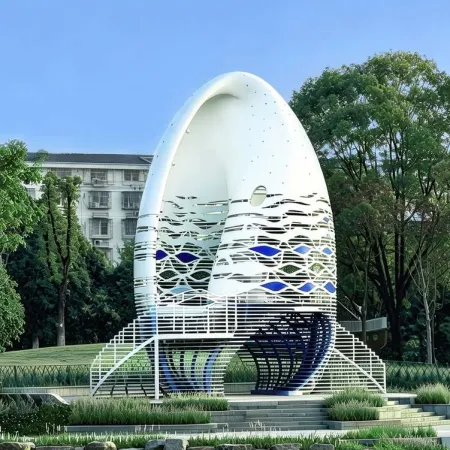
The way we structure a commission is described in our services overview, and a large interactive work that began as a concept study is Hello Conch. More examples of studio developed work appear in the project gallery.
Tell us about the place and what it should become, and we will show you what is possible. Working with the right creative stainless steel sculpture studio is the difference between a sculpture that is merely installed and one that belongs.