What Goes Into a Successful Large Scale Art Installation Design
Large scale art installation design is different in kind, not just in degree, from designing a courtyard piece: at landmark size the artwork stops being an object and becomes architecture, urban furniture, wayfinding and civic identity all at once. The form must read from a kilometer away and still reward a visitor standing beneath it; the structure must answer wind, ground and gravity like a small building; and the meaning must survive the attention of an entire city. Yifeng Sculpture Studio has practiced large scale art installation design since 2003, and this guide sets out the design disciplines that separate landmark works from oversized objects.
The sections below cover scale and context, the three-distance rule, environmental and structural design, human flow, material honesty and the design documentation a landmark project needs.
Scale is the first and least forgiving design parameter. A form that delights at three meters can bully a plaza at fifteen; one that reads powerfully at fifty meters can feel remote and cold up close. Large scale art installation design begins by deciding exactly what the work must do at each distance — and then proving it in studies before a single render is finalized.
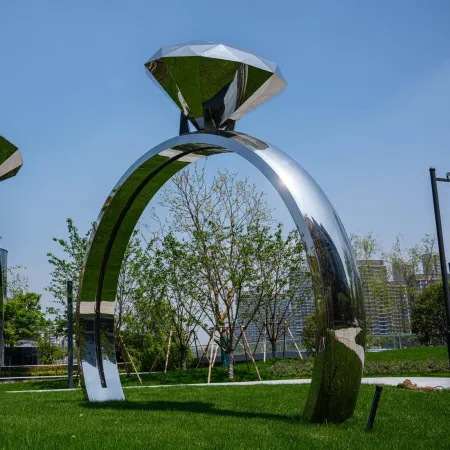
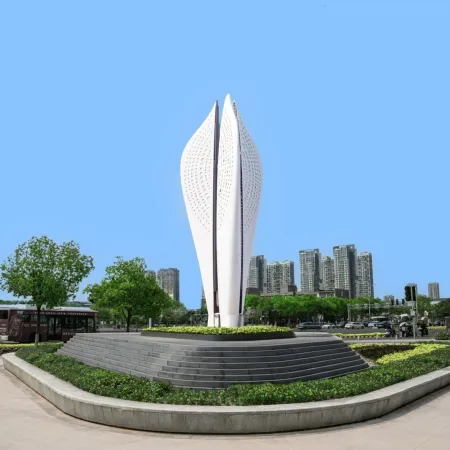
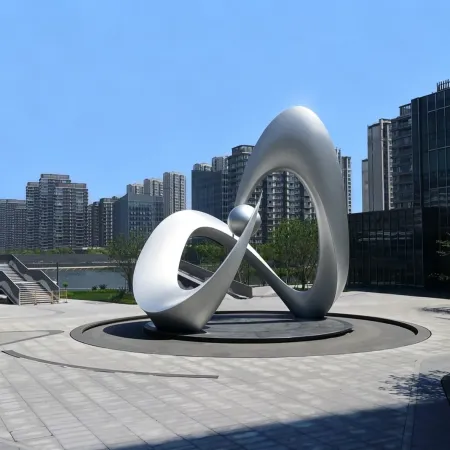
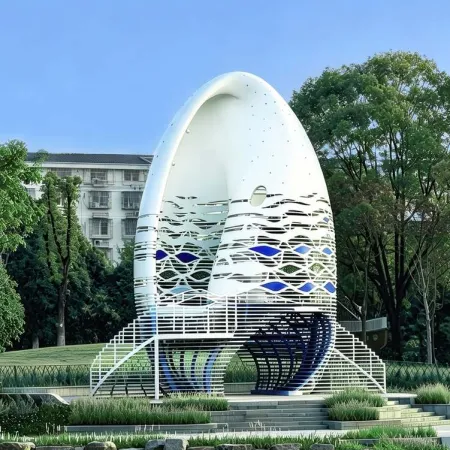
The services overview explains how concept, engineering and fabrication combine in one studio, the project archive shows landmark works in their real settings, and Peach Blossom demonstrates a twenty-meter-scale gateway designed as an integral part of its environment.
Reading the Site Before Drawing the Form
Large scale art installation design starts with a site reading that goes far beyond aesthetics. The designer must understand the sightlines that carry the work — from which roads, paths and buildings will people first see it, and from which angles will it be photographed daily? The scale of neighboring structures sets a minimum presence, while the scale of human activity sets a maximum intimacy. Sun paths decide where reflective or dark surfaces should face; prevailing winds and ground conditions constrain the structure; and the existing visual vocabulary of the district — materials, heights, rhythms — gives the new work its conversation partners. A landmark that ignores these inputs is a sculpture that happens to be large; one that absorbs them is a work that seems to have always belonged.
The Three-Distance Discipline
Every successful large-scale artwork is designed at three distances simultaneously. At the distant view — from a highway, a bridge or the far end of a plaza — the work must read as a confident silhouette against buildings or sky, which means its outline has to be decided before its details. At the approach distance, the composition unfolds: surfaces, rhythms and openings become legible, and the work begins to invite or guide the visitor. At the intimate distance, the material quality takes over — the finish, the craft of joints, the play of light on texture — because this is what people touch, photograph and remember. Our design reviews test every concept at all three distances using site photography and scale studies, and we reject any design that only works in one of them.
| Distance | Design Priority | Review Tool |
|---|---|---|
| Distant | Silhouette, presence, skyline dialogue | Full-width silhouette studies over site photos |
| Approach | Composition, rhythm, invitation | Eye-level walkthrough sequences |
| Intimate | Material quality, craft, touch detail | Physical finish samples and mock-ups |
Environmental and Structural Design Are Part of the Art
At landmark scale, the forces that smaller sculpture ignores become the medium of the design. Wind loads on large surfaces must be calculated and answered — with structural depth, aerodynamic shaping or both. Foundations must be engineered against real ground conditions and carried deep enough to resist overturning. Thermal movement across long spans must be detailed so the material can breathe without cracking its finish or its welds. Drainage must be resolved so water never pools where it can corrode or stain. None of these constraints diminishes the art; in the best large scale art installation design they become the discipline that gives the work its monumentality — a structure that stands lightly on the land while carrying a twenty-meter gesture is a more impressive piece of design than the same gesture bolted to a hidden concrete bunker.
What Our Studio Delivers With Every Large-Scale Design
Site reading, sightline and wind studies completed before form design begins
Three-distance design reviews with physical material samples
Structural and environmental engineering integrated into the concept
Designing for Human Flow and Daily Life
A large artwork does not sit beside public life; it sits inside it. Design must therefore account for the crowds that will gather beneath and around the work — shade where people queue, shelter from wind, surfaces that are comfortable to lean on and safe for children to touch. Pathways should be able to pass through or around the work without conflict, maintenance access must reach every surface without shutting down the space, and the work should perform a quiet service — a meeting point, a stage edge, a windbreak — that makes it indispensable to daily routines. The landmarks people love are rarely the ones they admire from a distance; they are the ones they have built their habits around, and designing for those habits is part of the artistic task.
Material Honesty at Monumental Scale
At landmark scale, materials must be chosen for how they behave over decades in the open, not for how they render in a brochure. Mirror stainless brings reflectivity that changes with the sky but demands regular washing; painted steel delivers flat color that must be recoated on a cycle; weathering steel ages into earthy permanence but needs disciplined drainage detailing; and stone or bronze bring weight and history at higher material and engineering cost. The honest design conversation weighs these trade-offs against the site's climate, the owner's maintenance capacity and the artistic intent — and then commits with confidence. A landmark is a fifty-year decision, and every material choice made in the design studio is a promise about how the work will look in its fiftieth year.
Documentation deserves a mention here because large-scale design produces decisions that must survive years of construction, approvals and staff changes. The design file should record not only what was chosen but why: the scale studies that set the dimensions, the wind analysis that shaped the structure, the material logic that selected the finish and the approval record that fixed the form. When those reasons are captured at the moment of decision, the design can be defended to new stakeholders, adapted to unforeseen site conditions and conserved faithfully decades later. We compile this record as the design progresses rather than reconstructing it at the end, and we consider it as much a deliverable of large scale art installation design as the drawings themselves.
Frequently Asked Questions About Large Scale Art Installation Design
How do we know a proposed scale will work before building it?
Through scale studies placed over real site photography at true size, full-width silhouette drawings and, for critical projects, on-site mock-ups or balloon tests that show the actual volume in the actual space. The eye is a poor judge of scale; calibrated studies are not.
What is the hardest part of designing at large scale?
Serving all three distances at once. A form that reads beautifully from afar can be hollow up close, and a surface that delights at arm's length can vanish from a distance. The discipline of testing every idea at every distance is where large-scale design is actually won.
Can the design include lighting, sound or motion?
Yes, and at landmark scale these layers are often what make a work unforgettable. We integrate them at the design stage so power, structure, control and maintenance are planned as one system — adding them later is always more expensive and usually less elegant.
How does the design handle extreme weather and climate?
Climate is a design input from the first sketch: wind determines structure, rain and salt determine materials and drainage, sun determines orientation and finish. We design for the site's real weather because a landmark must look right in its worst season, not only on opening day.
What should we prepare before approaching a design studio?
Site context is the most valuable thing you can bring: drawings or photographs, ground conditions, sightlines, the program you envision and any community or planning narrative already attached to the location. From that material a serious studio can begin the site reading that drives everything else.
Large scale art installation design is the discipline of thinking like an architect, an engineer and an artist at once — reading the site, serving three distances, engineering the environment and choosing materials for fifty years. The reward for that discipline is a work that stops being an object and becomes part of the city's address, the thing people name when they give directions and photograph when they have visitors. If your site is ready for that kind of presence, our studio would welcome the conversation — share the place and the ambition, and we will show you what considered large scale art installation design can make of them.