What a Custom Metal Sculpture Company Must Prove Before You Sign
A custom metal sculpture company should be evaluated on its workshop, its weld quality and its engineering records, because a custom commission is the opposite of a catalogue product and its success depends entirely on the maker's real capability. When every sculpture is made to order, the client has no off-the-shelf quality to inspect, so the studio's processes become the only guarantee.
Yifeng Sculpture Studio has functioned as a custom metal sculpture company since 2003, delivering over 3000 commissioned works to clients in 23 countries. Our sculptors and engineers come from traditions including the China Academy of Art, the Academy of Arts & Design at Tsinghua University and the Royal Society of Sculptors, and we fabricate in our own workshop where every weld, seam and surface can be inspected by the client.
See the range of bespoke work in our project gallery, understand our capabilities on the services overview, and study a custom landmark such as Fish Swarm, a kinetic stainless steel commission that required bespoke engineering from the first sketch to the final bearing.
Why Custom Metal Demands a Different Kind of Studio
Catalogue sculpture is made once and sold many times, which means its flaws are corrected before the client ever sees it; custom metal sculpture is made once and sold once, which means every risk is carried by that single client. The studio must therefore bring disciplines that mass production never needs: the ability to engineer a one-off structure, to sequence a build that has never been sequenced before, and to solve problems that appear for the first time on this particular project.
This is why a custom metal sculpture company with genuine engineering depth is different from a decorative metal shop. The decorative shop can fabricate what it is shown; the engineering studio can design what does not exist yet, verify that it will stand, and explain to the client why it will survive the wind, the salt and the decades. When the brief is truly custom, that design capability is not a luxury; it is the entire product.
The Four-Phase Process Behind Every Commission
Every serious custom commission we produce follows a four-phase structure that gives the client control at each step. Consultation establishes the site, the story, the scale and the budget; concept development turns the brief into a design the client can approve with confidence; fabrication builds the work under staged inspection; and installation places it on site with a full handover. The phases are documented in writing so both sides always know what has been decided and what comes next.
The table below shows what a client should expect at each gate of a custom metal sculpture company's process.
| Phase | Key deliverables | Client checkpoint |
|---|---|---|
| Consultation | Site study, brief analysis, budget feasibility | Confirm the brief is realistic before design starts |
| Concept development | Design proposal, 3D models, material logic | Approve the concept with full visual confidence |
| Engineering | Structural calculations, wind and foundation checks | Confirm the design is safe and buildable |
| Fabrication | In-house build with staged quality inspection | Inspect welds and surfaces before finishing |
| Installation | Transport, erection, commissioning, handover | Receive the work exactly as approved |
The Materials a Custom Metal Sculpture Company Should Master
The word custom implies freedom, and freedom in metal means mastering the full vocabulary of alloys and finishes rather than repeating one familiar recipe. Stainless steel in grades 304 and 316 serves most outdoor work, with 316 reserved for coastal and corrosive environments; weathering steel brings a warm rust that stabilises over time; mild steel offers formability and accepts paint; and aluminium provides lightness for large or kinetic forms. Each choice changes the engineering, the cost and the maintenance.
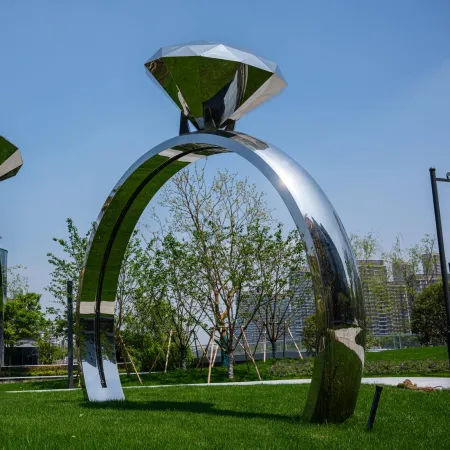
The studio's job is to recommend the material that fits the meaning and the environment rather than the one that is easiest to buy. A mirror-polished stainless finish can turn a sculpture into a living mirror of its plaza, while a painted mild steel may serve a playful children's work better; a coastal commission demands alloys and drainage details that an inland site never needs. When the material logic is right, the work looks inevitable; when it is wrong, the client inherits a decade of avoidable maintenance.
Welding and Fabrication Quality Are the Real Product
In custom metal sculpture, the weld is where art meets engineering and where quality is most often betrayed. A weld that is ground and polished invisibly on stainless steel demands welders who understand heat control, distortion and the metallurgy of the alloy; a structural weld that must carry a cantilever demands procedures, qualifications and inspection that a purely decorative shop never documents. The client should ask who welds the work, to what standard and how the welds are verified.
Surface finish is the visible twin of weld quality. Mirror-polished stainless must be free of ripples and heat tint; satin finishes must be even across compound curves; and painted surfaces depend on preparation that prevents corrosion from creeping under the coating. A custom metal sculpture company that opens its workshop and shows its finishing benches is demonstrating confidence; one that keeps the making behind closed doors is asking the client to buy a promise it will not let them test.
Engineering the Unique: Structure, Wind and Foundations
Because every custom piece is unique, its engineering cannot be borrowed from a previous job. The studio must calculate the actual loads on the actual form, considering self-weight, wind exposure, seismic conditions and the leverage created by cantilevers and tall slender elements. For kinetic works the moving parts add fatigue analysis, bearing selection and safety systems that a static sculpture never needs, and all of this must be verified before fabrication rather than discovered during installation.
The foundation is the half of the sculpture that nobody photographs and everybody depends on. The studio should provide the client with foundation drawings, anchor details and load data that the local engineer can incorporate into the site works, so the base is cast correctly the first time. When a custom metal sculpture company delivers this engineering package as standard, the client avoids the most expensive mistake in public art: a beautiful object bolted to an inadequate base.
Red Flags to Watch for When You Choose a Custom Studio
- Portfolio-only selling: if a studio sells on renderings but will not name the engineers, the welders or the workshop, its capability is unproven.
- Outsourced fabrication: a studio that subcontracts the build cannot control the welds, the schedule or the quality, and cannot honestly guarantee the work.
- Vague engineering: if the studio cannot explain how a similar structure was verified, it has not verified one.
- No inspection invitation: a studio that resists client visits or third-party inspection is hiding the very process that determines quality.
- No older works to show: if every portfolio piece is recent, there is no evidence the work survives its environment.
Each red flag is easy to test with a single question, and a studio that answers with transparency rather than defensiveness has already passed the first test of a good partner.
International Delivery of Custom Metal Work
Custom commissions frequently cross borders, and our delivery to 23 countries has taught us that distance is managed by documentation. Every international project runs on a named project lead, a fixed update rhythm and written decision records, while the fabrication is documented with photography and video so the client watches the work take shape from anywhere in the world. Export packing, shipping and customs are handled in-house by specialists in monumental freight.
The client on the other side of the world should receive more than a crate: they should receive an installation plan, a maintenance guide and a complete record of the making. When a custom metal sculpture company treats delivery as the beginning of the work's public life rather than the end of the sale, the client gains a partner for the whole life of the sculpture, which is exactly what a one-of-a-kind commission deserves.
The Studio That Earns a Custom Commission
Engineers and sculptors collaborate from the first sketch
Welds and finishes are inspected before the work ships
Materials are chosen for the site, not for convenience
Documentation travels with the work to its new home
Frequently Asked Questions About a Custom Metal Sculpture Company
What is a custom metal sculpture company?
A studio that designs, engineers and fabricates one-of-a-kind metal sculpture to a client's brief, with the full process controlled in its own workshop.
What metals do custom sculptures use?
Stainless steel grades 304 and 316, weathering steel, mild steel and aluminium are the common choices, selected for the site, the concept and the required maintenance.
How do I know the engineering is sound?
Ask for structural calculations, wind and foundation data and the engineer's identity, and confirm the studio provides drawings your local engineer can incorporate.
Can I inspect the work during fabrication?
A confident studio welcomes visits, photographs and third-party inspection at defined stages, because transparent making is the only honest guarantee of quality.
How long does a custom commission take?
Most commissions span several months from consultation to installation, with scale, complexity, approvals and international shipping determining the exact timeline.
A custom metal sculpture company is the partner who turns a one-of-a-kind ambition into a verified, welded, finished reality, and the right studio proves itself in the workshop rather than in the renderings. Choose engineers who calculate, welders who welcome inspection and a team that documents the build, and your custom commission will arrive exactly as the concept promised.
If you carry a brief that no catalogue can answer, send us the site and the story, and we will show you how a custom metal sculpture company would engineer, fabricate and deliver it.