How Abstract Sculpture Fabrication Turns Pure Form Into Standing Steel
Sculpture that carries no subject is the most demanding thing a workshop can be asked to build, because nothing in the visible world tells the maker whether the result is right. Abstract sculpture fabrication is therefore a discipline of proof rather than imitation: the form has to be tested, measured and argued into existence before it is trusted to metal, and every decision rests on the design intent alone. When there is no model to copy, the intent must be exact.
Yifeng Sculpture Studio has fabricated abstract works since 2003 and delivered more than 3000 sculptures to 23 countries, and the abstract commissions still teach us the most. Our artists, engineers and craftsmen share one building, so an abstract idea is modelled and challenged long before a plate is cut. That shared discipline is what abstract sculpture fabrication has to meet, and it is where most workshops quietly fail.
Why Abstract Sculpture Fabrication Is Harder Than It Looks
In figurative work the maker has a silent referee: an arm that is too long looks wrong, a torso that is too narrow reads as ill, and the eye corrects the hand without being asked. Abstract sculpture removes that referee entirely. A curve can be elegant at one angle and inert at another, a mass can feel weightless in a maquette and leaden at full scale, and a surface that seemed calm in a rendering can turn restless once it meets real light. Every one of those judgements must be made deliberately, because nothing external will make them for you.
The second difficulty is that abstract forms hide their own engineering. A figurative sculpture has a natural place for its armature, inside the body of the figure, but an abstract work may have no interior at all, or an interior that must remain visible, or a form whose thinnest section carries its greatest load. The fabricator must find the structure inside the art rather than beside it, and must do so without leaving a single visible clue that a problem was ever solved. That invisible problem-solving is the quiet craft of abstract sculpture fabrication.
From Maquette to Full Scale: How the Form Is Proven
The table below sets out how we move an abstract concept from a small model to a standing work, and why each stage exists. Skipping a stage is the fastest way to lose a form.
| Stage | What happens | What it protects |
|---|---|---|
| Maquette and study models | Physical models at desk scale, viewed in daylight and artificial light | The composition and the silhouette from every angle |
| Digital modelling and simulation | Full 3D geometry, section analysis and wind load simulation | The buildability and the structural safety |
| Full-scale mock-up | A critical detail built at real size in the real material | The surface, the joint and the finish |
| Production and inspection | Forming, welding, finishing and dimensional checks at set gates | The fidelity of the built work to the approved design |
Each stage exists to remove a specific risk. The maquette settles the composition, the digital model settles the geometry, the structural analysis settles the safety and the full-scale mock-up settles the surface. By the time production begins, every question that could deform the art has already been answered in a form the client has seen and approved.
Materials That Serve Pure Form
Abstract work is unforgiving about material, because a surface that would disappear into a figurative texture becomes the whole experience of an abstract piece. Polished stainless steel flatters a sweeping curve, because the reflection stretches the line and hides nothing; mild steel with a matte coating rewards a more angular language, because the shadows give the planes their weight; cast bronze gives a dense, warm mass that reads as permanent; and painted composite allows a colour field that would be impossible in metal. The material is not a finish applied to a form, it is part of the form's meaning.
We choose materials the way we choose proportions, by asking what the work must say. A piece about lightness wants a metal that can be thin and a finish that can be flawless; a piece about weight wants mass and a surface that absorbs light. Clients sometimes arrive with a material already in mind, and part of our job is to test that choice against the concept rather than accept it politely. The right material makes an abstract form feel inevitable; the wrong one makes it feel unresolved, however skilled the making.
Holding Proportion When There Is No Reference
Without a subject to measure against, proportion becomes the fabricator's most valuable tool. We work from a small number of controlling dimensions, the overall height, the width of the principal mass and the depth of the deepest relief, and we check every stage of production against them. A single percentage of drift in the width of a mass can change an abstract work from calm to clumsy, and the only defence is to measure relentlessly rather than trust the eye once the piece grows beyond arm's reach.
Viewing distance is the other half of proportion. A form designed to be read from across a plaza can afford a broad, simple gesture that would feel crude in a garden where the viewer stands close. We ask clients where people will actually stand, and we test the maquette from those distances rather than from a designer's desk. When a work must perform at both scales, we add a secondary layer of detail that rewards the close view without disturbing the large gesture, and that layering is one of the marks of a workshop that understands abstract sculpture fabrication as a spatial craft rather than a metal trade.
What Pure Form Demands of the Workshop
The courage to test a form before committing metal
Engineering that hides inside the art, never beside it
Proportion controlled by measurement, not by mood
A finish treated as part of the meaning, not a last coat
The Finish That Decides the Work
In abstract sculpture the surface is the work. A viewer has no narrative to follow, so the eye rests entirely on how the light behaves across the form, and a finish that is uneven, or that loses its character in a few seasons, destroys the piece as surely as a bent arm would destroy a figure. We treat the finish as a specification rather than a preference, naming the alloy, the abrasive sequence and the coating system, and we produce sample panels so the client approves the surface in the light of the actual site.
Durability is designed into the finish from the start. A mirror polish on a coastal site needs a grade of stainless steel that can resist the salt, and the maintenance regime must match; a matte coating must be specified as a system rather than a single product; and every edge must be prepared so that the coating can grip it for decades. When we hand over a work we also hand over the finish specification and the care instructions, because an abstract sculpture that is cleaned wrongly is an abstract sculpture that will slowly disappear.
- Sample first: the client approves the surface on a real panel, in the real light, before production begins.
- Name the system: alloy, abrasive sequence and coating are written down, never left to workshop habit.
- Design for care: the finish is chosen with the maintenance the owner can realistically provide.
- Hand over the record: the specification and the care notes travel with the finished work.
How We Prove an Abstract Form Before It Is Built
Proof in abstract work is a sequence of small certainties. We begin with study models that can be held in two hands and turned under a window, because the eye catches a fault in a maquette far faster than it catches one in a drawing. We then translate the approved model into full three-dimensional geometry, section it to see how the mass behaves, and run the wind and load analysis that a public work must survive. Nothing about this stage is glamorous, and it is the reason our abstract works arrive as the forms they promised.
The final proof is a full-scale sample of the hardest part. A tight radius, a long seam or a deep reflection will all behave differently at real size, so we build that one detail in the real material and in the real finish before production opens. Clients are sometimes surprised that we spend a week on a single joint; they are never surprised by the result, because the surprise has already been paid for in the sample rather than in the finished sculpture.
Working With a Fabricator on an Abstract Commission
Clients who commission abstract work should look for a fabricator who asks about meaning before asking about material. The first questions we put to a client are about the site, the light, the people who will pass the work each day and the feeling the piece is meant to leave behind, because those answers decide the form far more than any catalogue of finishes. A workshop that begins with the metal is a workshop that will deliver a well-made object and not a work of art.
It also helps to agree how change will be handled. Abstract work invites late refinement, because a form that looks resolved on paper often asks for one more adjustment once it stands at full size, and the contract should say how those refinements are priced and approved rather than treating them as failures. We document every approved change and price it before we execute it, so the client keeps control of the budget while the art keeps its freedom to improve. That balance is what makes abstract sculpture fabrication a partnership rather than a purchase.
Frequently Asked Questions About Abstract Sculpture Fabrication
What makes abstract sculpture fabrication different from figurative work?
There is no subject to correct the maker, so every proportion, section and surface must be proven deliberately rather than checked against a familiar form.
How do you keep an abstract form faithful at full scale?
By fixing a few controlling dimensions, checking production against them at every gate and building a full-scale mock-up of the most demanding detail.
Which materials suit abstract sculpture best?
Polished stainless steel, matte coated steel, cast bronze and painted composite each carry a different quality of light and mass, and the choice should follow the idea.
Can an abstract sculpture be structurally safe outdoors?
Yes, provided the structure is engineered inside the form and the design is checked against wind and load conditions for the specific site.
How long does an abstract commission usually take?
It depends on scale and approvals, but the sequence is always the same, design and proof, then production, then finishing, transport and installation.
Pure form is the most honest test of a workshop, because there is nowhere for a compromise to hide. A curve that is slightly wrong cannot be excused by a likeness, and a surface that is slightly dull cannot be explained away by detail. When you commission an abstract work you are commissioning the maker's discipline as much as the artist's idea.
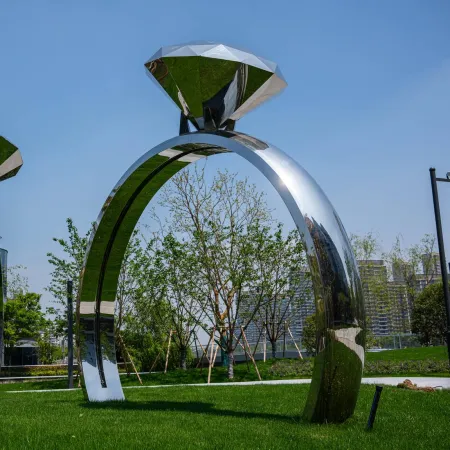
If you want a form that stands on its own with nothing to lean on, bring us the idea and the site, and we will show you what careful abstract sculpture fabrication can make of it. See how our forms have performed in the world in our project gallery, review the full chain of work on the services overview, and study The Diamond Rings, a pure geometric form whose every proportion had to be measured rather than borrowed.
Every abstract commission still begins the same way, with a form that has no model in the world and a workshop that must prove it before it is built. That is what abstract sculpture fabrication asks of us.