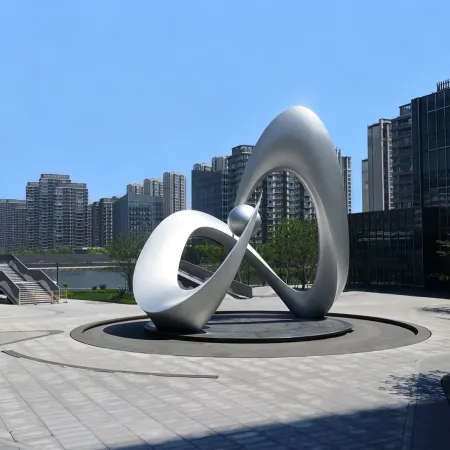
What a China Urban Sculpture Manufacturer Handles Before Steel Is Cut
A China urban sculpture manufacturer is judged by what happens long before the first plate is cut. The material certificates, the welding procedure, the trial assembly, the surface samples and the packing plan decide whether a work arrives in a city square exactly as designed or arrives as a problem to be solved on site by whoever happens to be standing there. Overseas clients rarely see this stage, and that is precisely why it separates a real factory from an ordinary workshop.
Yifeng Sculpture Studio has fabricated urban works since 2003, with more than 3000 completed pieces delivered to 23 countries. The lessons that matter most were learned in dense city environments, where a sculpture has to be divided into sections that fit through a gate, lifted by a crane the contractor actually owns and reassembled to tolerances that were set in a drawing office on the other side of the world. A factory that has never solved those problems is not yet a manufacturer for cities.
What a China Urban Sculpture Manufacturer Must Prove First
The first proof is material traceability. Urban work lives with pollution, salt, temperature swing and constant contact, so the grade written on the drawing must be the grade that arrives on the workshop floor. A serious factory keeps mill certificates for every batch of stainless steel, aluminium or bronze and can match each certificate to the section cut from it. When a client asks a year later why a particular joint has behaved differently from expectation, the answer should come out of a file rather than out of memory.
The second proof is process discipline. Welders should be qualified for the positions and materials they work in, weld procedures should be written down and followed, and dimensional checks should happen at defined stages rather than only at the end. None of this is glamorous, and all of it is what keeps a twenty metre landmark square when it is finally bolted to its base after a journey of several thousand kilometres.
| Stage | What the client should receive | Why it matters |
|---|---|---|
| Design freeze | Approved drawings and a build plan | Stops the workshop from improvising on site |
| Material intake | Mill certificates matched to sections | Confirms grade and corrosion performance |
| Welding | Weld procedure and welder qualifications | Protects structural integrity and appearance |
| Trial assembly | Photographs and a dimensional report | Catches fit problems before shipping, not after |
| Surface finishing | Samples viewed in the light of the site | Controls colour, gloss and reflection |
| Packing | Packing plan and loading photographs | Protects edges, welds and coatings in transit |
Materials, Welding and the Records Behind Them
In urban sculpture the material conversation usually turns on stainless steel grades. 304 is the common choice for inland cities, while 316 and its marine variants are specified where chlorides are present, on the coast or where de-icing salt is spread heavily in winter. The decision should be recorded together with its reason, because the city will one day ask why a particular grade was chosen and the answer needs to be defensible rather than convenient.
Welding follows the same logic. A visible weld on a mirror polished surface is a design decision rather than an accident, so the sequence has to be planned: which joints are welded first, how distortion is held in check, how heat tint is removed and how the original surface is restored without leaving a ghost of the repair. Technique and records matter equally here, because a client who cannot see the weld still deserves to know how it was made.
- Grade selection: 304 for inland conditions, 316 or marine grades where salt and chlorides are part of daily life.
- Weld planning: joint sequence, consumables and procedure agreed before the first arc is struck.
- Distortion control: fixtures, tacking order and staged welding to hold the geometry that was approved.
- Heat tint removal: pickling, passivation or mechanical restoration so corrosion resistance is not lost.
- Record keeping: certificates, procedure sheets and inspection sign-offs filed for the life of the work.
What a Documented Factory Gives You
Material grades you can verify rather than assume
Welds that behave the way the drawing promised
Sections that fit on site because they fitted in the yard
Answers available years later, from the file, not from memory
Engineering for Transport, Lifting and Site Reality
The most common cause of an expensive site delay is a sculpture that was designed as a single beautiful object and then discovered to be unshippable. Sectioning is an engineering art: the work must be divided at points that are strong enough to travel, small enough to pass through the available opening and few enough that the on-site assembly remains achievable within the crane time that the client has actually booked.
Lifting follows from that. Lifting points, spreader beams, temporary bracing and the sequence of assembly should all be decided in the factory, where a mistake costs a morning, rather than on site, where the same mistake costs a crane, a crew and a day of the client's programme. A manufacturer who asks for the access drawings and the crane capacity before finishing the design is a manufacturer who has done this before.
- Section for the route: divide the work at points that survive transport and fit the actual openings.
- Design lifting points: agree pick points, spreader beams and bracing before fabrication starts.
- Trial assemble: build the work in the yard so the site assembly is a repeat rather than a rehearsal.
- Match the crane: confirm capacity, radius and working hours against the assembly weight of each section.
- Plan the sequence: document the order of placement, bolting and finishing so the site team is never guessing.
Communication, Inspection and Handover Across Time Zones
Distance is manageable when the communication system is designed instead of improvised. The best arrangements fix a weekly call at a time that suits both sides, require a written update before every call, name one contact who answers within a working day and keep a decision log so that nothing agreed verbally is later disputed. The factory should also publish its holiday calendar and production windows early, so the client can plan approvals around the moments when the workshop will be quiet.
Inspection should be a right rather than a favour. The client or an appointed third party should be able to visit the factory, walk the workshop, review the files and witness the critical stages, and the factory should welcome that without friction. Where a visit is impractical, progressive photo and video documentation at the agreed milestones gives most of the same protection, provided the milestones are real and the images are dated.
Handover completes the chain. A well-run project ends with drawings as built, material and finish records, a maintenance plan, touch-up materials for the specified finish and a named route back to the makers for future repair. Cities keep what they can look after, and a client who receives that package is handing the maintenance team a work they can genuinely care for.
Costing, Currency and Contract Terms With a Factory Abroad
The commercial side of an overseas commission deserves the same attention as the technical side. A quotation should separate design, engineering, materials, fabrication, finishing, packing, freight and installation support, so the client can see where the money sits and challenge any line with full information. Currency, validity period and the conditions under which a price may be adjusted should all be written down, because material markets move and a factory that will not discuss that openly is storing a surprise for later.
Payment structure should protect both sides. Milestones tied to verified progress, such as material ordered, sections fabricated, trial assembly complete, inspection passed and work shipped, keep the client's money behind real work while giving the factory the cash flow it needs to buy material well. A final balance retained until acceptance and documents handed over gives the factory a reason to finish properly, and it gives the client a remedy that does not depend on goodwill.
Frequently Asked Questions About a China Urban Sculpture Manufacturer
How do we verify a factory before placing an order?
Ask for the workshop walk-through, the quality procedures, references from comparable urban projects and permission to send your own inspector. A factory that resists any of those requests is telling you something useful.
Which stainless grade should a city project specify?
304 suits most inland settings, while coastal sites, heavy de-icing salt and industrial atmospheres justify 316 or a marine grade. The choice should be recorded with its reason so it can be defended later.
Can the work be trial assembled before shipping?
It should be for any complex urban piece. A yard trial assembly proves the sections fit, the joints align and the lifting sequence works, all of which is far cheaper to correct at the factory than in a city centre.
How is quality controlled from overseas?
Through dated milestone documentation, third-party inspection where required and an open invitation to visit. Photographs at agreed stages, plus records of materials and welds, give a client most of the protection of being present.
What should the final handover package contain?
As-built drawings, material and finish records, a written maintenance plan, spare touch-up materials for the specified finish and a clear route back to the makers for any future repair or extension.
How our studio structures a commission is set out in the services overview, and a city scale work with a strong local identity is Cloth Dragon. Further urban projects appear in the project gallery.
Send us the site plan, the access constraints and the story the place is meant to tell, and we will return a buildable proposal with a section plan and a delivery sequence attached. Handled by a China urban sculpture manufacturer that documents every stage, a commission arrives as a controlled delivery rather than an open question.