How Contemporary Sculpture for Plazas Turns Empty Paving Into Public Life
Contemporary sculpture for plazas is the difference between a paved open space and a public living room — the element that gives a square a center, a reason to stop and an identity people name in conversation. Plazas are among the hardest spaces in a city to make work: they are vast, exposed and crossed by people who rarely have a reason to linger. Sculpture answers that problem better than any other instrument because it can gather a crowd without programming, give a vast space a human scale and turn a passage into a destination. Yifeng Sculpture Studio has designed contemporary sculpture for plazas since 2003, delivering works across more than twenty countries, and this guide explains what makes a plaza work succeed where so many fail.
We look at the plaza's particular challenges, the design responses that activate a square, and how a plaza commission is developed and delivered.
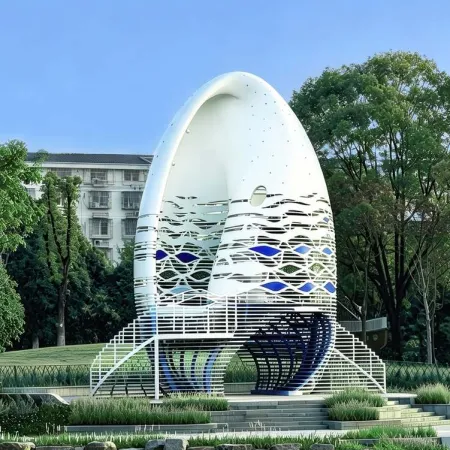
Our project archive includes works that anchor civic squares, the services overview explains our full process, and the Honeycomb Pavilion shows a plaza-scale work that gives people both a landmark and a place to stand inside.
Why Plazas Are So Hard to Make Work
Every plaza designer confronts the same paradox: the larger and more open the space, the less people use it. A vast paved square reads as a void to cross, not a place to stay — it offers no shelter, no focus, no reason to stop, and its scale diminishes the people in it. The plaza's emptiness is compounded by its exposure: sun, wind and weather sweep across it without relief. Planners fill such spaces with benches and planting and still find them empty, because furniture without a center does not gather life. What a plaza needs is a reason — something worth walking to, standing near and photographing with, a presence large enough to hold its own against the space but human enough to invite approach. That is precisely the role contemporary sculpture for plazas is designed to play, and it is why the world's most successful squares are almost always anchored by a strong work.
What a Plaza Work Must Do
A successful plaza sculpture performs several jobs at once, and the design brief should name them all. It must give the space a center of gravity — a visual anchor that organizes the plaza and gives the eye somewhere to land. It must hold its own at plaza scale: large enough to be present across the whole square, composed to read from every edge and approach. It must gather people, offering something that rewards stopping — a form to lean against, walk through, sit near or photograph with. It must give the plaza an identity, becoming the image that represents the square and the district in photographs and conversation. And it must survive the plaza's public life: crowds, festivals, cleaning machines and weather without shelter. A work designed to do all of this transforms the space around it; one designed only to look sculptural leaves the plaza as empty as before.
The Jobs a Plaza Work Performs
- Center of gravity: a visual anchor that organizes the whole square
- Human scale: a presence that makes the vast space feel approachable
- Gathering point: something worth walking to, standing near and meeting at
- District identity: the image that names the square in photographs
- Event host: a backdrop that survives festivals, markets and crowds
Scale, Placement and the Geometry of the Square
Scale and placement decide a plaza work's fate before its form is even judged. Scale must be resolved against the plaza's true dimensions: a work too small disappears into the paving, while one that ignores the surrounding facades can overwhelm the space it was meant to serve. The reliable method is empirical — scale studies placed in site photography, then a full-size mock-up of a critical element on the ground, because plaza scale deceives the eye in renderings more than any other setting. Placement follows the plaza's own geometry and life: where the sightlines from the surrounding streets land, where the sun gathers the afternoon crowd, where the events set up and where the daily crossing routes pass. The work is often composed off-center, leaving the square's open space intact for markets and gatherings, and its orientation is set against the arrival routes so it reads from the moment a visitor enters the plaza. These decisions, made together, are what make a work feel inevitable in its square.
| Plaza Condition | Design Response | Result for Users |
|---|---|---|
| Open void | A composed center of gravity | The eye and the path have a destination |
| Exposed weather | Shelter-scale forms where climate demands | People stay longer in comfort |
| Event demands | Off-center siting that keeps space open | Markets and gatherings still fit |
| Night emptiness | Integrated lighting for a night presence | The square stays alive after dark |
Designing for Public Life and Public Safety
A plaza work is lived with harder than almost any other sculpture — leaned on by commuters, climbed by children, surrounded by festival crowds and washed by municipal machines — and it is engineered for that life from the first sketch. Climbing is designed for rather than assumed away: geometry either makes the work unclimbable or makes it safe to climb, with structure sized for the load of many children and edges detailed so no pinch, cut or trip point exists. Anchorage is calculated for crowd loading and event rigging, so a festival can tie banners to the work without risk. Materials and finishes are chosen for the plaza's exposure and for resistance to the cleaning and contact the space guarantees. And the work is detailed so that maintenance is practical for a municipal crew — accessible, documented and specified with the care manual that keeps it looking intentional for decades. Safety in a public square is not a compliance exercise; it is part of the design language.
What Our Studio Delivers for Plazas
Placement and scale studies resolved against your square's real geometry
Concepts designed for gathering, identity and event life
Public-safe engineering, lighting and maintenance detailing
Fabrication, installation and documentation under one roof
From Bare Square to Living Room: A Plaza Case Pattern
The transformation that contemporary sculpture for plazas achieves follows a recognizable pattern. Before the work, the square is a crossing: people pass through it on their way elsewhere, and its benches host only the briefest pauses. The sculpture arrives as a center — something visible from every entry, composed at a scale that holds the space — and the first change is behavioral: people begin to meet at the work, photograph with it and use its presence to navigate the square. As the work becomes familiar, it becomes a host: markets set up around it, events use it as the stage backdrop, and local life reorganizes around the anchor it provides. Within months the square has an identity it lacked for years, appearing in the district's photographs and conversation under the work's name. This pattern repeats across the plazas we have served, and it is why the clients who commission plaza sculpture describe it as infrastructure for public life rather than decoration.
Frequently Asked Questions About Contemporary Sculpture for Plazas
How large should a plaza sculpture be?
Large enough to hold its own across the square and read from every approach, but composed against the surrounding facades rather than competing with them. The reliable method is empirical: scale studies in site photography followed by a full-size mock-up of a critical element.
Will the sculpture interfere with markets and events?
Not if it is sited well — typically off-center, leaving the square's open space intact for markets, stages and gatherings. The event calendar is part of the design brief, and the work is often engineered to host event rigging safely.
Can people climb on a plaza sculpture?
Public works are engineered for the contact they will receive. Where geometry invites climbing, the structure and detailing are designed for it safely; where the concept requires a hands-off form, the design discourages climbing through geometry and base rather than through fragile materials.
How do we choose the right location in the plaza?
Through a placement study that maps the square's sightlines, crossing routes, sun and event patterns. The work is placed where it will organize the space and gather existing life, not where it merely fills an empty corner.
What maintenance does a plaza work need?
A defined regime of washing, inspection and periodic refinishing, documented in a care manual written for a municipal crew. Materials are chosen at design stage for low-care longevity in the plaza's real exposure.
Contemporary sculpture for plazas is the instrument that turns empty paving into public life — giving a square a center, an identity and a reason to stay, and serving the district as infrastructure for gathering for decades. Our studio has delivered that transformation since 2003, with contemporary sculpture for plazas standing across more than twenty countries and adopted by the communities that gather around it. If your square is waiting for its center, bring us the plaza and its people — the contemporary sculpture for plazas we design together will be scaled to hold the space, sited to gather life and built to host the district's public moments for generations.
Share the plaza drawings and the events that shape its year, and we will return a placement study and a family of contemporary sculpture for plazas concepts composed for your square.