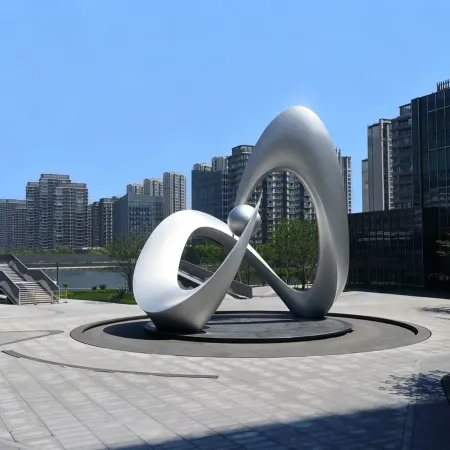
How a Giant Sculpture Manufacturer Plans a Work Bigger Than the Workshop
A giant sculpture manufacturer is solving a problem of scale that touches everything: the building, the road, the crane, the foundation and the tolerance. When a work is larger than the workshop door, it can never be seen complete until it is assembled on site, so every dimension has to be right by calculation rather than by observation. That single fact reshapes the whole manufacturing method.
Yifeng Sculpture Studio has delivered large and monumental work since 2003, with more than 3000 completed projects across 23 countries and pieces standing in plazas, parks, gateways and public squares. A giant sculpture manufacturer is judged not by the size of its ambition but by its ability to break a very large idea into parts that can be made, moved, lifted and joined without losing the line of the original form.
Sectioning: The First Real Design Decision
Every large work must be divided into parts, and where those divisions fall is a design decision rather than a logistical afterthought. Sections should be sized to the widest transport that can legally reach the site and the heaviest load the crane can lift at the required radius, but they must also fall where the joins will be least visible and where the structure is strongest. A seam across a smooth curved face will always be visible; a seam on a change of plane can disappear.
Sectioning also drives the internal structure. Each part needs its own rigidity so it does not distort in transit, and each joint needs a connection that can be aligned on site and locked without introducing a kink into the surface. A giant sculpture manufacturer that plans the sections and the connections together, rather than treating them as separate problems, delivers a work that goes together as designed rather than as tolerated.
| Constraint | What it forces | How we plan for it |
|---|---|---|
| Workshop height and door size | Nothing can be assembled complete indoors | Trial assembly of critical sections before finishing |
| Transport limits | Maximum section size and weight on the road | Sections sized to the route, with permits arranged early |
| Crane capacity and radius | The heaviest lift the site can actually make | Lift plan drawn from real crane charts, not estimates |
| Site access and time | Closures, hours and pedestrian safety | Sequence rehearsed, protection planned for finished faces |
Engineering at Monumental Scale
At six or twenty metres, the loads stop being trivial. Wind becomes a dominant force that varies with height and exposure, self-weight creates bending moments that must be resolved into the base, and thermal movement over a long span can be measured in centimetres. The structural engineer must be involved from the first concept, because a form that cannot be braced economically at full size should be adjusted before the client falls in love with it.
Foundations follow the same logic. The base is designed for the loads the sculpture imposes and for the ground conditions on site, which may be far less accommodating than the drawings suggest. A giant sculpture manufacturer should insist on proper ground information before finalising the foundation, and should treat any late change to the sculpture's weight or geometry as a trigger to revisit the base rather than an adjustment to absorb quietly.
- Wind study: loading calculated for the height, the exposure and the shape, because a large open form catches far more wind than its silhouette suggests.
- Load path clarity: every force traced from the surface to the foundation so nothing depends on a connection that was never designed.
- Thermal allowance: joints and fixings that let a long span move with the seasons without cracking or distorting.
- Ground information: real soil data before the base is finalised, because retrofitting a foundation under a giant work is brutally expensive.
- Lifting design: certified lifting points built into the structure so the crane never relies on a sling around a finished surface.
Trial Assembly and Tolerance Control
Where a work cannot be assembled complete in the workshop, the manufacturer must create certainty another way. The usual answer is trial assembly: the critical sections are brought together on the shop floor or in the yard, checked for fit and alignment and then separated for finishing. Even a partial trial of the joints and the main frame removes most of the risk that a large work will not close up on site.
Tolerances have to be managed across the whole assembly rather than part by part. Small deviations that are invisible in a single component accumulate across a large structure, so the setting-out is taken from a single datum and the checks are cumulative. A giant sculpture manufacturer that measures against the master reference at each stage, rather than against the previous part, keeps a twenty-metre work as true as a two-metre one.
What Scale Really Demands
Sections planned around transport and crane reality
Trial assembly so the site is not the first test
Tolerances measured from one master datum
Engineering that started with the first sketch
Transport, Site Work and the Long Day
Moving a giant work is a project in itself. Oversize loads need permits, escort vehicles and routes surveyed for bridge heights, road widths and turning radii, and the schedule has to allow for the possibility that a route is refused. Sections must be braced for transport so they arrive without distortion, and finished surfaces must be protected against rubbing, road spray and handling. A manufacturer who has done this before builds the transport plan into the programme rather than discovering it afterwards.
On site the work is a controlled operation. The crane is positioned from the lift plan, the sequence is followed step by step, the alignment is checked before each connection is locked and the surface protection stays in place until the last possible moment. Because everything is larger, everything is slower, and the day is planned with margin. The reward for that discipline is a work that stands correctly from the first attempt rather than one that is argued into place.
- Survey the route: check bridges, widths and turning radii, and secure permits before the sections are finished and packed.
- Brace for transit: temporary bracing sized so that vibration and handling cannot distort a large section on the road.
- Confirm the base: verify the foundation, the anchor group and the setting-out against the drawing before the crane arrives.
- Follow the lift plan: crane position, rigging and sequence as designed, with alignment checked before each connection is locked.
- Protect to the end: keep masking and padding on finished faces until commissioning, so the work is unveiled as it left the workshop.
Cost Drivers at Monumental Scale
At monumental scale the cost of material is rarely the largest item. The drivers are engineering, the crane, the transport, the site works and the time that all of them consume. A design that needs an unusually large crane, a road closure of several days or a foundation that requires deep excavation can cost more than the sculpture itself, and those consequences follow directly from decisions made in the concept stage.
Controlling cost therefore means controlling the design before it is fixed. Reducing the number of sections reduces crane lifts and site time; designing for a crane that is locally available avoids importing one; keeping the weight within a standard transport category avoids permits and escorts. A giant sculpture manufacturer should present those trade-offs openly, because the client is often choosing between a slightly different form and a substantially different budget.
Frequently Asked Questions About a Giant Sculpture Manufacturer
How do you build something taller than your workshop?
By sectioning the work to transportable and liftable parts, trial-assembling the critical joints in the workshop and completing the assembly on site to a single master datum.
How is wind loading handled on a very large work?
Through structural analysis for the height, exposure and shape, with the load path traced to the foundation and connections designed for the forces they will actually carry.
Can a giant sculpture be shipped internationally?
Yes. Sections are sized to container or flat-rack dimensions, braced for the voyage and documented for customs, and we have delivered to 23 countries on that basis.
How long does on-site assembly take?
It depends on the number of sections and the crane availability, and we set out the sequence and the working days in the programme before fabrication begins.
What happens if a section is damaged in transit?
We plan for it. Sections are braced and protected, the finish is supplied with a matching touch-up system and, where necessary, a replacement can be made from the kept tooling.
A giant sculpture manufacturer is really a planner of scale. The artwork sets the ambition and everything else follows: how the form is divided, how the structure is resolved, how the pieces travel, how the crane lifts them and how the assembly is measured. Get that planning right and a twenty-metre work goes together with the calm of a small one; get it wrong and size becomes a permanent excuse.
Our largest work is documented in the project gallery, and the full chain from concept to installation is described in the services overview. For a sense of what a twenty-metre gateway demands, look at Peach Blossom.
Send us the form and the site, and we will tell you how it divides, travels and stands. A giant sculpture manufacturer who shows you the sectioning plan, the lift plan and the trial assembly is one who has done this before.