What Public Urban Sculpture Owes the People Who Live With It
Public urban sculpture is the only art most people meet without choosing to. It stands where they catch a bus, walk a dog, wait for a friend or look out of a window at the end of a working day. That involuntary audience places a real obligation on the work: it must be safe, readable, durable and generous enough to serve people who never asked for it, and it must still be worth looking at after the novelty of its opening has faded.
Yifeng Sculpture Studio has made public work since 2003, with more than 3000 pieces delivered across 23 countries. The commissions that taught us most were the ones in ordinary places rather than prestigious ones, because a work in a residential street or a small town square is judged by people who see it every day. That daily judgment is stricter than any jury, and it is the standard a public commission should be designed for.
The Obligations That Come With Public Urban Sculpture
The first obligation is safety for people who are not paying attention. A public work sits where people are distracted, so there should be no sharp edges at hand height, no hidden level changes at the base, no gaps that can trap a foot or a bicycle wheel and no element that invites climbing unless it was designed and engineered for it. Clearances for wheelchairs, prams and maintenance vehicles should be checked against the site rather than assumed.
The second obligation is legibility without a caption. Most people will never read the plaque, so the work must communicate through form, scale and material alone. That does not mean it must be simple, but it does mean the first reading should be available to anyone, with deeper meanings reserved for those who stop and look longer.
| Public obligation | Why it matters | How it is met |
|---|---|---|
| Safety by default | Users are distracted and include children | Radiused edges, stable base, considered clearances |
| Legibility | Most viewers will never read an explanation | Strong form that reads at a glance from the approach |
| Durability | Public money must not produce a short lived object | Grades, finishes and fixings chosen for the local climate |
| Maintainability | Care must fit an ordinary municipal budget | Surfaces a standard crew can clean and inspect |
| Shared ownership | The work belongs to everyone who passes it | Local stories carried into the design and the consultation |
Why Consultation Shapes Better Public Urban Sculpture
Consultation is often treated as a box to tick, and it is more useful than that. A designer from outside cannot know which corner the wind funnels through, where teenagers already gather, which local story carries weight and which subject is still raw. Listening early costs a few meetings and prevents the far more expensive discovery, two years later, that the community has decided the work does not belong to them.
Listening does not mean designing by committee. The useful approach is to gather local material, then interpret it with a clear artistic position rather than averaging everyone's preference into a form nobody loves. A work that carries a genuine local idea will be defended by its community for decades; a work imposed from outside will be tolerated at best and resented at worst.
- Listen for specifics: wind, sightlines, existing gathering points and the practical habits of the place.
- Carry a real idea: a genuine connection to local history or landscape, interpreted rather than copied.
- Avoid design by average: consultation informs a position, it does not replace one.
- Explain the work: clear public information so residents can understand what they are being given.
- Stay reachable: a route for questions after installation, when the real conversation starts.
What the Public Actually Needs
A work that is safe without needing a warning sign
A form that reads before the plaque is read
A surface that still looks cared for in year twenty
A local idea the community can claim as its own
Procuring Public Urban Sculpture Fairly
Most public commissions are procured through an open competition, an invited shortlist or a paid concept round, and the choice of process decides what kind of studio applies. Requiring complete designs from every entrant without payment favours those who can afford to speculate and quietly excludes the strongest practices, while paying a modest fee to three or four shortlisted studios buys real ideas and a comparison that a jury can defend.
The brief is the most powerful document in the process. A clear statement of the site, the users, the ambition, the maintenance reality and the constraints allows studios to propose something that can actually be built, and it prevents the painful moment when a beautiful concept fails its first engineering review. Evaluation should then weigh process, engineering capability and delivery record alongside the image, because the city will live with those qualities long after the competition is forgotten.
- Write a real brief: site, users, ambition, budget range and constraints stated plainly.
- Pay for concepts: a modest fee to a shortlist produces better ideas and a fairer process.
- Judge the process: ask how the work would be engineered, delivered and maintained, not only how it looks.
- Name the decision makers: one representative with authority, and a written record of approvals.
- Plan the maintenance: agree who will care for the work and with what budget before it is installed.
Materials and Surfaces in a Public Setting
Public work is touched, leaned on, climbed over and occasionally damaged, so the material specification has to assume contact rather than protect against it. Stainless steel in 304 or 316 depending on the atmosphere, bronze for weight and tradition, aluminium where weight matters and composite where complex geometry or budget demands it all have their place, and the choice should follow the exposure of the site and the maintenance budget rather than fashion.
Surfaces decide how the work ages. A mirror polish is spectacular and unforgiving, because every mark and fingerprint shows and the surface reflects whatever surrounds it; a brushed finish is quieter and hides contact better; a sandblast gives mass and softness without reflection; and a coloured or patinated surface introduces identity but demands a repair system that matches. Whichever is chosen, the owner should receive touch-up materials and a simple care routine.
Graffiti, litter, bird fouling and seasonal staining are practical facts of public life, and the design should make them easy to deal with. Smooth surfaces that can be washed, drainage that does not trap water, bases that do not collect debris and lighting that keeps the work visible at night all reduce the burden on the people who look after it, and a work that is easy to clean stays presentable long after a more delicate piece has been allowed to decline.
Accessibility and Who Gets to Use the Work
A public work has to serve people whose needs differ widely, and accessibility is part of the art rather than an addition to it. Wheelchair users, parents with prams, older visitors and small children all approach the same object in different ways, so the clearances, the level changes at the base, the surface underfoot and any seating nearby should be considered together. A work that can only be appreciated by an adult standing upright has excluded a large part of the public it was made for.
The work should also be legible to people who do not read the language of the plaque or who cannot see it well. Strong tonal contrast, tactile interest in the surface, a form that reads by touch as well as by sight and, where the brief allows, audio or tactile interpretation all widen the audience. The test is simple: a person who arrives with no explanation should still understand that the work is there, why it is placed there and how to move around it comfortably.
Frequently Asked Questions About Public Urban Sculpture
Who owns a public sculpture once it is installed?
Usually the commissioning authority or the landowner, with the artist retaining moral rights in many jurisdictions. The contract should state ownership, maintenance responsibility and the rules for any future relocation.
How do we handle objections from residents?
By consulting early, explaining the idea clearly and giving people a real chance to contribute local knowledge. Objections that surface during design can be answered; objections that surface after installation can only be endured.
Should the work be interactive?
Only if the interaction is robust, safe and genuinely rewarding. Interactive elements add value when they invite a natural gesture, and add cost and maintenance risk when they are included simply because they are fashionable.
What maintenance will it need?
Routine washing and inspection, with occasional refinishing of the surface depending on the finish and the local atmosphere. A written plan and touch-up materials should be part of the handover.
How long should the process take?
It depends on the scale and the approval route, but a public commission is rarely quick. Building in time for consultation, engineering and permitting produces a better work than compressing those stages to meet a ceremony date.
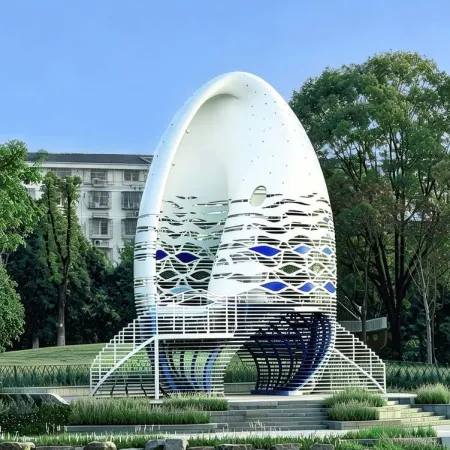
How we run a public commission from first conversation to handover is described in the services overview, and a twelve metre interactive landmark that became a meeting point for its town is Hello Conch. More public works appear in the project gallery.
Send us the site, the people who use it and the story the place already tells, and we will propose something they can claim as theirs. Designed with its public rather than merely for them, public urban sculpture stops being an object in a square and becomes part of how a community describes itself.