How 3D Digital Sculpture Design Changes What Clients Can Approve Before Steel Is Cut
3D digital sculpture design has transformed the way public art is conceived, because it lets a client walk around a proposed work, study it in its real site and change it on screen before a single piece of material is committed. What used to be communicated through drawings and hope is now communicated through digital models that behave like the finished object, and that change has made commissioning safer, faster and far more collaborative.
Yifeng Sculpture Studio has worked with digital design tools since our founding in 2003, and we now run every commission through a full 3D digital sculpture design workflow before fabrication begins. Our studio has delivered more than 3000 works across 23 countries, and the digital stage is where much of that reliability is earned, because problems found in the model never reach the workshop.
What a Modern 3D Digital Sculpture Design Workflow Looks Like
A serious digital workflow begins with a digital scan of the real site, which gives the design team accurate ground levels, existing structures and sightlines to work against. The concept is then modelled in three dimensions, where the sculptor can test proportion, silhouette and surface from every angle, and where the engineer can begin checking wall thickness, bracing and connection points while the form is still alive and changing.
The client participates through interactive reviews rather than static renderings. We present the model in the real site context, we orbit, we zoom into the details, and we adjust the form live while the client watches, so the person paying for the work experiences the design as a physical object long before it exists. That experience is the core promise of 3D digital sculpture design: approval based on understanding rather than imagination.
The Stages of a Digital Sculpture Design Process
The table below summarises how a professional 3D digital sculpture design process moves from raw site data to a file the workshop can build from. Each stage produces a deliverable the client can review, so nothing is assumed and nothing is hidden.
| Stage | Digital tool | What the client receives |
|---|---|---|
| Site capture | Laser scan and photogrammetry | An accurate digital model of the real ground |
| Concept modelling | Parametric and freeform modelling | Proposed forms you can orbit and compare |
| Site integration | Context rendering and scale studies | The work placed truthfully in its real setting |
| Engineering | Structural analysis and simulation | Confirmation the form will stand and survive |
| Fabrication data | Unfolding and CNC programming | Cutting files that drive the workshop machines |
Why Digital Design Reduces Risk for the Client
The greatest risk in commissioned sculpture has always been the gap between what the client imagined and what the studio delivers. 3D digital sculpture design closes that gap with evidence: the client approves a model that shows the true scale, the true materials and the true relationship to the site, so the finished work arrives as something already familiar rather than something surprising. Disputes about proportion, placement and finish become rare because they are resolved on screen, where change costs nothing, instead of in the workshop, where it costs dearly.
Digital design also protects the schedule. Geometry that is modelled accurately can be unfolded into cutting patterns, checked for fit in virtual assembly and programmed for CNC cutting, robotic welding and polishing with far fewer surprises than hand-drawn methods allow. When the digital model is complete and approved, the fabrication phase becomes a process of realising known geometry rather than of discovering it, and the client benefits from a delivery date that the workshop can actually keep.
Reviewing a Digital Sculpture Design Like a Pro
- Demand the real site: the model must be shown in the actual location with accurate scale, not floating on a neutral background that flatters the form.
- Change something live: ask the designer to move an element or adjust a curve during the review, because that proves the model is a working design tool rather than a fixed picture.
- Study it from the public eye: review the views a passer-by will actually see, from the approach, from the street and from the seating areas, not only from flattering camera angles.
- Ask about the fabrication link: confirm that the same model will drive the cutting and forming machines, because that is where digital accuracy is converted into physical quality.
- Check material honesty: the render should show the real finish, the real reflections and the real weathering behaviour, not an idealised version the workshop cannot match.
Clients who test these points consistently choose studios whose digital process is genuine, because a model that can be interrogated is worth ten renderings that can only be admired.
From Digital Model to Physical Landmark
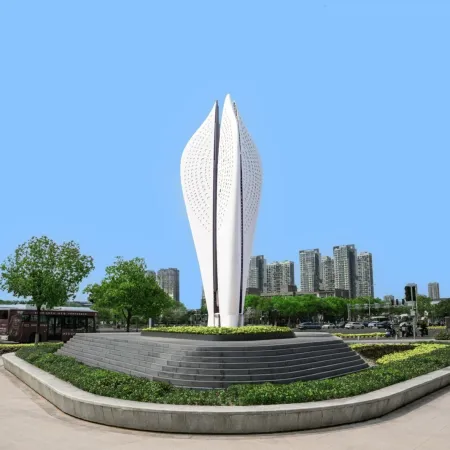
The ultimate test of 3D digital sculpture design is whether the physical result matches the digital promise, and that test is passed in the workshop. We unfold our approved models into fabrication data, cut and form the actual panels from the digital geometry, and verify the assembled work against the model's dimensions before it ever leaves the factory. Explore the works that have travelled this digital path in our project gallery, where forms such as Peach Blossom, a 20.8-metre stainless steel petal gateway, show how modelled geometry becomes engineered landmark.
See the range of services that sit around the digital core on the services overview, and study an interactive example such as Wisdom Tree, whose kinetic and lighting systems were coordinated entirely within the digital model before installation.
What Digital Sculpture Design Delivers
Approval based on a model you can walk around
Site-accurate scale studies before any material is cut
Engineering certainty built into the geometry
Fabrication files that keep the build faithful to the design
When a Client Should Insist on a Digital Workflow
Not every commission needs the full digital treatment, but several situations make 3D digital sculpture design close to essential. Complex double-curved surfaces cannot be communicated in two dimensions at all; large-scale works need accurate site integration to justify their size; kinetic and interactive pieces need the model to coordinate movement, lighting and control systems; and any project where the client must persuade a committee deserves a model that lets reviewers truly understand the proposal before they vote.
The studio should be honest about when digital tools add value and when they add theatre. For a simple geometric form, a clean model and a few site views may be enough; for a complex landmark, the digital stage should be exhaustive. A mature studio matches the depth of the digital process to the difficulty of the design, and tells the client what level of modelling their project actually needs rather than selling the most impressive option available.
The Digital Design Handover and the Client's Own Review Tools
One of the quiet benefits of a full 3D digital sculpture design process is that the client receives tools it can use long after the approval meeting. The same digital model that guided the design can be shared with committees, community groups and funding bodies, letting every stakeholder explore the proposed work from their own screen rather than relying on a single presentation. Architects can overlay the model on their own drawings, planners can check sightlines against the digital context and marketing teams can produce imagery that reflects the true proposal rather than an artist's impression.
That shared model also protects the project through its later life. The approved geometry becomes the reference for fabrication, the installation team works from the same coordinates and the maintenance records can reference the model when the work needs care or repair in future years. A client who insists on receiving the design data, not merely the pretty pictures, is building an asset that serves the sculpture from its first approval to its last maintenance, and that is the real dividend of committing to a genuine 3D digital workflow rather than a rendering service wearing its name.
Frequently Asked Questions About 3D Digital Sculpture Design
What is 3D digital sculpture design?
The practice of designing, testing and approving sculpture within three-dimensional digital models that show true scale, materials and site context before fabrication begins.
Can I see my sculpture in its actual location before it is built?
Yes, the digital model is placed in an accurate scan of the real site, so you can judge scale, sightlines and material behaviour in context before approving.
How much does digital design change cost compared with later changes?
Changes in the model are far cheaper than changes in fabrication, because digital revisions consume design time only, while workshop changes consume material and labour.
Does the digital model guarantee the physical result?
It guarantees the geometry when the same model drives fabrication, but material quality and finish still depend on the workshop's skill and its quality systems.
Is digital design only for complex or large sculptures?
It adds the most value on complex, large or kinetic works, but even simple commissions benefit from a model that lets the client approve with confidence.
3D digital sculpture design has made commissioning transparent: the client now sees exactly what will be built, in the place where it will stand, before any commitment is made. Choose a studio whose digital process is a working design tool rather than a presentation technique, and the sculpture you approve on screen will be the sculpture your community receives.
If your project deserves the certainty of a true digital workflow, send us your site and your idea, and we will show you what 3D digital sculpture design can reveal before the first panel is cut.