What an Art Installation for Public Park Settings Must Get Right
An art installation for public park environments carries a promise that no other site asks of sculpture: it must belong to everyone. Museums filter their audiences at the door, plazas serve the building they front, but a park belongs to joggers at dawn, families at noon, elderly chess players all afternoon and dog walkers after dark. At Yifeng Sculpture Studio, since 2003, we have learned that designing for this unconditional audience is both the hardest and the most rewarding brief a studio can receive.
This guide sets out how a park commission should be approached — the siting logic, the material choices, the safety standards, the community dynamics and the long-term care that separate a cherished park landmark from an ignored object on the lawn.
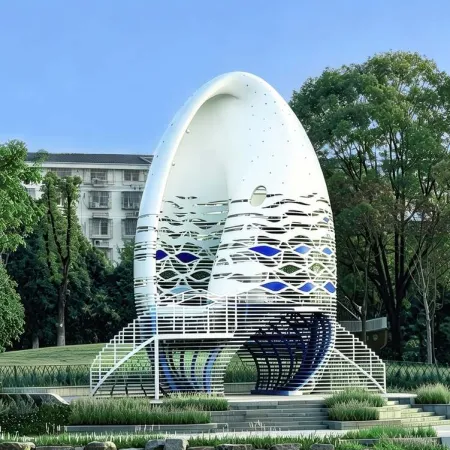
Our project archive records many works made for open green space, the services overview walks through the commission process, and the Homing Nesting installation shows how a sculpture can give a park both an ecological story and a gathering point at once.
Reading the Park Before Drawing the Sculpture
Every park has a rhythm, and an art installation for public park sites succeeds only when it rides that rhythm instead of interrupting it. We begin every park commission with observation days at different hours: where the morning light falls, where the lunchtime crowd settles, which paths carry the most feet and which corners stay quiet. A sculpture placed where life already gathers multiplies that life; a sculpture placed where nobody walks becomes furniture. The observation also reveals the park's character — playful, contemplative, historic, athletic — and the artwork should amplify that character rather than argue with it. Skipping this stage is the single most common reason park art ends up admired by committees and ignored by everyone else.
The Questions We Ask Before Any Park Design
- Who is the park for? — children, elders, commuters or festival crowds each suggest a different sculptural voice
- What already works here? — the beloved corners of a park tell you where value concentrates
- What is missing? — shade, a landmark, a photo point, a reason to walk one path further
- What must be protected? — mature trees, sightlines to heritage buildings, quiet zones and sports turf
Siting the Work: Destination, Threshold or Pause
Park sculptures earn their keep in three classic positions, and choosing between them is the first real design decision. A destination piece stands at a point worth walking to — the far shore of a lake, the top of a rise — and gives the park a reason to be crossed. A threshold piece marks an entrance and becomes the meeting point, the address, the "see you at the sculpture" of local life. A pause piece punctuates a long path, offering a bench, a shadow and a moment of interest halfway through a journey. Most parks benefit from one destination and several pauses rather than three competing landmarks.
| Position Type | Best For | Design Implication |
|---|---|---|
| Destination | Large parks, waterfront edges, hill crests | Bold silhouette, photo-friendly massing |
| Threshold | Main entrances, transit connections | Welcoming scale, clear identity at speed |
| Pause | Long paths, quiet gardens, reading lawns | Human scale, seating integration |
| Play zone | Family areas, children's gardens | Climbable forms, rounded edges, tactile finish |
Materials and Safety for Unsupervised Public Use
A park artwork is touched, climbed on, rained on and occasionally dragged on — every day, without supervision. Material selection therefore leads the design rather than following it. We work primarily in stainless steel and aluminum for their weather resistance, powder-coated finishes for color that survives ultraviolet exposure, and carefully detailed corten steel where the landscape calls for an earthy oxide surface. Every edge is radiused, every climbable form is engineered for the load of a dozen children at once, and every anchoring is designed so that no bolt, gap or catch point can pinch, cut or trip a visitor. Safety in a park is not a compliance exercise; it is a design language of its own, and our workshop speaks it fluently on every project we deliver.
- Risk mapping — every interaction a child could invent is anticipated on paper before fabrication
- Load engineering — climbing, leaning and crowd loading treated as primary design cases, not add-ons
- Surface discipline — no sharp arris, no rust-staining joint, no heat-trapping dark metal at hand height
- Ground safety — impact-attenuating surrounds where climbing is invited, flush covers where services pass
What a Park Gains From Studio-Led Delivery
One accountable team from concept sketches through final torque on the last anchor bolt
Public-safety documentation ready for the parks department and its insurers
A maintenance manual written in plain language for the crews who will keep the work looking new
An installation crew that works around park programming and leaves turf undamaged
The Community Conversation Around Park Art
Parks are democratic spaces, and their art is judged in public opinion every single day. We encourage clients to treat this as an asset rather than a threat: a design process that shares its story — sketches, models, the meaning behind the forms — builds an audience before the crane arrives. Communities defend what they helped to imagine. The works of ours that parks residents defend most fiercely are always the ones whose story they can tell, whether that story is ecological, historical or simply the memory of the day a strange beautiful object arrived on thirty wheels and became theirs.
Maintaining an Art Installation for Public Park Landscapes
Parks departments run on tight budgets, so a responsible art installation for public park sites arrives with a maintenance plan that respects those budgets. We specify finishes by expected repainting interval rather than by catalog promise, design drainage so that no base collects standing water, and detail every joint to be inspectable from ground level. Where irrigation sprays or lake mists reach the sculpture, materials are upgraded accordingly. The goal is a work that, ten years on, still looks like opening day — with nothing more exotic than scheduled washing and a periodic inspection any competent grounds crew can perform.
The maintenance manual we deliver is written for the people who will actually use it: the groundskeepers, not the engineers. It names each cleaning agent safe on each finish, marks every inspection point on a single diagram, and translates the structural vocabulary into plain tasks — check this drain, wipe this joint, report this sound. Parks teams have told us this plainness is the difference between a manual that lives in a drawer and one that lives on the workshop wall. The art installation for public park use is only as durable as its cheapest year of care, and our documentation is designed to make that cheap year easy to fund.
Frequently Asked Questions About Park Sculpture
How much space does a park sculpture need around it?
We plan a viewing buffer of at least the sculpture's height on its principal face, with clear approach paths on at least two sides. Gathering space — lawn or paving where people can stand back and take the whole work in — matters as much as the sculpture itself.
Can the sculpture be climbable on purpose?
Yes, and children will climb regardless, so the honest answer is to design for it deliberately. Where the brief invites climbing, we engineer loads, radius every edge and specify impact-friendly ground surfaces. Where it does not, we use form and planting to guide behavior gently rather than fences and signs.
How long does a park installation take?
Design development typically runs several weeks, fabrication a few months depending on scale and complexity, and installation on site is usually a matter of days. The critical path is usually approvals, so we recommend involving the studio while the permit conversation starts.
What happens in extreme weather?
Wind, snow and thermal loads are engineered into the structure from the first calculation, with the site's recorded climate used as the baseline. Moving or kinetic elements have defined weather limits and are designed to rest safely beyond them.
Can lighting be integrated for evening use?
Yes. We integrate lighting during fabrication — concealed fixtures, cable routes and drivers designed into the structure — so the sculpture extends the park's evening life without visible boxes or trailing cables that parks maintenance would later have to chase.
The observation days that open every park project we run have saved more designs than any drawing session ever has.
A park earns its landmark; it is never simply purchased. The right art installation for public park use grows out of the site's own rhythm, survives its weather and its visitors, and becomes the backdrop of a thousand ordinary days. Our studio has built exactly such works since 2003, and we would be glad to bring that discipline to your ground. Send us the park drawings and the story you want people to meet there — the art installation for public park spaces we design together will do the rest, from the first site walk to the day a child leans on the finished sculpture without a second thought, which is the moment the work truly becomes part of the park.