What Happens Inside an Environmental Art Fabrication Workshop
Environmental art fabrication is where a beautiful design survives or dies, because every decision made in the workshop, the steel grade, the weld quality, the finish sequence, the way panels are joined and braced, decides whether the installed piece looks like the rendering for years or degrades within one season. I have spent more than a decade running public art production, and the gap between studios that fabricate seriously and studios that assemble hopefully is the widest quality gap in this industry. This guide explains what professional environmental art fabrication involves and what you should verify before production begins.
We will look at material selection, structural translation, welding and finishing craft, quality control and the inspection milestones that protect your commission.
Our services page describes our full in-house production model, the project archive shows fabricated works at scale, and the Butterfly Dance installation demonstrates what precision metal fabrication can deliver in a public landscape.
Material Selection Happens in the Workshop, Not the Brochure
Environmental art fabrication begins with material decisions that are tested against the reality of the workshop and the site. Stainless steel must be chosen by grade for the local climate, with 304 serving most inland sites and 316 or better specified where coastal salt will attack the surface; weathering steel requires control over runoff and joints; painted steel depends entirely on the coating system and its application. The fabricator should be able to explain why each material was chosen, show you its certificates and demonstrate how the finish will behave in your environment, because a material selected from a colour chart without reference to climate is a maintenance problem waiting to happen.
Translating Art Into Structure That Stands
Before any metal is cut, the design must become an engineered structure. The fabricator and the engineer work out how the sculpture carries its own weight, how it resists wind load on large surfaces, how it connects to its foundation and how it will be lifted and transported without distortion. This stage produces fabrication drawings that specify every plate, tube, weld and connection, and those drawings are the contract between the design and the finished object. When fabrication and engineering live under one roof, the structure is developed to serve the form rather than fight it, and the armature disappears into the art instead of compromising it.
| Fabrication Stage | What Happens | Why It Matters |
|---|---|---|
| Engineering | Structure, foundations and lifting planned | Safety and durability are decided here |
| Cutting and forming | Metal shaped into the design geometry | Accuracy now prevents distortion later |
| Welding | Sections joined by qualified welders | Weld quality decides structural life |
| Finishing | Grinding, polishing, coating and sealing | Surface quality is the art the public sees |
Welding and Joining: The Hidden Quality Test
Welding is where environmental art fabrication reveals its true level, because a sculpture is only as strong and as beautiful as its welds. Qualified welders working to documented procedures produce joints that carry the structure invisibly; poor welding produces cracks, corrosion traps and surfaces that polishing can never fully hide. Serious workshops inspect welds at defined stages, grind and finish them so the join disappears into the form, and can show you their quality records. When you visit a workshop, look at the work in progress rather than the finished showpieces, because the floor reveals the discipline that the gallery hides.
Finishing Is the Art the Public Sees
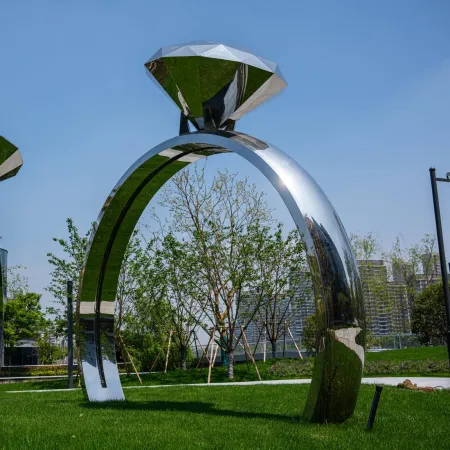
The finish is where a sculpture becomes beautiful or merely functional. A mirror-polished stainless surface demands a grinding and polishing sequence that removes every weld mark and scratch; a painted work depends on surface preparation and coating application that protect the metal beneath the colour; a patinated bronze requires controlled chemistry and sealing. The fabricator should produce finish samples before full production so the client approves the actual surface on real material, because the difference between finishes is impossible to judge from photographs and easy to judge on a sample held in the hand.
- Finish samples: approve real material, colour and texture before mass production
- Dated milestones: receive photographic progress at defined fabrication stages
- Third-party checks: welcome inspection visits or documented quality records
- Test assembly: verify fit and finish before the piece is packed for shipping
What to Verify Before Production Starts
Material certificates for every grade specified
A live look at the workshop and its equipment
A finish sample approved on real material
Documented inspection stages in the schedule
Quality Control and the Inspection Milestones
Professional fabrication runs on documented inspection, not on hope. The schedule should include defined quality milestones, such as the approval of the finish sample, the inspection of the primary structure after welding, the review of the assembled piece and the final check before packing, and the client should receive dated photographic evidence at each one. For large commissions, a live video inspection or a physical visit at the assembly stage is worth more than any number of assurances, because seeing the piece whole, at full scale, before it ships is the moment when problems become visible and fixable at workshop cost rather than site cost.
Packing, Shipping and Site Delivery
Environmental art fabrication is not finished when the last weld is polished; it is finished when the work arrives on site undamaged and installs without drama. Serious fabricators design for transport, planning modules that suit containers and cranes, protecting polished surfaces with correct packing and documenting the installation sequence for the local contractor. Large pieces are often test-assembled in the workshop precisely so that problems appear before shipping, when they are cheap, rather than on site, when they are not. Ask how the workshop has delivered works of similar size and what documentation the local installer will receive.
When to Visit the Workshop in Person
Photographs and video calls have limits, and for a commission of real scale or value a physical visit to the fabrication workshop is worth far more than its cost. The right moment to visit is not at the beginning, when the floor shows only promise, nor at the end, when the finished piece is staged for its best angle, but at the assembly stage, when the structure stands half-finished and every weld, every joint and every surface is visible and honest. Walking the floor at that moment lets you see the thickness of the material, the quality of the welds, the discipline of the finishing sequence and the attitude of the people doing the work, and it lets you raise concerns while they are still cheap to fix.
For overseas buyers a physical visit may not be practical on every project, but a structured video inspection at the assembly stage achieves much of the same value when it is directed by someone who knows what to look for. We welcome both, and we schedule our production so that clients can inspect at the moments that matter rather than at the moments that flatter. The visit also builds the relationship that carries a project through its difficulties, because trust is easier to sustain with people you have stood beside. When a fabricator opens its floor at the honest moment, it is telling you that the work itself can bear inspection, and that is the confidence every buyer should demand before the crate is sealed.
Frequently Asked Questions About Environmental Art Fabrication
Should fabrication be in-house or subcontracted?
In-house fabrication gives the studio direct control over quality, schedule and cost, and lets engineering and making happen under one roof. Subcontracting is workable but adds coordination risk, so verify how the subcontractor is managed and inspected.
How do I know the materials are what the contract specifies?
Demand material certificates as part of the handover pack. A serious fabricator provides certificates for steel grades, coatings and other specified materials without being prompted, because traceability protects both parties.
Can I visit or inspect the workshop during production?
Serious workshops welcome visits and offer structured video inspections for overseas clients. Schedule the inspection around a meaningful milestone, such as the assembled structure before finishing, so your visit has something real to verify.
Why is the finish sample so important?
Screen colours and photographs lie, while a sample held in the hand tells the truth about colour, texture, gloss and quality. Approving a sample before mass production prevents most finish disappointments and gives both sides a clear acceptance standard.
What documents should I receive at handover?
Fabrication drawings, material certificates, structural calculations where relevant, a maintenance guide and installation instructions. These documents make the work verifiable today and maintainable for decades.
Environmental art fabrication rewards clients who look behind the renderings, because the workshop is where your sculpture actually becomes what it will be for the next generation. Since 2003 our studio has fabricated environmental art for clients across twenty-three countries with owned workshops, qualified welders and documented quality control, and we treat every stage, from material certificates to the final polish, as part of the art itself.
Send us your design or your concept and we will show you what disciplined environmental art fabrication looks like on your project.