Why Sculpture Design and Fabrication Should Live Under One Roof
Sculpture design and fabrication are two halves of one act of creation, and when they are separated the client pays twice, once in money and once in meaning. The gap between a beautiful drawing and a faithful physical work is filled with a thousand small decisions, and every one of those decisions is safer when the people who conceived the form are the people accountable for building it.
Yifeng Sculpture Studio has combined sculpture design and fabrication under one roof since 2003, delivering more than 3000 works across 23 countries. Our artists, engineers and workshop craftsmen work in the same building, so every concept we draw is a form our own hands must realise, and that accountability has shaped the way we design.
The Cost of Separating Design From Making
When sculpture design and fabrication are handled by different parties, the handover is the most dangerous moment in the project. The designer must translate the concept into drawings and specifications that carry the full artistic intent, the fabricator must interpret those documents without the designer's knowledge of what mattered and why, and every ambiguity is resolved by the party furthest from the art. The result is a work that technically matches the drawings and spiritually misses the design, and the client often cannot say why it feels wrong.
The commercial cost is just as real. Two parties means two margins, two schedules to coordinate, two sets of assumptions about materials and standards, and endless variation orders when the drawings meet the reality of the workshop. The integrated studio prices the work from its own knowledge, absorbs the design-fabrication dialogue internally and gives the client one budget and one chain of responsibility instead of a relay race.
How Integration Changes the Design
The table below shows how integrated sculpture design and fabrication change the way a concept is developed, compared with a separated process. The difference is visible in the finished work.
| Design question | Separated process | Integrated process |
|---|---|---|
| Can this curve be built? | Answered later, by the fabricator | Answered at the drawing board, in-house |
| What thickness is needed? | The fabricator may change it silently | Chosen by the team protecting the intent |
| How will seams be hidden? | Left to the fabricator's convenience | Planned by the designer, invisible in the form |
| What does this detail cost? | Discovered as a variation order | Known early, engineered into the value |
| Who owns the quality? | Divided and arguable | One team, accountable to the end |
The Workshop That Teaches the Designers
Designers who work beside a workshop design differently, because they learn what metal can do. A designer who has watched a curve being formed knows how much a material can bend without distress; one who has seen a weld ground and polished knows where a seam must never fall; and one who has lifted a finished section knows how structure and transport shape the art. That knowledge enters the concept at the drawing stage, so integrated sculpture design and fabrication produces forms that are more buildable, more honest and often more beautiful.
The workshop also teaches restraint. When the people designing are the people who will spend the hours cutting, welding and polishing, they value the maker's time as their own, and the design is refined to where effort creates meaning rather than merely expense. The client benefits from a work whose budget has been engineered by people who understand both the art and the labour, which is a discipline no separated process can reproduce.
Why Clients Choose an Integrated Studio
- One accountable partner: a single team owns the design, the engineering, the fabrication and the installation, so quality has one address.
- Fidelity of intent: the concept is never diluted at a handover, because the hands that build are guided by the minds that designed.
- Honest budgets: the price is built from the maker's real knowledge, and value engineering happens in the design room, not the workshop.
- Continuity through changes: when reality forces a change, the team that resolves it understands the artistic reason behind every element.
- Visible quality: the client can watch the work grow in the same studio where it was conceived, inspecting at every stage.
These are the practical reasons clients choose integration, and the deeper reason is trust: the client knows the people who dreamed the work are the people who must deliver it.
The Proof in Delivered Works
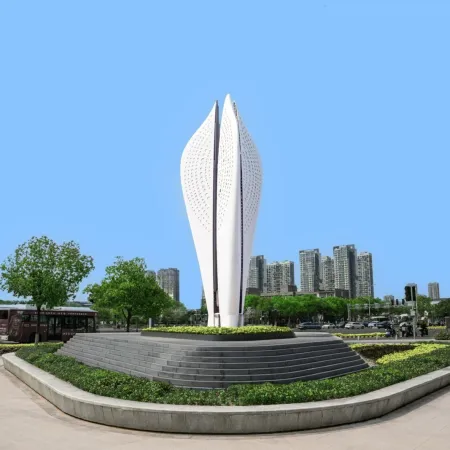
The value of integrated sculpture design and fabrication is proven in the delivered work, where concept and craft are one. See the outcomes in our project gallery, review the services that span the whole chain on the services overview, and study Peach Blossom, whose 20.8-metre stainless petals required the closest possible marriage of drawn form and fabricated structure.
What Integration Protects for the Client
The artistic intent, uncorrupted by handover
One budget, one schedule, one address for quality
Designs shaped by real knowledge of the making
A work the client can watch grow where it was born
Choosing Between Integrated and Separated Delivery
There are legitimate reasons a client might separate sculpture design and fabrication: a public tender may split the contracts, an artist may be appointed separately from a manufacturer, or a client may already have a trusted fabricator. Where separation is necessary, the client should protect the handover with exact specifications, approved samples, inspection gates and the designer's involvement through production. But where the client has the freedom to choose, integration removes the single greatest source of disappointment in commissioned sculpture.
We have lived the integrated model for more than two decades, and we have seen its effect on every kind of commission, from intimate garden works to monumental civic landmarks. The client who chooses an integrated studio is not merely simplifying procurement; the client is choosing a way of working in which the art is never lost between the dream and the delivery. That continuity is the quiet reason our works arrive as their concepts promised, and it is the reason clients who commission us once tend to commission us again.
How the Integrated Team Handles the Unexpected
Every real commission meets the unexpected, a site condition that differs from the drawings, a material that behaves differently than expected or a change from the client that arrives mid-production, and the integrated studio handles those moments with a decisive advantage. Because the same team designed and is building the work, it can assess the impact of any surprise on both the art and the making at once, propose a response that protects the concept and cost it with real knowledge rather than with defensive guesswork.
The client experiences that advantage as calm. When a problem arises, there is no relay between a designer who blames the fabricator and a fabricator who blames the drawings; there is one team that owns the issue, explains it plainly and resolves it with the concept intact. We treat every unexpected event as a normal part of making, we document what happened and how it was resolved and we use the lesson on the next commission, so the client benefits not only from this project's certainty but from every surprise we have already survived. That accumulated steadiness is one of the quietest and most valuable products of integrated sculpture design and fabrication.
The integrated model also simplifies the client's own team, because there is one partner to brief, one schedule to follow and one point of accountability for every question that arises. The client's project manager does not mediate between a designer and a maker, and the client's lawyers do not untangle disputes between parties who blame each other, because there are no parties, only one team that owns the whole. That simplicity is worth real money in any commission, and it is one of the quiet reasons clients return to integrated studios for their second and third works.
Frequently Asked Questions About Sculpture Design and Fabrication
What is integrated sculpture design and fabrication?
A delivery model in which one studio conceives the design and builds the work, keeping the artistic intent intact through the entire craft chain.
Why does separation between designer and maker cause problems?
Because every ambiguity in the handover is resolved by the party furthest from the art, so the built work drifts from the conceived work.
Is integrated delivery more expensive?
Usually less, because the client pays one margin instead of two and avoids the variation orders that separated handovers generate.
Can I still use my own artist with an integrated studio?
Yes, many studios fabricate for independent artists under a clear protocol that protects the artist's intent through production and inspection.
What should I verify in an integrated studio?
That the same team truly owns design and build, with real artists in the workshop culture and delivered works that match their concepts.
Sculpture design and fabrication belong together because a sculpture is not a drawing that gets built; it is an idea that must survive becoming physical, and it survives best when the same hands and minds carry it all the way. Choose an integrated studio, and the work you approve will be the work your community receives.
If you want a work whose design and making are one continuous act, bring us your story and your site, and we will show you what sculpture design and fabrication can achieve together.