How to Vet a Large-Scale Art Installation Company Before You Sign Anything
Choosing a large-scale art installation company is one of the highest-stakes procurement decisions in public art, because the gap between a beautiful proposal and a durable landmark is filled entirely by company capability: engineering depth, workshop control, transport logic and installation discipline. Any studio can render an impressive image; the company you hire is the one whose drawings match its promises, whose welds survive inspection and whose crew finishes the job it started. Yifeng Sculpture Studio has operated as such a company since 2003, and this guide gives procurement teams the exact criteria to evaluate a large-scale art installation company before committing public or private money.
The sections below cover capability verification, engineering and quality evidence, financial and delivery health, references that mean something, and the contract protections that keep a landmark project honest.
A useful mindset for selection: you are not buying a sculpture, you are buying an outcome — a work that stands safely, looks right for decades and arrives on a schedule your whole project can trust. Every evaluation question below serves that outcome.
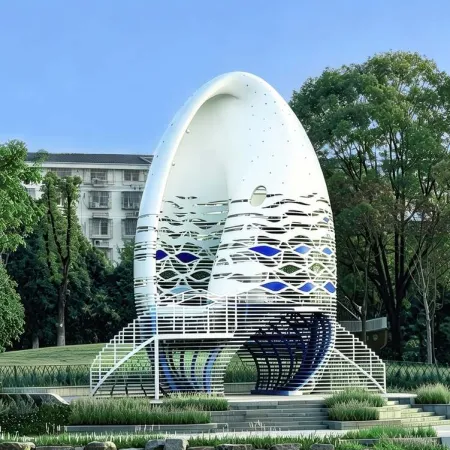
The services overview defines the full-scope model we recommend every client demand, the project archive provides built evidence of capability, and the Fishing Net Canopy demonstrates structural engineering at landmark scale.
Capability Verification: Look for Evidence, Not Adjectives
A large-scale art installation company should be able to prove five capabilities in writing: structural engineering appropriate to public sculpture, in-house or directly managed fabrication at controlled quality, material stewardship with traceable certificates, transport engineering for oversized works, and supervised installation by crews it employs rather than subcontracts at the critical moment. Ask for the project engineer's name, the workshop's quality procedure and a specific example of each capability in a completed work. Marketing language costs nothing to print; named people, dated records and addressable references are the currency of real capability, and a serious company will volunteer them before you ask twice.
Engineering Depth: The Invisible Difference Between Companies
The engineering behind a landmark is invisible when done well and catastrophic when done badly. The company you choose must demonstrate competence in wind loading on sculptural forms, foundation design that respects real ground conditions, fatigue considerations for any moving elements, and detailing that keeps water, corrosion and thermal movement from destroying the work over time. Request the structural documentation from a completed project comparable in scale to yours — not a summary, the actual calculations and drawings — and have your own engineer review them. A large-scale art installation company that opens its engineering files confidently is telling you the truth about its depth; one that hesitates is telling you something else.
Evidence to Request From Every Candidate
| Evidence | What It Proves | Red Flag If Absent |
|---|---|---|
| Past structural files | Real engineering depth, not borrowed reports | Only renders and summaries offered |
| Material certificates | Traceable alloys tied to your order | Generic inventory paperwork |
| Trial assembly records | Modules actually fit before shipping | First assembly happens on site |
| Installation crews | Supervised, accountable site delivery | Handover to unknown subcontractors |
Quality Control: What the Workshop Should Show You
Quality in landmark sculpture is a system, not an accident, and the system should be visible on a workshop visit. Look for documented weld inspection on structural joints, finish samples produced under real production parameters, a trial assembly area large enough to dry-fit your modules, and a housekeeping discipline that reflects the craft standard. Ask how defects are caught — inspection checkpoints, sign-off records, third-party testing where required — because the answer reveals whether quality is verified or assumed. The best large-scale art installation company will welcome your own inspector at agreed stages; confidence is exactly what a controlled workshop has to sell.
Finish quality deserves its own line in the evaluation, because it is what the public actually sees every day. Ask how surface treatments are tested before production — sample panels made with the real alloys, real abrasives and real coating parameters, not color chips printed in an office. Ask how color is matched across modules fabricated weeks apart, how brushed direction is controlled so panels read as one surface, and how the workshop protects finished surfaces between fabrication and installation. The difference between a landmark that looks machine-made and one that looks hand-finished is not luck; it is a documented finish procedure with sign-offs at each step, and it is one of the fastest ways to separate a company that has shipped hundreds of public works from one that has shipped a handful.
Delivery Health: Can This Company Actually Finish?
Landmark projects fail on schedule more often than on craft, so delivery health deserves the same scrutiny as artistic quality. Ask how the company plans programs — who owns the schedule, how milestones are tracked, how delays are communicated and what the change process costs in time. Request references from projects of comparable scale and, ideally, comparable complexity, and ask those references two questions that brochures never answer: did the work arrive when promised, and how did the company behave when something went wrong? The second question matters most, because every complex project hits at least one problem, and the company's behavior at that moment — honest, swift, solution-oriented — is the real measure of delivery character.
Financial stability is a quieter but equally real part of delivery health. A landmark commission spans months or longer, and the company must be able to carry its own obligations through that whole period — purchasing materials, paying its workshop and honoring commitments even when a milestone payment lands late. Procurement teams can probe this politely by asking about the company's project load, its material purchasing practice and whether suppliers are paid on terms that keep the workshop reliable. None of this replaces the artistic judgment that started the search, but together these checks tell you whether the studio you admire artistically is also a company you can build a schedule on.
What Our Studio Delivers as Your Large-Scale Art Installation Company
One accountable team from feasibility study to installation handover
Open engineering files and quality records for your own review
References that answer the hard questions about schedule and honesty
Contract Protections That Keep the Project Honest
The contract is the last line of defense, and it should protect the artwork as much as the budget. Define the scope with precision — what is designed, what is engineered, what is fabricated, what ships, what installs — and tie payments to verifiable milestones rather than calendar guesses. Specify the documentation deliverable: as-built drawings, structural sign-off, material certificates, installation records and a maintenance manual. Agree the approval process for changes and the consequence of unapproved ones. And name the inspection rights at each stage, because a company that accepts inspection at weld, finish and trial-assembly checkpoints is a company confident in its work. A large-scale art installation company that argues against these protections is telling you where its weakness lives; one that welcomes them is showing you where its strength is.
Frequently Asked Questions About Hiring a Large-Scale Art Installation Company
Should we choose a local company or an international one?
Choose the company that can prove the capability, then manage the geography. International delivery is routine when engineering, module planning and installation methods are handled by one accountable team, and the largest landmarks are frequently built far from where they stand.
What is the most important question to ask a candidate?
Ask for a comparable completed project and then ask to speak with that client about what went wrong and how it was handled. The answer tells you more about engineering, honesty and delivery than any presentation ever will.
How do we verify quality before the work ships?
Through the four checkpoints any serious company will accept: material certificates, weld inspection records, finish samples and a full trial assembly. Where scale or risk justifies it, bring your own inspector to the workshop for those stages.
What documentation should the contract require?
As-built drawings, structural sign-off, material certificates, finish specifications, installation records and a maintenance manual — all delivered at handover. If a company cannot commit to this file in the contract, the artwork is only half delivered on day one.
How early should we involve the company in our project?
As early as the site and program exist. Involving the producing company at feasibility stage lets engineering, transport and approval realities shape the design instead of fighting it — the difference between a landmark that is buildable and one that must be redesigned to survive.
Selecting a large-scale art installation company is ultimately a risk-management decision, and the criteria above are how procurement teams turn risk into evidence: engineering files you can review, quality records you can audit, references that answer hard questions and contracts that protect the artwork itself. A company that opens its workshop, its files and its references is a company with nothing to hide and everything to prove. If your project deserves that level of scrutiny and that level of confidence, put us to the test — send us your brief, and we will show you why clients across more than twenty countries continue to trust this large-scale art installation company with their most visible investments.