What a Landmark Outdoor Sculpture Must Survive to Stay Iconic
A landmark outdoor sculpture lives a harder life than any gallery piece, because it is asked to survive weather, crowds, pollution and time while remaining beautiful enough to define a place, and every one of those demands shapes the design from the first sketch. The difference between an outdoor sculpture and an indoor one is not the roof, it is the entire discipline of the work, from the alloy in its skin to the drainage in its cavities to the fixings in its foundation. I have spent more than a decade creating landmark outdoor sculpture for clients across twenty-three countries, and this guide explains what a work must survive and how it is designed to do so.
We will look at the environmental enemies a landmark faces, the materials and details that defeat them, and the commissioning questions that protect an outdoor work for decades.
Our outdoor sculpture services engineer public works for real climates, the delivered projects archive shows landmark outdoor sculpture in its settings, and the Heart of Changfeng installation demonstrates an outdoor landmark designed for public life.
The Enemies Every Outdoor Landmark Faces
A landmark outdoor sculpture is under continuous attack from forces that indoor art never meets. Ultraviolet light fades pigments and degrades polymers; rain, humidity and condensation carry pollutants into every crevice; freezing and thawing prise open any crack that water can reach; wind loads the structure and can excite resonance in slender forms; coastal salt corrodes metals that would last indoors for centuries; and the public, with bicycles, graffiti and simple wear, tests every surface. A design that ignores any of these enemies is a design that will be repaired within years.
The seasons add a further test that is easy to underestimate. A landmark outdoor sculpture must read well in high summer against full foliage and in deep winter against bare branches and low sun; it must survive snow loads on its horizontal surfaces; and it must look intentional in the grey light of rain as well as the golden light of evening. Designing for the whole calendar, not the opening-day photograph, is what makes an outdoor work earn its place through the years.
Materials Chosen for the Real Climate
Material selection for a landmark outdoor sculpture must begin with the climate of the actual site rather than the climate of the studio. Coastal commissions demand grades of stainless steel and fixings that resist salt; cold climates demand drainage and sealing systems that defeat the freeze-thaw cycle; hot, sunny climates demand pigments and coatings with proven ultraviolet stability; and urban sites demand finishes that tolerate pollution and graffiti cleaning. The same form in two climates may require different materials, and the studio should specify accordingly.
| Environment | Threat | Design Response |
|---|---|---|
| Coastal | Salt corrosion of metals | Marine-grade alloys and seals |
| Cold climates | Freeze-thaw water damage | Full drainage and sealing |
| Hot and sunny | Ultraviolet fading | UV-stable pigments and paints |
| Urban public | Pollution, graffiti, wear | Cleanable, repairable finishes |
Details That Decide Whether a Landmark Lasts
Outdoor landmarks fail at their details long before they fail at their grand ideas, and the details are where experienced studios concentrate. Water must be shed from every horizontal surface, drained from every cavity and kept away from every joint; fixings must be of compatible materials to avoid galvanic corrosion; access must allow safe inspection and cleaning; and edges must be detailed so that coatings do not peel back from vulnerable points. These are invisible disciplines, but they are the difference between a landmark that is maintained and one that is repaired.
The public is also a design condition. A landmark outdoor sculpture should tolerate the touch of thousands of hands, resist casual climbing where it should not be climbed, and survive cleaning regimes that may include pressure washing. Sharp edges, unstable elements and accessible voids are either designed out or designed safely, and the work is engineered so that minor damage can be repaired without compromising the whole. Good outdoor sculpture design treats the public not as a threat but as a force of nature, and plans accordingly.
- Water: shed, drained and kept out of every cavity
- Fixings: compatible materials, inspectable connections
- Public: safe, climb-resistant, cleanable surfaces
- Access: maintenance crews can reach every surface
Designing a Landmark to Read in Every Season
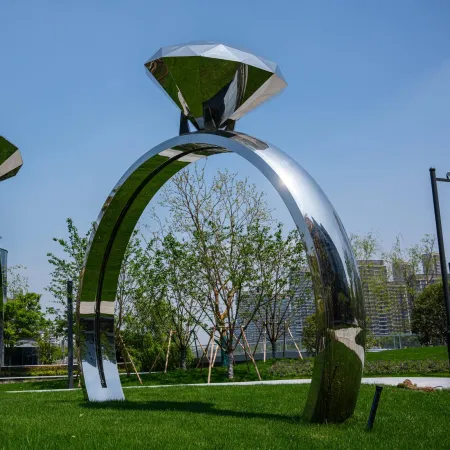
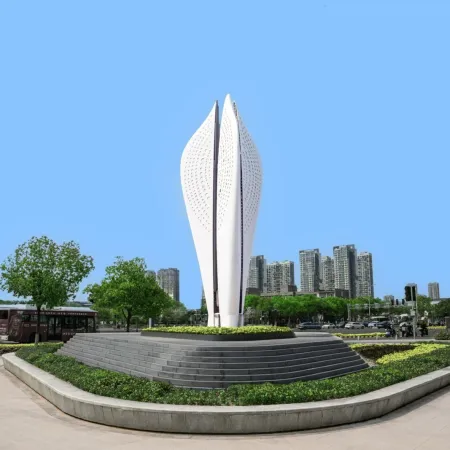
The visual life of a landmark outdoor sculpture is a year-round performance, and the strongest designs are composed with the whole calendar in mind. A form that relies on summer foliage for its context should still hold its own in winter; a mirror surface should be angled to catch low winter sun as well as high summer light; a pale form should not disappear against snow; and a dark form should not vanish at dusk. The studio should test the concept against seasonal photographs of the site and should advise the client honestly on how the work will appear in each season.
Signs of an Outdoor Landmark Built to Last
Material matched to the real climate
Water engineered away from all surfaces
Form reads in every season and light
Maintenance access designed in from birth
Commissioning an Outdoor Landmark With Its Eyes Open
Commissioning a landmark outdoor sculpture is an exercise in honesty, because the client is buying decades of outdoor performance, not a photograph. The studio should present the material and finish specification for the specific climate, the engineering calculations for the specific site, the maintenance plan the work will need and the expected lifespan of each component. Clients should ask what will need attention in five years, in ten years and in twenty, and should budget for that care, because every outdoor landmark has an upkeep story and the honest studios tell it before the contract is signed.
Since 2003 our studio has designed and installed landmark outdoor sculpture across twenty-three countries, in coastal cities, mountain parks and desert plazas. We specify every work for its actual climate, engineer it for its actual site and deliver a maintenance manual with every commission, because we believe a landmark should look better in its twentieth year than most works do on their first.
A landmark outdoor sculpture is a promise to a place that it will be represented well for decades, and that promise is kept in the alloy, the drainage detail and the coating specification as much as in the beauty of the form.
Foundations, Fixings and the Hidden Half of the Work
Half of every landmark outdoor sculpture is invisible, buried in the ground or hidden inside the form, and the quality of that hidden half decides whether the visible half survives. The foundation must be engineered for the soil conditions, the wind load and the weight of the work, and its anchor bolts must be positioned to tolerances that the sculpture base can meet, because a foundation that is wrong cannot be moved once the concrete has cured. The fixings that connect the sculpture to its foundation must be of materials compatible with the structure, protected against corrosion and designed to be inspected, and the drainage of the base must keep water away from the critical connections. Clients rarely see this half of the work, but they will live with its consequences for the life of the landmark.
The inspection of the hidden half should therefore be written into the commissioning process rather than left to trust. The client should receive the foundation design and approve it before the concrete is poured; the anchor positions should be verified before the pour and checked again before the sculpture is lifted; and the fixing and drainage details should be documented in the as-built record. A studio that treats the foundation as part of the art, documenting it, inspecting it and explaining it to the client, is a studio that understands how outdoor landmarks fail and how they endure. The invisible half of a landmark outdoor sculpture deserves the same care as its most beautiful surface, because it is the part that keeps the beauty standing.
Frequently Asked Questions About Landmark Outdoor Sculpture
How long does an outdoor landmark sculpture last?
With materials matched to the climate, correct detailing and a maintenance plan, a well-built outdoor landmark can look strong for decades. Bronze and stainless have served public space for centuries when cared for.
What maintenance will our sculpture need?
Periodic cleaning, coating inspection, drainage checks and structural reviews, with the frequency depending on climate and material. Every commission should arrive with a written maintenance manual.
How is wind load handled for an exposed landmark?
The site wind speed and exposure are analysed, the structure is designed against the resulting loads and resonance, and the foundation and anchors are engineered to resist overturning with a proper safety margin.
Can we light a landmark outdoor sculpture at night?
Yes, and lighting is often essential to a landmark presence after dark. The lighting design should be integrated into the engineering and should specify fixtures that can be maintained safely.
How do we protect the sculpture from vandalism and graffiti?
Good siting, lighting and community ownership deter most damage, while finish selection makes cleaning possible. Some surfaces accept graffiti removal better than others, and the specification should reflect the site risk.
A landmark outdoor sculpture is a long marriage between art and weather, and like any marriage it succeeds through honesty, preparation and care. Commissioned with its eyes open, specified for its real climate and maintained with discipline, it rewards the place that raised it for generations.
Tell us about your site and its climate, and we will show you how a landmark outdoor sculpture can be built to stay iconic for decades.