Why Geometric Sculpture Design Brings Order to Public Space
Geometric sculpture design speaks the universal language of order, and that is why it works so well in the visual chaos of the modern city. Where architecture competes with signage, traffic and crowds, a resolved geometric form offers the eye a moment of clarity, a pure shape that can be read instantly and remembered for years, and that clarity is the quiet power of the mode.
Yifeng Sculpture Studio has practised geometric sculpture design since 2003, delivering more than 3000 works across 23 countries. Our designers bring training from the China Academy of Art, the Academy of Arts & Design at Tsinghua University and the Royal Society of Sculptors, and we have learned that the simplest-looking geometric forms demand the most rigorous design thinking to feel inevitable rather than arbitrary.
The Appeal of Pure Geometry in Sculpture
Geometric sculpture design connects with the public through recognition. A circle, a cube, a sphere or an arc is understood by every culture and every age without explanation, so the sculpture communicates instantly even as it carries meanings that are anything but simple. The designer plays with that tension, using forms everyone knows to express ideas no one has seen before, and the result is a work that is both immediately accessible and endlessly readable.
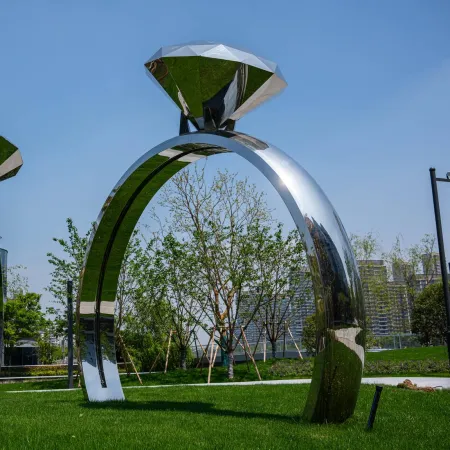
Geometry also carries a distinctive emotional register. The circle can suggest unity, continuity and protection; the arch can suggest passage and threshold; the cube can suggest stability, weight and the man-made; and the ascending spiral can suggest growth and aspiration. A skilled geometric designer composes these associations deliberately, giving each work a meaning that emerges from the mathematics rather than being imposed on it.
The Geometric Vocabulary and Its Meanings
The table below outlines the primary forms used in geometric sculpture design and the expressive associations each one carries. These are starting points, because the meaning of a form is completed by its material, its scale and its setting.
| Form | Associations | Common settings |
|---|---|---|
| Circle and ring | Unity, continuity, gathering, protection | Plazas, roundabouts, community centres |
| Cube and block | Stability, weight, the man-made, order | Corporate plazas, civic architecture |
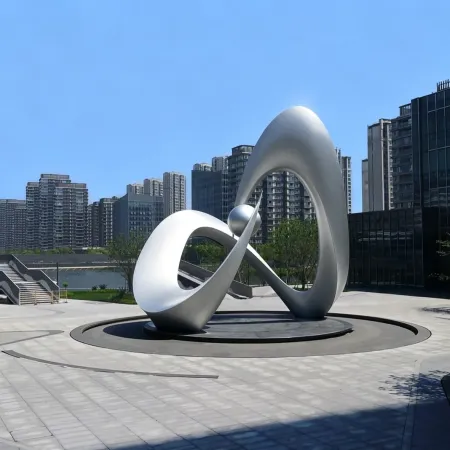
| Sphere and orb | Wholeness, the cosmic, perfection, reflection | Entrances, gardens, science districts |
| Arch and arc | Passage, threshold, welcome, embrace | Gateways, parks, promenades |
| Spiral and helix | Growth, energy, ascent, transformation | Innovation parks, landmarks, gardens |
Why Geometric Work Demands Precision Engineering
Geometric sculpture design exposes every flaw because the eye knows perfect geometry instantly. A sphere that is not quite round, an arc that is not quite true or a seam that interrupts a pure surface will be seen by every viewer, even those who cannot say what they noticed, so the engineering and fabrication standards must be exceptionally high. The material must be formed, welded and finished to tolerances that a more forgiving organic form would never demand.
The precision begins in the digital model and continues through every fabrication stage. Curved panels must be developed, cut and formed accurately, the substructure must support the skin without distorting it, and the polishing must preserve the geometry rather than softening it, and each of these steps is where a studio either honours the pure form or quietly betrays it. Clients commissioning geometric work should ask how the studio achieves that precision, because the answer will determine whether the finished form looks mathematical or merely approximate.
Placing Geometry in the Landscape
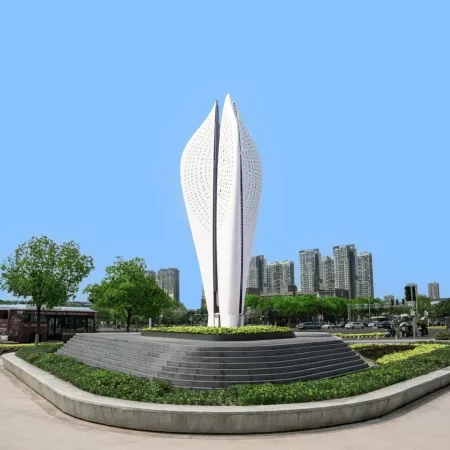
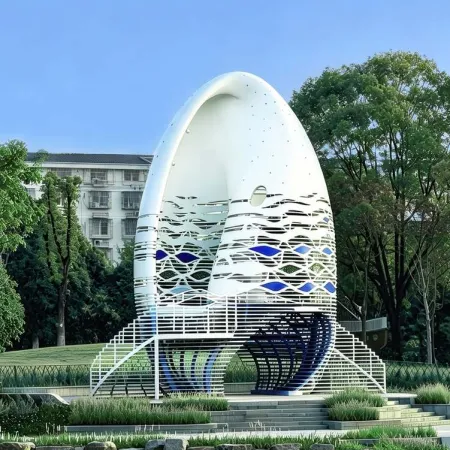
A geometric sculpture exists in dialogue with its setting, and the design must read that dialogue carefully. In a formal plaza the geometry can echo the architecture's own order; in a natural landscape a pure form can create a moving contrast with organic growth; and in a streetscape the form can organise a space that otherwise has no centre. The scale and the orientation of the geometry are decisions that can only be made on the site, which is why our geometric designs always pass through real scale studies before approval.
Light is geometry's most powerful partner. A polished geometric surface catches the sun, moves its reflections through the day and turns the sculpture into a changing composition that belongs to the hours rather than standing frozen in them. Geometric forms also accept integrated lighting beautifully, with light tracing edges, washing surfaces or glowing from within, and the designer should consider the night-time life of the work from the first sketches rather than adding lighting as an afterthought.
What to Discuss Before Commissioning Geometric Work
- The meaning beneath the form: what idea should the geometry carry, because a pure shape without intent is decoration rather than sculpture.
- The site dialogue: should the form echo the architecture, contrast with the landscape or organise an open space, and at what scale?
- The precision standard: what tolerances will the fabrication hold, and how will the studio verify the geometry of the finished work?
- The material finish: how will mirror, satin, painted or textured surfaces change the reading of the pure form in your climate?
- The light plan: how will the work look at dawn, noon and night, and should lighting be designed into the geometry from the start?
A studio that raises these questions is designing geometry as sculpture rather than assembling shapes as objects, and that difference is visible in the finished work.
From Pure Form to Built Landmark
Geometric sculpture design reaches its full power when the form is realised at scale with uncompromising craft. See the geometric and organic works we have built in our project gallery, explore the services that carry a geometric concept through engineering on the services overview, and study Sailing Competition, where pure geometric sails were resolved as a 9-metre wind-driven kinetic landmark through disciplined engineering of curved surfaces.
What Geometric Sculpture Design Offers
Clarity the public reads instantly and remembers
Meanings carried through form every culture knows
Order that organises busy or empty public space
Precision craft that honours the purity of the form
The Discipline of Making Geometry Feel Human
The greatest risk in geometric sculpture design is that the work feels cold, and the answer is not to abandon geometry but to compose it with human warmth. Proportions can be drawn from the human body, rhythms can echo natural growth, and the base can invite sitting, leaning and touching, so the pure form becomes a place rather than an object. We design geometry with its future public in mind, testing how children will play around the arcs and how adults will rest against the blocks, because a geometric sculpture that people use is a geometric sculpture that people love.
The finest geometric works hold two truths at once, they are mathematically exact and emotionally alive, and reaching that balance is the quiet ambition of the discipline. The order gives the city a moment of clarity, and the humanity gives that clarity a heart, so the sculpture earns its place in the daily life of the community rather than merely decorating it. When clients see that double life in a resolved geometric design, they understand why the mode has become one of the most enduring voices in contemporary public art.
Geometry, Light and the Changing Hours
A geometric sculpture is rarely still, because the light that moves across it changes the reading of every edge and surface through the day. A polished circle catches the morning sun on one arc and the evening glow on another; an open cube throws shadows that shift across its interior; and a sphere gathers the colours of the sky so it seems to belong to the hour rather than to the noon. The designer composes with that moving light, considering how the form will look at every hour it will be seen, and that temporal composition is as real as the geometry itself.
Integrated lighting can extend the geometric life into the night. Edges can be traced with light, interiors can glow, and the pure forms can be picked out of the darkness so the sculpture continues to organise the space after sunset. We design the lighting with the geometry, deciding which lines deserve emphasis and which surfaces should fall away, and we document the lighting plan for the owner's maintenance team so the night presence keeps its quality for years. A geometric work that is designed for the full cycle of light becomes a companion to the day rather than an object that only exists at noon.
Frequently Asked Questions About Geometric Sculpture Design
What is geometric sculpture design?
The discipline of composing sculpture from circles, cubes, spheres, arcs and other pure forms, balancing mathematical precision with expressive meaning.
Does geometric sculpture feel cold or impersonal?
Only when it is composed without human warmth; resolved geometry can carry deep meaning and invite public use when designed with care.
Why does geometric work need such precise fabrication?
The eye recognises perfect geometry instantly, so any distortion, seam or flaw in a pure form is seen by every viewer even when unnamed.
What materials suit geometric sculpture?
Mirror and satin stainless steel, painted metal, bronze and stone all serve geometric forms, with the finish shaping how the pure shape reads.
Can geometric design include light or movement?
Yes, integrated lighting and kinetic elements extend the life of geometric forms, especially when planned from the first design stages.
Geometric sculpture design offers the city a language of order and clarity, composed with the precision that pure form demands and the warmth that public life requires. Choose a studio that can engineer geometry to exacting standards while designing it for human use, and your work will be the clear note in the city's visual noise.
If your space needs a centre of order and meaning, tell us about the place and the feeling, and we will show you what geometric sculpture design can bring to it.