How Contemporary Public Sculpture Gives a City Its Voice
Contemporary public sculpture is how a city tells the world — and itself — what it values, who it remembers and how it imagines its future. Unlike gallery art, which speaks to those who choose to visit it, public sculpture speaks to everyone: the commuter who passes it daily, the child who grows up with it, the visitor who photographs it and the citizen who defends it when it is threatened. That is why the best public sculpture commissions are treated as civic events rather than purchases — they are shaped with the community, engineered for the ages and understood as the city's permanent voice. Yifeng Sculpture Studio has created contemporary public sculpture since 2003 for cities across more than twenty countries, and this guide explains how a public work is conceived, approved and made to last.
We look at what public sculpture does for a city, how public commissions actually work, and how a work becomes adopted rather than merely installed.
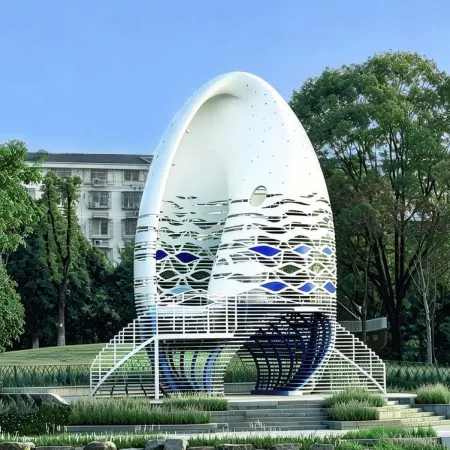
Our project archive is full of civic commissions, the services overview explains how we work with public clients, and the Honeycomb Pavilion shows a civic work that gives a public space both shelter and identity.
What Public Sculpture Does for a City
A city without public sculpture is a city with an incomplete conversation with itself. Sculpture gives places names — the square with the wind sail, the park with the bronze horses — and names are how people navigate, remember and belong. It gives districts identity at the moment they need it most: a new waterfront becomes a destination when a landmark arrives; an old industrial quarter becomes a cultural address when art claims it. It preserves memory in a form more generous than a plaque, letting history be felt rather than merely read. And it makes the intangible tangible — a city's confidence, ambition or grief given physical form that everyone can share. The best contemporary public sculpture does all of this while being simply enjoyable: something people meet at, photograph with and take visitors to see. That combination — civic meaning and daily pleasure — is what makes public sculpture a city's best investment in its own image.
How Public Commissions Actually Work
Public commissioning follows a more structured path than private work, and understanding the path helps every participant succeed. It usually begins with a vision — a council, an arts board, a developer's public art requirement or a community group — and a site. The studio is engaged to develop concepts that answer both the site and the brief, often presenting a family of directions so the decision-makers can feel the range. The chosen direction passes through the layers that public money requires: design review, engineering sign-off, accessibility and safety review, and — increasingly — community consultation. The fabrication follows under documented quality control, and the installation is planned with the site's public life in mind. Throughout, the studio acts as the translator between artistic ambition and civic process, shaping presentations for each audience so the work is understood and defended at every stage. The result is a work that arrives pre-adopted by the people who will live with it.
Stages in a Public Commission
- Vision and site: the story, purpose and location are defined together
- Concepts: a family of directions presented for selection
- Reviews: design, engineering, safety and community consultation
- Fabrication: documented making under quality control
- Installation and handover: unveiling, documentation, care manual
Designing for the Whole Public
Public sculpture is designed for an audience that never chose to attend — the tired commuter, the curious child, the skeptical ratepayer, the visitor from another culture — and it must earn each of them differently. The discipline of public design is therefore generosity at every distance. From a distance the work must have a silhouette that reads from a moving bus and gives the district an image. At approach it must reward with presence — scale, material, light — that makes the detour worthwhile. Close up it must offer detail, texture or invitation that gives the second look a reason, whether that is a surface worth touching, a form worth entering or a story worth asking about. And it must be accessible to everyone: physically reachable without barriers, comprehensible without a degree, and safe for children, older visitors and people with disabilities alike. Sculpture designed for the whole public is a more demanding brief than sculpture for a gallery — and a more rewarding one.
| Audience Distance | What the Work Must Give | Design Response |
|---|---|---|
| Street distance | A silhouette and an image | Bold composition and confident scale |
| Approach | A reason to detour | Material, light and presence |
| Close contact | A reward for the second look | Detail, texture and invitation |
| Everyone | Access without barriers | Inclusive siting and safe detailing |
Community: The Approval That Matters Most
The most powerful approval a public work can receive is not from a committee but from the community that lives with it. Contemporary public sculpture succeeds when the people who pass it daily come to feel it is theirs — and that ownership is cultivated, not assumed. Community consultation is woven into the process: the studio listens before designing, learns what the place means to the people who use it, and shapes concepts that answer their stories as well as the brief. The work is presented honestly at each stage, with the reasoning behind decisions made visible, so that the public understands the work before it arrives. And the unveiling is treated as a civic celebration — the moment the community meets its new landmark and begins the long relationship. When a work has been shaped with its community, the arguments that surround so many public commissions rarely appear; the work is adopted before it is installed, and defended after it stands.
What Our Studio Delivers to Cities
Concepts developed from the site, the brief and the community's story
Presentations shaped for councils, boards and public consultation
Engineering, safety review and documentation for public money
Fabrication, installation and a sustainable care plan
Materials and Making for the Public Realm
Public sculpture is built to a higher standard of endurance than private work because its audience is unlimited and its maintenance budget is public. Materials are chosen for low-care longevity in the site's real climate: stainless and weathering steel for their decades-long outdoor lives, bronze for its permanence, painted steel with coating systems rated for the site's sun. Structure is engineered for the full reality of public life — wind, crowds, climbing, cleaning machines — and detailed so that inspection and maintenance are practical for a municipal crew. The documentation that accompanies a public work matters as much as the work itself: engineering records, material certificates, installation records and a care manual that outlives the administration that commissioned it. Cities change, staff change, but the documentation keeps the work knowable and maintainable for its whole life. A studio experienced in the public realm builds that permanence into both the sculpture and its file.
Measuring the Success of a Public Work
The success of contemporary public sculpture is measured not at unveiling but across the years that follow. The signs are simple and human: do people meet at the work by name; does it appear in the city's self-published photographs; has the space around it developed the slight wear ring of daily use; do the maintenance logs show affectionate rather than defensive interventions; do local businesses and event organizers treat it as an asset? When those signs appear, the work has done what public sculpture exists to do — converting a passage into a place and a place into a point of pride. When they do not appear, the honest diagnosis is usually the same: the work was installed rather than adopted, dropped rather than designed. That is why our process invests so heavily in the before — the listening, the siting, the community — because the after takes care of itself when the before is done properly.
Frequently Asked Questions About Contemporary Public Sculpture
How does a city or district start a public sculpture project?
With a vision and a site. Many projects begin informally — a council conversation, an arts plan, a developer's public art commitment — and our studio helps shape that beginning into a brief, a budget framework and a commissioning path that can pass through public process.
Do you work through design competitions?
Yes — we regularly participate in and support selection processes, from open competitions to invited tenders. We also help clients structure the process so that shortlisted studios are judged fairly on concept, capability and demonstrated delivery.
How is community feedback handled in the design?
As design material, not as a hurdle. We listen before designing, present concepts honestly, and let the community's response refine the work — its story, its siting and its relationship with the place — while protecting the artistic coherence that makes it strong.
What documentation should a public client receive?
A complete file: engineering and design records, material certificates, fabrication and installation documentation, and a care manual written for a municipal maintenance crew. The file is part of the public asset and should outlive any single administration.
Can public sculpture be temporary or touring?
Yes — temporary and touring works are a valuable part of the public art field, letting cities test sites and audiences before permanent commitment. We build temporary works to a standard that survives their touring life and returns to the studio ready for the next city.
Contemporary public sculpture is the longest sentence a city writes about itself — a work commissioned by one generation and lived with by many, standing in shared ground and speaking to everyone who passes. Our studio has helped cities write those sentences since 2003, with contemporary public sculpture standing across more than twenty countries and adopted by the communities that live with it. If your city, district or development is ready to give its public space a voice, bring us the place and the people — the contemporary public sculpture we develop together will be shaped with your community, engineered for your climate and loved for generations.
Begin with a conversation about the site and the story you want it to tell; that is how every contemporary public sculpture in our archive found the community that would come to own it.