Why Brushed Stainless Steel Sculpture Holds Up in the Public Realm
A brushed stainless steel sculpture is usually the most practical choice for a busy public place, because the directional satin grain softens glare, hides the small marks that crowds inevitably leave and gives a large form a calm, even sheen. A mirror finish is more dramatic on the day of opening, but a brushed surface is the one that still looks well kept after a decade of school groups, weather and window cleaners. Choosing it is a decision about how the work will live, not just how it will photograph.
Yifeng Sculpture Studio has produced stainless work since 2003 and delivered more than 3000 pieces to 23 countries, and we have seen how finishes behave over long service. Brushed surfaces are the ones that age with the least drama. They do not demand a spotless environment and they tolerate the ordinary life of a plaza, which is exactly the environment most commissions are made for. That reliability is worth more to most clients than the maximum reflectivity of a polish.
What the Grain Actually Does
Brushing is a mechanical process that draws fine, parallel abrasion lines across the surface with a controlled abrasive grade. Those lines scatter light in a predictable way, so instead of a sharp reflection the viewer sees a soft gradient that travels as they move. The grain also breaks up small imperfections visually: a hairline scratch running with the grain tends to disappear, while the same scratch across the grain stands out. This is why direction control is the single most important skill in producing a good brushed finish.
Grain direction is a design tool as much as a technical one. On a curved form the grain can follow the curve and reinforce its movement, or it can run vertically to make a tall element feel taller. On a large assembly the grain must be continuous across panel joints or the seams will read as stripes. On a work that will be touched, a slightly coarser grain is more forgiving than a fine one, because it hides fingerprints and contact polish far better. These choices should be settled with a physical sample before production.
| Surface | Reflection | Behaviour in public |
|---|---|---|
| Mirror polish | Sharp and complete | Striking, but shows every touch and every joint |
| Fine brushed | Soft and directional | Refined sheen, moderate tolerance of marks |
| Coarse brushed | Broad and matt | Very forgiving, hides contact polish well |
| Bead blasted | None | Uniform matt, reads as mass rather than reflection |
| Mixed grain | Controlled contrast | Grain direction used to describe form and shadow |
Producing a Consistent Brushed Stainless Steel Sculpture
Consistency is the hard part. A brushed finish is produced by hand or by machine with abrasives of a defined grade, and the visible result depends on pressure, speed, overlap and the number of passes. Two panels finished by different hands can look subtly different under the same light, and that difference is obvious once they sit side by side on a curved shell. The workshop controls it by standardising the abrasive, training the operatives, and finishing all the panels of one work in a single campaign rather than across weeks.
Protection after finishing is equally important. A brushed surface that is handled with bare hands, stacked against other steel or transported without a protective film will arrive with contact marks that have to be reworked on site, where matching the grain is far harder. We film the finished panels, pack them so they cannot rub, and instruct the installation crew on how to remove the film and handle the faces. A brushed stainless steel sculpture that is protected properly through the journey arrives as it left the workshop.
- Fixed abrasive grade: one specified grit for the whole work, so no panel is subtly different from its neighbour.
- Controlled direction: a grain plan agreed at the design stage and marked on the shop drawings.
- Single finishing campaign: all visible panels brushed together so the sheen matches across the assembly.
- Sample sign off: the client approves a physical plate in the light of the site before production begins.
- Protective handling: film, gloves and careful packing so the finished faces reach the site unmarked.
Why Public Projects Choose Brushed
Glare reduced for drivers, cyclists and neighbours
Contact marks and light scratches disappear into the grain
Cleaning is straightforward and does not require special products
The surface reads well in both strong sun and overcast light
Repairing and Cleaning a Brushed Surface
One of the quiet advantages of a brushed finish is that it can be repaired locally. A scratch that runs with the grain can often be blended out by reworking the area with the same abrasive in the same direction, and a competent maintenance team can make the repair disappear. A scratch across the grain is harder, but it can still be dressed and re grained by a specialist. This repairability is why we recommend brushed surfaces for works in busy places where contact is certain.
Cleaning should follow the same logic as any stainless: fresh water, a mild detergent and a soft cloth, working along the grain rather than across it. Abrasive pads and chloride containing cleaners do more harm than the dirt they remove. The owner should also be told which direction the grain runs, because a cleaner who works across it will leave a visible crosshatch. Simple guidance at handover prevents most of the surface damage we are called back to correct.
- Clean along the grain: the direction of the brush marks should guide every wiping and washing action.
- Use mild detergent: fresh water and a neutral soap remove deposits without attacking the passive film.
- Avoid abrasives: scouring pads scratch the grain and trap contamination in the scratches they leave.
- Keep a repair kit: matching abrasive and a short written method so the owner can dress minor marks.
- Record the grade: note the abrasive used, so any future repair matches the original surface exactly.
Where a Brushed Stainless Steel Sculpture Works Best
Transit environments are one of the strongest cases for a brushed finish. Stations, interchanges and bus shelters see enormous footfall, constant incidental contact and a cleaning regime that has to be fast and simple, and a satin surface meets all three demands. It resists the appearance of fingerprints, it hides the small scuffs that come from crowds and luggage, and it can be washed with ordinary equipment by a team with many other duties.
Campuses and institutional grounds suit it for similar reasons. A brushed stainless steel sculpture in a university quadrangle or a hospital courtyard will be sat on, leaned against and photographed, and it will be seen every day by the same people for years. A calm, evenly lit surface wears well under that scrutiny, while a mirror finish would demand constant attention and show every mark left by a student leaning against it.
Commercial and retail settings often combine a brushed finish with lighting, because the directional grain spreads light softly across a form and gives it presence without the glare of a polish. That quality is valuable where the sculpture has to work beside shopfronts, signage and screens, and where the client wants the work to attract attention without competing with the environment. The grain also reads consistently in photographs.
Where a work combines functions, such as sculpture that also provides seating or screening, the brushed finish is usually the practical choice because those surfaces will be touched constantly. The finish does not make the steel softer or less durable; it presents the material in a way that tolerates ordinary human use. A brushed stainless steel sculpture chosen for a busy setting is a decision about how the work will look in year ten rather than on opening day.
Frequently Asked Questions About Brushed Stainless Steel Sculpture
Is brushed less attractive than polished?
It is a different effect rather than a lesser one. Brushed surfaces read as calm and solid, while polished surfaces read as light and ephemeral, and the right answer depends on the design intent.
Does the grain direction really matter?
It matters more than most clients expect. A change of direction at a joint reads as a visible seam, and a well planned grain can reinforce the movement of a curved form.
Can a brushed finish be changed later?
It can be repolished or refinished if the surface is sound, but doing so is a workshop operation rather than a site task, so the finish should be chosen carefully the first time.
How does it perform near the sea?
The finish itself does not change corrosion behaviour, so a brushed surface still needs an appropriate grade and a washing routine, but it shows the early signs of attack less dramatically than a polish.
Will the sheen fade over time?
The grain does not fade, but a film of atmospheric dirt will dull it, which is why periodic washing restores the appearance so effectively.
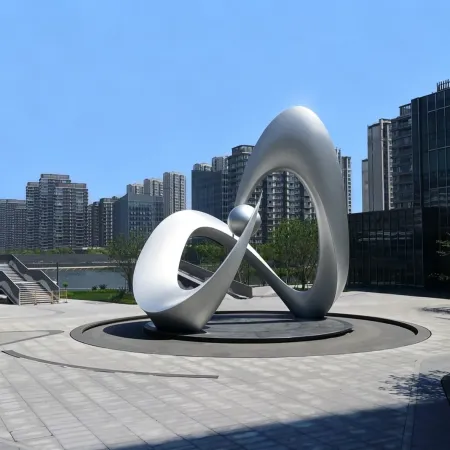
Finish selection is part of our fabrication service, and a work where a soft sheen carries the design is Wind Sail. Other stainless pieces with different surface treatments are shown in the project gallery.
Tell us how the site is used and how much contact the work will receive, and we will specify the grain accordingly. Chosen with that care, a brushed stainless steel sculpture stays quietly handsome through years of ordinary public life.