Why a Landmark Bronze Sculpture Still Commands Public Space
A landmark bronze sculpture carries a weight of tradition that no other material can imitate, because bronze has commemorated heroes, founded cities and marked sacred ground for millennia, and that inherited authority still shapes how the public reads a bronze form today. When a city or institution wants a work that feels permanent, important and worthy of its occasion, bronze remains the material that says so without a single word. I have spent more than a decade casting landmark bronze sculpture for clients across twenty-three countries, and this guide explains the craft, the process and the decisions behind a commission that will outlive us all.
We will look at why bronze still matters, how the lost-wax and sand casting processes work at landmark scale, and how to commission a bronze that carries both authority and artistry.
Our casting and fabrication services cover bronze work at any scale, the project archive documents completed public commissions, and the Zhang Cangshui monument shows a bronze narrative figure realised at civic scale.
The Authority Bronze Carries Into Public Space
No material carries more accumulated meaning into a public commission than bronze. For thousands of years bronze has been the medium of the monument, the memorial and the civic portrait, and that history is embedded in the way people respond to it: a bronze figure feels like history, a bronze abstract feels like a treasure, and a bronze landmark feels like an inheritance rather than a decoration. The material itself performs the task of conferring importance, which is why governments, universities and institutions continue to choose it for their most significant commissions.
Bronze also ages with a dignity that other materials struggle to match. Rather than degrading, the surface develops a patina that deepens its character, and a bronze that has stood for decades acquires a depth of tone that no new sculpture can counterfeit. In coastal and polluted environments, careful specification and protective treatment keep that ageing graceful, and a well-maintained bronze landmark is effectively a permanent civic asset, one that can be restored and preserved across centuries rather than replaced within decades.
How Bronze Is Cast at Landmark Scale
A landmark bronze sculpture is almost always produced by the lost-wax process, adapted to a scale that would astonish a jeweller. The artist's full-size model, usually built in clay or plaster over an armature, is used to create a flexible mould; from that mould a wax version of the sculpture is produced, and the wax is coated in ceramic to form the investment. The wax is then melted out, leaving a cavity that receives the molten bronze, and after cooling the ceramic shell is broken away to reveal the rough cast, which is assembled, welded, chased and finished by hand.
| Stage | Craft Involved | Why It Matters |
|---|---|---|
| Full-size modelling | Sculpting in clay or plaster | Sets the artistic quality |
| Mould and wax | Sectioning and wax reproduction | Defines castable sections |
| Investment and pour | Ceramic shell and bronze pour | Requires foundry discipline |
| Assembly and chase | Welding, chasing and finishing | Hides every seam by hand |
| Patina and seal | Chemical colour and protection | Sets the final character |
Figurative and Abstract Bronze Landmarks
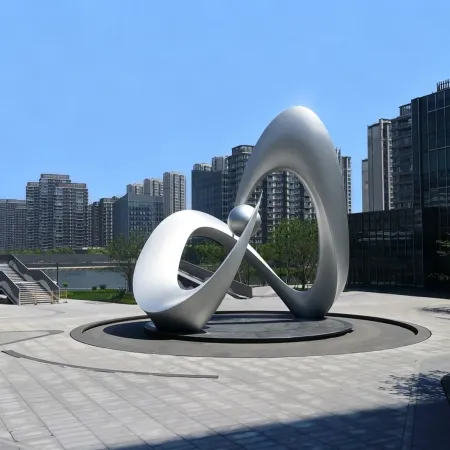
Bronze serves both of the great landmark languages with equal authority. A figurative landmark bronze can honour a historical figure, commemorate an event or celebrate a community hero with a presence that photography cannot flatten, and its sculpting demands mastery of anatomy, character and drapery. An abstract landmark bronze, by contrast, exploits the material warmth and mass, allowing forms that read as pure sculpture while still carrying the inherited gravity of bronze, and many of the most distinguished modern civic commissions are abstract works in bronze.
The choice between them is a choice about meaning. Figurative bronze speaks directly, naming its subject and its story; abstract bronze speaks atmospherically, inviting interpretation while lending its occasion an air of permanence. Clients should choose the language that fits their story and their place, and should choose a studio that is genuinely strong in that language, because figurative and abstract sculpture demand different artistic instincts even within the same material.
- Commemorative: figures and scenes that honour people and events
- Allegorical: forms that carry symbolic meaning and civic values
- Abstract: pure form exploiting bronze mass and patina
- Architectural: integrated bronze elements and portals
Commissioning a Bronze That Will Be Judged by History
A landmark bronze sculpture is commissioned for the long judgement of history, so the process should honour that seriousness. The concept must be developed with the site, the occasion and the community in mind, the full-size model should be reviewed at scale before casting, and the foundry work should be inspected at the wax stage, the assembly stage and the patina stage, because each is a point of no return. Bronze casting hides nothing: every seam, every weld and every surface decision remains visible for centuries, so the inspection regime must match the permanence of the medium.
Inspection Points for a Bronze Landmark
Full-size model approved at scale
Wax sections checked before investing
Cast assembly reviewed before chasing
Patina approved on the finished piece
Caring for a Bronze Across Decades
Bronze asks for modest but regular care, and a landmark should arrive with a maintenance plan. Depending on the environment, the surface may need periodic washing, renewal of its protective coating and attention to any areas where the patina is changing unevenly. The interior of a hollow cast bronze should be ventilated to avoid condensation, and the fixing system should be inspectable so the structure can be verified over time. A studio that delivers a bronze without a maintenance manual is leaving the last chapter of the commission unwritten.
Since 2003 our studio has designed and cast landmark bronze sculpture across twenty-three countries, for cities, institutions and private collectors. We run our own modelling, casting and finishing facilities, and we treat every bronze commission as a conversation with the future, because that is what a landmark is.
A landmark bronze sculpture is the most permanent statement a community can make about what it values, and it will carry that statement for centuries. Cast with mastery, finished with care and sited with intelligence, it becomes part of the civic inheritance, a landmark bronze sculpture that future generations will read as history.
Bronze Alloys and the Science of a Good Cast
The quality of a landmark bronze sculpture begins in the foundry with the alloy itself, and the specification of that alloy is one of the quiet decisions that decide a cast future. Most sculptural bronze is an alloy of copper and tin, with small additions that affect its fluidity, strength and colour, and the correct specification depends on the size of the cast, the complexity of the form and the environment the work will face. The foundry should be able to explain its alloy choice, to certify the composition of the metal and to demonstrate its control of the pouring temperature, because bronze that is poured too hot or too cold carries hidden weaknesses that may not appear until years of outdoor life have tested the work.
The casting process itself is where the science meets the craft, and a serious foundry controls every variable. The ceramic shell must be built to withstand the heat of the pour; the wax must be completely removed so that no residue contaminates the metal; the bronze must flow into every recess of the mould; and the cooling must be managed so that the cast does not distort or crack. After the shell is removed, the cast sections are inspected, welded together and chased, and the quality of that chasing determines whether the seams disappear and the surface reads as a single continuous form. A landmark bronze sculpture is the product of hundreds of controlled decisions in the foundry, and each one leaves its mark on the finished work.
Frequently Asked Questions About Landmark Bronze Sculpture
How long does casting a landmark bronze take?
Modelling, moulding, casting, assembly and finishing of a large bronze typically take many months, and the schedule depends on scale and complexity. The full-size model phase alone deserves generous time.
What is the difference between lost-wax and sand casting?
Lost-wax casting captures fine detail from a wax reproduction of the model, while sand casting presses the form into sand moulds and suits simpler, larger geometry. Most sculptural bronze uses the lost-wax process.
Can a bronze landmark survive outdoors for centuries?
Yes, with correct alloy specification, protective treatment and periodic maintenance. Bronze has survived outdoors for millennia, and a modern commission with a maintenance plan is built to endure.
How is a large bronze sculpture installed?
Large bronzes are cast in sections, assembled and welded in the studio, then transported and placed on a prepared foundation with an engineered fixing system. Very large works may be assembled on site.
How do we maintain the patina of an outdoor bronze?
Periodic gentle washing, renewal of the protective coating and inspection of drainage and fixings keep a patina healthy. A studio should deliver a maintenance manual with every outdoor commission.
A landmark bronze sculpture is an act of faith in the future, a decision that this story, this person or this place deserves to be remembered in the most permanent medium we possess. When the casting is true and the siting is wise, the work outlives its makers and speaks for its community to generations that have not yet been born.
Tell us the story your landmark must carry, and we will show you how a landmark bronze sculpture can carry it for centuries.