What a Large Scale Sculpture Company Must Engineer Before It Builds Big
A large scale sculpture company lives or dies by its engineering, because when a sculpture grows to monumental size every assumption of small-scale craft stops applying. Weight multiplies with volume, wind loads grow with surface area, and a form that stands easily at three metres may need an internal skeleton of steel at twelve, so the leap in scale is really a leap in discipline.
Yifeng Sculpture Studio has operated as a large scale sculpture company since 2003, delivering over 3000 works including monumental landmarks across 23 countries. Our team unites sculptors trained in the traditions of the China Academy of Art, the Academy of Arts & Design at Tsinghua University and the Royal Society of Sculptors with structural engineers who calculate every monumental form before a single sheet of steel is cut.
See monumental works in our project gallery, review the engineering services on the services overview, and study a signature large work such as Fishing Net Canopy, a 47-metre structural canopy that demanded engineering thinking at every scale.
Why Monumental Scale Changes Every Rule
Scale is not a matter of making a small sculpture bigger; it is a transformation of the entire problem. A sculpture doubled in every dimension weighs eight times as much, catches four times the wind and demands foundations, transport and erection that the small version never considered. What was a single sheet of metal becomes a ribbed shell; what was a simple base becomes a reinforced concrete foundation engineered for overturning and soil bearing.
This is why a large scale sculpture company must think like a bridge builder as much as a sculptor. The studio has to verify the structure against real loads, plan how the sections will be fabricated, transported and lifted, and design the internal skeleton so that the outer form stays true while carrying forces that small works never feel. Clients who commission monumental art are buying this engineering maturity, and the ones who skip it discover why too late.
The Engineering Checks Behind Every Monumental Work
The table below sets out the engineering disciplines a large scale sculpture company applies to every monumental commission, and the questions each one answers.
| Engineering check | What it verifies | Why it matters |
|---|---|---|
| Structural analysis | Self-weight, load paths, member stresses | Confirms the skeleton can carry the form |
| Wind engineering | Wind loads, overturning and vibration | Prevents the sculpture becoming a sail |
| Foundation design | Soil bearing, anchorage, overturning resistance | Grounds the work safely in its site |
| Sectioning plan | How the work splits for transport and erection | Makes monumental logistics possible |
| Seismic and fatigue | Local ground motion, moving-part fatigue | Protects the work in its real environment |
Designing the Invisible Skeleton
The inner structure of a large sculpture is a design problem as creative as the outer form. The skeleton must carry the skin, resist the loads and allow access for maintenance, all without distorting the silhouette the artist approved. Our engineers model the interaction between shell and frame, positioning ribs and stringers where they strengthen the form and hide inside its geometry, so the visible work remains pure while the hidden work does its job.
The skeleton also has to anticipate the life of the work. Drainage paths must be built in so water never collects where it can corrode or freeze; access points must allow future inspection and repair; and connections must be designed for the thermal movement that large structures experience between summer and winter. A large scale sculpture company that thinks about year fifty while it designs year one is protecting the client's investment in ways that never appear in the renderings.
How Monumental Works Are Built and Installed
Fabricating a monumental sculpture requires planning the build sequence as carefully as the design. Sections must be fabricated within the workshop's capacity, pre-assembled to verify fit, then broken down again for transport; weld distortion must be controlled across large assemblies; and the finish must be applied in a sequence that protects completed areas while work continues on others. Every step is documented so the site team knows exactly how the pieces go together.
Installation is the moment when all the planning is tested. The studio arranges cranes of the right capacity, plans the lifting sequence so sections are guided into place without damage, aligns the joints to the approved geometry and completes the final welding and finishing on site. For major works our own team leads the erection, and for international deliveries we provide a complete installation package or supervise on site, because the opening day of a landmark is not the time for improvisation.
What to Look for When Commissioning at Scale
- In-house engineering: does the studio employ structural engineers who calculate the work, or does it outsource the numbers and hope?
- Monumental track record: ask for large works the studio has delivered end to end, and verify their condition years after installation.
- Foundation package: the studio should provide foundation drawings and load data your local engineer can build from.
- Erection plan: how will the sections be lifted, aligned and joined? A serious studio plans this in writing before fabrication.
- Wind and seismic honesty: the studio should raise these topics before you do, because monumental works cannot afford to discover them late.
A client who commissions a large scale sculpture company on these criteria is choosing engineering maturity over marketing imagery, which is exactly the right basis for a work that will stand for generations.
The Artistic Freedom That Big Engineering Unlocks
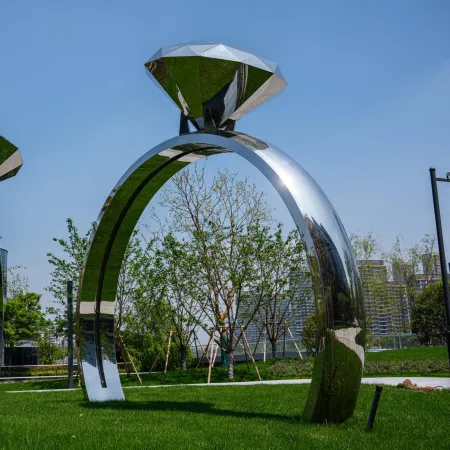
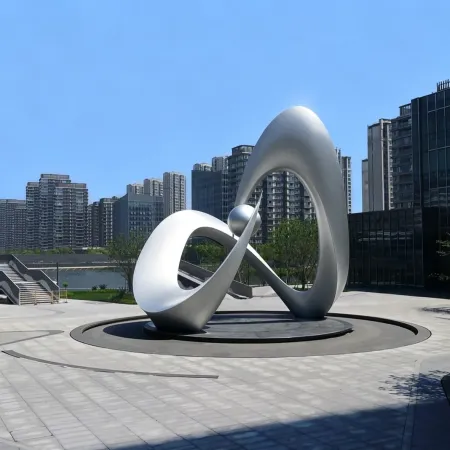
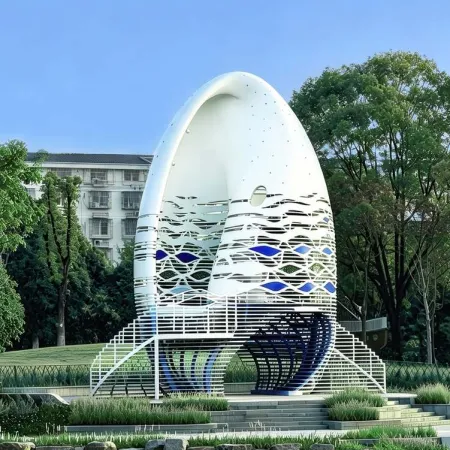
The purpose of all this engineering is not to constrain art but to liberate it. When the structure is certain, the artist is free to reach for forms that would be reckless without it: cantilevers that extend over plazas, shells that enclose space, canopies that span forty metres and figures that rise above the surrounding architecture. Some of our most memorable landmarks, from the sweeping petals of Peach Blossom to the engineered span of Fishing Net Canopy, exist only because their engineering was resolved before their ambition was limited.
That is the deepest value a large scale sculpture company offers its clients: the confidence to dream big, backed by the certainty that the dream will stand. When art and engineering are truly integrated, the client stops worrying about whether the work can be built and starts imagining what it will mean to the people who live with it, which is exactly where every great public commission should begin.
The Foundation of a Great Large Work
Structure verified by engineers before steel is cut
Wind, foundation and seismic loads calculated honestly
Sections planned for transport and erection from day one
Artistic freedom unlocked by engineering certainty
Budgeting Realistically for Monumental Work
Monumental sculpture is expensive for reasons that are often invisible until they arrive, and a large scale sculpture company protects its clients by being honest about where the money goes. The cost of a large work is driven by material quantities, structural engineering, the shop time of highly skilled craftsmen, the finishing of vast surfaces, and the transport and craneage that a monumental object demands, and each of these must be estimated with experience rather than optimism. A realistic budget, presented transparently and phased with the design gates, lets the client decide where to invest and where to simplify before commitments are made.
The studio's experience is the client's best protection against budget surprise, because a studio that has engineered many monumental works knows where the hidden costs live. Foundations can cost more than the client expects when ground conditions are poor, access can limit crane choice and add rigging complexity, and finishing a large surface to a high standard consumes more skilled hours than small works ever reveal. By surfacing these realities early and pricing them honestly, a responsible studio ensures that the client's ambition and budget meet on solid ground rather than colliding at the worst moment.
Frequently Asked Questions About a Large Scale Sculpture Company
What is a large scale sculpture company?
A studio that designs, engineers and fabricates monumental sculpture, with structural engineering, sectioning and erection planning capable of works far beyond ordinary scale.
What makes a sculpture large scale?
There is no fixed threshold, but works that demand structural engineering, sectioned fabrication and crane installation, typically from around six to eight metres upward, enter the monumental category.
How is a monumental sculpture transported?
Large works are fabricated in sections planned to fit transport envelopes, pre-assembled to verify fit, then shipped and re-erected on site by the studio's team.
Who designs the foundations for a big sculpture?
The studio provides foundation drawings, anchorage details and load data, which the client's local structural engineer incorporates into the site foundation works.
How long does a monumental commission take?
Monumental projects typically run many months from concept through installation, with engineering, approvals, fabrication and erection each adding to the timeline.
A large scale sculpture company is the partner that makes monumental dreams structurally certain, turning ambition into a verified, engineered landmark that will stand for generations. Choose in-house engineering, a proven monumental record and an honest approach to wind, foundation and erection, and your city will gain a landmark built on certainty rather than hope.
If you are imagining a landmark that will define a skyline or a gateway, bring us the site and the vision, and we will show you how a large scale sculpture company would engineer it into reality.