Why an Architectural Facade Sculpture Turns a Building Envelope into a Landmark
An architectural facade sculpture is a sculptural element that is built into or attached to a building facade, working with the envelope instead of standing apart from it. It can take the form of sculptural cladding, art louvers, relief panels, a canopy sculpture or a three-dimensional composition anchored to the wall, and its purpose is to give the building a face that people remember. In our studio we have found that facade-integrated artwork changes how a whole district perceives a project.
The commercial logic is straightforward. Two office buildings can share the same floor plate, the same glazing and the same rent, but only one of them becomes a landmark, and the difference is usually a moment of character on the outside. Developers spend heavily on lobby finishes that visitors see for seconds, yet the facade is seen by every passerby every day. A facade sculpture is one of the few investments that converts that daily visibility into lasting identity, press imagery and leasing leverage.
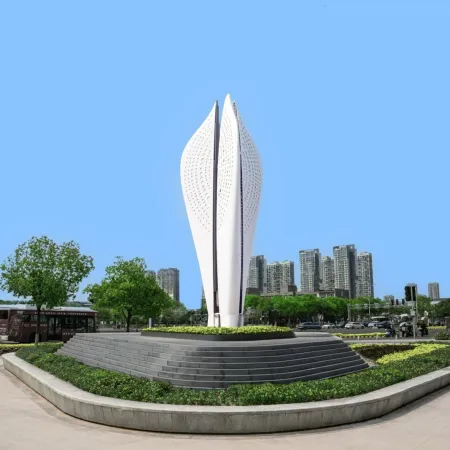
Bringing this kind of artwork to life requires a team that understands both art and building science. At Yifeng Sculpture Studio we manage the whole chain from the first concept to the final anchor bolt, following our four-step process described on the services overview, with delivered projects documented in our project archive. A strong reference for sculptural form connected to architecture is Peach Blossom, a 20.8 m stainless steel petal gateway we delivered as a landmark entrance statement.
What an Architectural Facade Sculpture Can Be
Clients often imagine a facade sculpture as a single heroic object, but the most successful examples we have produced are more varied. Some are sculptural screens that shade a glass wall while carrying an artistic pattern. Some are relief compositions that give depth to a blank elevation. Some are three-dimensional forms that project from the wall at entrance level, and some are full sculptural envelopes where the artwork and the cladding system are one and the same system.
- Sculptural screens and art louvers: panels that manage sun and views while creating a patterned, layered surface that changes through the day.
- Relief and panel compositions: low-relief metal or composite panels that add shadow and texture to otherwise flat elevations.
- Projecting forms at entry: canopies, fins and three-dimensional gestures that mark the entrance and shape the arrival experience.
- Integrated lighting surfaces: facades where sculpture and illumination work as one night-time composition.
Engineering a Facade Sculpture That Performs
A sculpture on a building facade is exposed to forces that a ground-level artwork never meets. Wind loads grow with height, and local pressure around corners and parapets can be severe, so every projecting element is engineered with calculated loads rather than intuition. Thermal movement also matters: a large metal panel attached to a facade expands and contracts with every day-night cycle, and the fixing system must allow that movement without transferring stress to the artwork or the building.
Water management is the quiet killer of facade artwork. We detail every joint, drip edge and drainage path so water never runs behind panels or sits inside hollow forms, and we coordinate the waterproofing membrane with the building envelope specialist. Because a facade sculpture is maintained from a cradle or a lift rather than from the ground, we also design access points and replaceable modules into the system, so a future repair never requires dismantling the whole work.
Materials for Architectural Facade Sculpture
The material palette for facade sculpture is dictated by the building's own envelope. Stainless steel in 304 or 316 grade suits polished, brushed and colored finishes and performs well in most climates. Aluminum offers lighter weight for large screens and projecting fins, and it accepts durable powder coatings in a wide color range. Copper alloys bring warmth that ages naturally, while composite systems allow deeply sculpted panels at lower weight. Each material has a different structural behavior, joining method and maintenance profile, and our fabrication team works in all of them.
Finish quality is where facade sculpture succeeds or fails in public perception. A polished stainless panel that shows weld lines, or a painted surface that fades unevenly, will embarrass the building owner for years. Our workshop controls finishing in-house, and we test samples under the actual site conditions, including the direction of the sun, before approving a production finish. We also confirm the coating system meets the project's expectations for color stability.
Working a Facade Sculpture into the Project Program
The single biggest mistake we see is treating a facade sculpture as a late decoration decision. If the artwork is added after the envelope system is designed, the project pays twice: once for the artwork and once for the structural modifications needed to carry it. When the sculpture is planned with the facade, the supporting steel, the waterproofing and the access strategy are designed once, and the artwork becomes a coordinated component of the envelope.
We therefore ask to join the project at the facade design stage. At that point we can review the wall build-up, the structural grid and the maintenance strategy, and we can propose a sculpture concept that uses the existing systems rather than fighting them. For projects with public art requirements, we also prepare the approval documentation that architects and municipal reviewers expect, including structural assumptions and material certifications.
Budgeting and Approving a Facade Sculpture
Money for a facade sculpture is found in different pockets depending on the project. Private developers often allocate it from the marketing and brand budget, because the artwork directly supports leasing and press coverage, while civic projects frequently draw on public art programs that require a percentage of construction cost to be committed to commissioned work. Understanding which pocket the money comes from changes how the proposal is framed, and we help clients build the internal case that survives a finance committee review rather than dying in the first meeting.
The approval package matters as much as the art itself. Reviewers want to know how the sculpture is fixed, what loads it imposes on the structure, how it will be cleaned and what happens if a panel needs replacement. We prepare these documents as a standard part of the service, written in language that structural engineers, building officials and art committees can each accept. For a building owner, this means the artwork arrives with its engineering homework already done, which shortens the approval cycle and removes the most common reason projects stall.
Life-cycle thinking completes the budget picture. A facade sculpture built with quality finishes and designed for maintenance access costs less to own over thirty years than a cheaper artwork that needs frequent attention at height. We are transparent about this trade-off because it is central to our advice: the goal is not the lowest first cost, it is the lowest cost of a work the owner is still proud of in a generation.
Our Facade Integration Review, Step by Step
- Site and elevation study to identify anchor zones
- Interface drawings issued to the project engineer
- Load assumptions confirmed against the wall build-up
- Prototype approval, fabrication and staged installation
Why Clients Build Facade Artwork into Their Projects
- Distinctive identity that supports leasing and brand value
- Approval-ready artwork that satisfies public art expectations
- One accountable studio from concept to installation certificate
- Engineered details that protect the envelope warranty
Common Questions About Adding an Architectural Facade Sculpture
Will a facade sculpture affect the building warranty?
Not if it is coordinated with the envelope contractor. We design the interface so the artwork and the waterproofing systems remain independent and documented, which keeps both warranties intact.
How is the sculpture cleaned and maintained at height?
We design for cradle or lift access, specify cleaning methods for each finish, and hand over a maintenance schedule with the installation documents.
Can the design be changed after the facade is under construction?
Some changes are still possible, but they become expensive once supporting steel is fixed. The earlier you engage us, the more design freedom you keep.
What information do you need to engineer a facade piece?
We start with elevation drawings, the wall build-up, the structural grid and the site's wind zone. From these we produce interface drawings that your structural engineer can review, so the sculpture and the building share one load path instead of two competing assumptions.
Can lighting be integrated with the building's own system?
Yes. We coordinate fixture selection, wiring routes and control points with the facade and electrical consultants, so the sculpture reads as part of the architecture after dark rather than as a separately lit object.
Because a facade sculpture is judged at close range by people who pass it every day, we verify craft before production begins. The approval process includes finish samples, weld mock-ups and, for large or complex works, a full-scale trial section that lets the client see the actual surface quality rather than imagining it from a render. This step catches the mismatches that photographs hide, such as a brushed direction that clashes with the glazing or a color that shifts under the site's particular light, and it gives every stakeholder the confidence to approve the final production run.
The buildings that define a skyline are rarely the tallest ones; they are the ones with a face you can name. An architectural facade sculpture gives a building that face, and when it is engineered as part of the envelope it costs less, lasts longer and integrates more cleanly than an artwork added as an afterthought. Across thousands of installed works in more than twenty countries since 2003, we have seen this principle repeat in every market.
If your project has a facade system being designed, or a blank elevation waiting for a reason to exist, send us the elevation drawings and the site context. We will come back with practical options for an architectural facade sculpture that fits your structure, your budget story and your timeline. Start the conversation with our studio.