Why Abstract Public Space Art Endures Where Literal Works Date
Abstract public space art endures because it invites each generation to find its own meaning instead of lecturing with a frozen story, and that openness is exactly what a long-lived public commission needs. When a work represents a figure or a fixed event, its message ages with the politics and the fashion of its moment; when a work is composed of pure form, light and material, it stays alive because the conversation it starts belongs to the viewer.
In our work across 23 countries since 2003 we have watched this truth repeat: the public pieces that still feel fresh after a decade are almost always the ones that trusted abstraction, while the literal ones quietly became invisible. This guide explains how abstract public space art is commissioned, designed and built, why abstraction reduces risk rather than increasing it, and how to choose an abstract form that your community will keep finding meaning in.
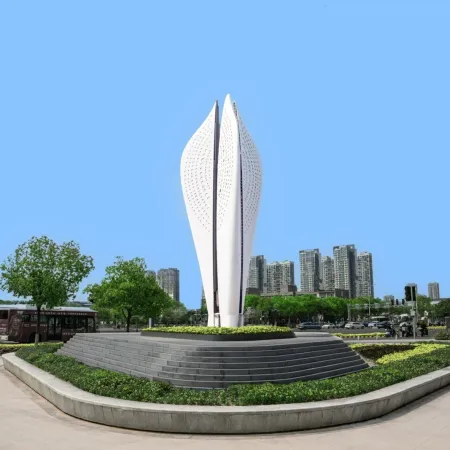
Browse completed works in our project gallery, the full capabilities in our services overview and an abstract landmark such as Peach Blossom, a 20.8-metre sculptural gateway.
What Abstraction Offers a Public Commission
The first advantage of abstract public space art is interpretive freedom. A civic committee rarely agrees on a single story, but a community can agree on a form, a gesture or a material that feels right for its place, and every resident can then read it in their own way. Children see a game in it, older residents see a memory, visitors see a landmark, and none of those readings is wrong. That multiplicity is not a weakness of abstraction; it is the entire point, and it is the reason abstract works survive changes of leadership and taste.
The second advantage is timelessness in material and silhouette. An abstract composition in stainless steel, bronze or stone speaks the language of sculpture itself rather than the language of a particular era, so it does not carry the visual costumes that date a representational work. A curved steel form that echoed a river will still echo it in forty years; a figurative tribute to a specific technology will look quaint once the technology is obsolete. Clients who want a permanent gift to their city are therefore often best served by a form that resists dating.
The Discipline Behind Seemingly Simple Forms
A misleading myth holds that abstract public space art is easier than figurative work because there is no likeness to get wrong. In practice the opposite is true: a non-representational form has no reference to hide behind, so its proportions, its balance, its negative space and its finish must be exactly right or the failure is naked. Every curve, joint and shadow is judged on its own terms, which is why the strongest abstract works come from studios with serious artistic training and long material experience rather than from sign makers who happen to bend steel.
The artistic pedigree behind the work matters. Our designers come from backgrounds connected to institutions such as the China Academy of Art, the Academy of Arts & Design at Tsinghua University and the Royal Society of Sculptors, and we have collaborated with artists including Nick Hornby and Assadour Markarov. That lineage shows in the things laypeople cannot name but can feel, the exact widening of a form, the placement of a void, the way light lands on a surface, and those judgments are what separate a sculpture from an object.
| Quality | What it looks like in the work | Why it matters |
|---|---|---|
| Proportion | The form answers the scale of its site | A wrong scale never stops feeling wrong |
| Negative space | Voids that frame sky and people | The space around the form is part of the form |
| Material truth | Finish and structure behave honestly | Honest material ages with dignity |
| Light behaviour | Surfaces planned for sun and night light | A work is seen at all hours, not only noon |
How an Abstract Concept Is Developed and Approved
A serious abstract commission follows a disciplined path even though the outcome is poetic. It begins with a conversation about the place, its history, its users and the feeling the client wants the space to carry, and only then does the studio search for forms that answer those questions. The concept is tested through sketches and digital models in the context of the actual site, presented honestly with its reasoning, and refined through feedback until the committee recognises the work as its own.
Presenting abstraction to stakeholders takes craft in itself. We have learned to talk about an abstract proposal in the language of the site rather than the language of art theory, explaining how the form will catch the morning light, how it frames the view from the café terrace, how it reads from the passing road and how children will move around it. When people understand a form through their own experience of the space, the abstraction stops feeling alien and starts feeling inevitable, and approval follows understanding.
Designing an Abstract Work That Suits Its Site
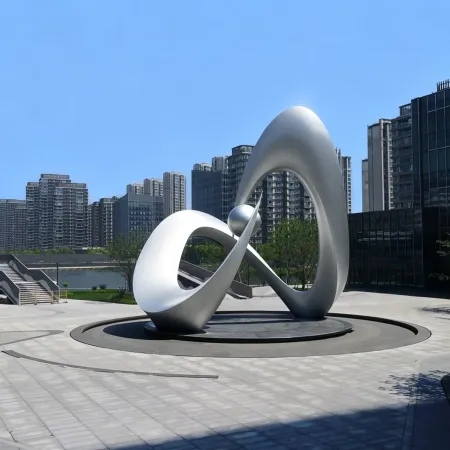
The site is the first material of any abstract public space art. A plaza form must hold its own against buildings and traffic, a park form must answer trees and paths, a waterfront form must echo the movement of water, and a courtyard form must scale itself to the people who pause there. Our design process begins with the site's dimensions, sightlines, sun paths and the daily choreography of its users, so the abstraction grows from the place rather than being imported into it.
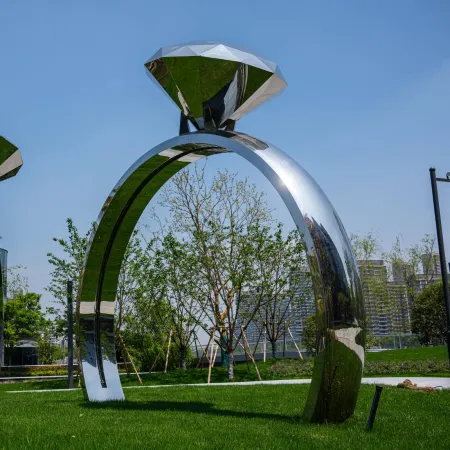
We also design the work's behaviour across the day and the seasons. A mirror-polished form changes with every cloud, an illuminated form belongs to the night, a wind-responsive form lives with the breeze and a weathered form deepens its character over years. The client should decide which of these lives the work will lead, because each one changes the engineering, the maintenance and the budget, and an abstract work that is designed for its full daily cycle rewards the city at every hour.
Fabrication and Engineering of Abstract Forms
Behind every effortless abstract silhouette sits serious engineering. A large steel form must be analysed for wind load, dead load and seismic behaviour; curved plates must be formed without buckling and welded without distortion; mirror finishes must be protected from contamination; and monumental works must be sectioned so they can travel and be re-joined invisibly on site. Our workshop fabricates works up to monumental scale under one roof, so the artists who conceive the form are the same people who must make it stand.
The finish is where abstraction is won or lost. A figurative work can survive an imperfect surface because the eye is busy reading the subject; an abstract work offers no such distraction, so the polishing, the patina or the coating must be flawless and consistent across every section. We hold finish samples in the light of the actual site, we protect surfaces through packing and transport, and we inspect the completed form against the approved sample before release, because in an abstract work the surface is the message.
What a Well-Resolved Abstract Work Delivers
A landmark that resists dating and stays fresh for decades
A form every viewer can claim without any reading being wrong
A silhouette that frames the site at every hour of the day
A surface so resolved that the craft disappears into the form
Commissioning Checklist for Abstract Public Space Art
- Write the brief around feeling and place, not around a prescribed shape.
- Shortlist studios with real artistic lineage, because abstraction hides nothing.
- Judge concepts in site context, with models and photomontages, not drawings alone.
- Approve the finish on full samples before any production begins.
- Plan the night and maintenance life of the work as part of the budget.
Frequently Asked Questions About Abstract Public Space Art
Why choose abstract public space art over figurative work?
Because abstraction invites every generation to find its own meaning, it does not depend on a fixed story and it resists dating in a way that literal work cannot.
Is abstract work harder to get approved by a committee?
It needs a different presentation, one that explains the form through the site, the light and daily life, but that approach often unites committees that cannot agree on a single story.
What materials suit an abstract public work best?
Stainless steel for mirror and longevity, bronze for warmth and patina, weathering steel for landscape character, and aluminium for light, coloured or kinetic forms.
How do I evaluate an abstract proposal I cannot fully visualise?
Ask for contextual digital models, physical scale models, material samples and the studio's reasoning, and judge how the form answers the site rather than how it looks in isolation.
Do abstract works need more maintenance than figurative ones?
Not more, but more visible, because an abstract surface shows every mark, so the specification should choose finishes and coatings matched to the site and its cleaning routine.
Abstract public space art is not an escape from meaning; it is a higher trust in meaning, a belief that a community can meet a great form and grow into it over years. The works that earn that trust are designed by artists, engineered by makers and finished to a standard that hides nothing, and they reward their cities for generations.
If your site is ready for an abstract public space art commission, we will bring contextual models, material samples and the reasoning behind our forms to the first conversation, and let the place tell us what it needs.