What a Sculpture Installation Company Does That Fabrication Alone Never Covers
A sculpture installation company exists because the hardest part of a sculpture's life is often the day it meets its site, and that day is where beautiful fabrication frequently comes undone. Transport, lifting, alignment, anchoring and commissioning each carry risks that no workshop can control, and a studio that also masters installation protects the work through its most dangerous hours.
Yifeng Sculpture Studio has worked as a sculpture installation company since 2003, installing more than 3000 works across 23 countries. Our team combines the artistic training of the China Academy of Art, the Academy of Arts & Design at Tsinghua University and the Royal Society of Sculptors with site engineers and rigging specialists who plan every lift, every foundation and every commissioning sequence before the truck arrives.
See the results of careful installation in our project gallery, review the services around delivery on the services overview, and study an installation-heavy commission such as Hello Conch, a 12.8-metre interactive landmark whose erection demanded precise planning and careful commissioning.
Why Installation Is Where Sculptures Are Won or Lost
A sculpture may be perfect in the workshop and still be ruined in the last hundred metres to its foundation. Cranes can stress sections their designers never imagined, lifting slings can scar polished surfaces, alignment errors can throw a monumental composition out of true, and a foundation cast to the wrong level can leave a landmark sitting awkwardly for decades. Installation is a discipline with its own skills, its own risks and its own planning, entirely separate from fabrication.
This is why the studio that fabricates should also install, or at least plan the installation as part of the design. When the same team that engineered the sections plans their lifting points, their transport and their erection sequence, the work is designed for its installation from the start. When installation is left to a crew meeting the sculpture for the first time on site, the client is gambling the entire investment on strangers.
The Installation Sequence From Workshop to Opening
The table below sets out the stages a sculpture installation company manages between the workshop and the finished site installation.
| Stage | What is managed | Risk controlled |
|---|---|---|
| Transport planning | Route survey, vehicle selection, protection packing | Damage and delays in transit |
| Foundation check | Level, position, anchor points and load capacity | A base that cannot carry the work |
| Lifting plan | Crane capacity, rigging points, lifting sequence | Stress and damage during erection |
| Alignment and fixing | Plumb, level, orientation and permanent anchorage | A landmark that stands visibly wrong |
| Commissioning | Electrical, kinetic and interactive systems testing | Failure on the first public day |
Planning the Lift Before the Crane Arrives
The lifting plan is the heart of professional installation, and it is written long before the crane arrives on site. The studio must know the weight of every section, the position of its centre of gravity, the capacity and reach of the crane, the rigging points that will not damage the work and the sequence in which sections must be placed. For monumental pieces the plan may include temporary bracing, multiple crane positions and a choreography that guides each section into place without contact damage.
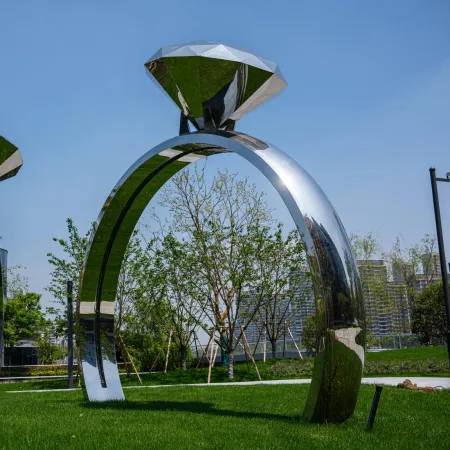
Rigging is where surface damage most often happens. Slings must bear on points designed for them or be protected where they must cross finished surfaces; polished stainless and painted work need special handling that a general rigging crew may not understand; and every contact point should be planned so that the finish that took weeks to perfect survives the hours of erection. A sculpture installation company that has handled mirror finishes and delicate surfaces knows exactly where the dangers lie.
Foundations and the Alignment of Truth
A sculpture can only stand as true as its foundation, so the installation team verifies the base before the work is ever lifted. The foundation must be level to the specification, positioned to the survey marks, strong enough for the loads and fitted with the anchors the design requires. Where the foundation is wrong, the studio must decide whether it can be corrected on site or whether the work should wait, because installing a landmark on a faulty base stores failure for later.
Alignment is the visible proof of installation quality. A sculpture that should rise vertical must be plumb within tolerance; a composition that should face a certain direction must be oriented to the sightlines; and sections that were fabricated separately must meet at the approved geometry. Our teams use surveying instruments and careful measurement to set the work true, because the public may not know why a sculpture looks wrong, but they will know that it does.
Commissioning Interactive and Kinetic Works
For interactive and kinetic sculpture, installation ends not with the lift but with commissioning, the process of making the work actually function as designed. Electrical systems must be connected safely, sensors must be calibrated to the real site, moving elements must be balanced and tested through their full range, and the control system must be configured and verified before the public is admitted. Every function is tested, every safety system is confirmed and every failure mode is considered before opening day.
The commissioning also trains the owner. The client's team should learn how to operate the work daily, what to check each week and how to respond to common faults, so a small issue is cleared on site rather than escalating into a long outage. A sculpture installation company that hands over a fully commissioned work with a trained owner has completed the job; one that leaves the client to discover the controls alone has not.
What to Look for in a Sculpture Installation Company
- Design-linked installation: does the studio that engineered the work also plan and lead its installation, so the sections are designed for their erection?
- Written lifting plan: ask to see how a similar work was lifted, rigged and aligned before you trust them with yours.
- Surface protection: how does the crew protect polished and painted finishes through rigging and erection?
- Foundation verification: will the team check the foundation, the level and the anchors before the work is lifted?
- Commissioning depth: for interactive works, does the studio test, calibrate and train the owner before opening day?
A client who tests these five points will find a partner that treats installation as a craft rather than an afterthought, which is exactly the care a finished sculpture deserves at its most vulnerable moment.
International Installation and Remote Supervision
Installing works across 23 countries has taught us to deliver installation expertise in every format. For many international commissions we provide a complete installation package, detailed drawings, step-by-step erection sequences and remote supervision by video, which lets a capable local crew erect the work with our engineers watching and guiding in real time. For complex monumental works, our own team travels to lead the installation, because some erections justify the presence of the people who designed them.
Whichever format the project needs, the standard is the same: the work is installed true, safe and fully commissioned, and the client receives the records and guidance to maintain it. A sculpture installation company that can deliver this standard on the other side of the world has turned the riskiest day of a sculpture's life into a controlled, professional operation, and that is the security every client deserves.
What Professional Installation Delivers
Sections engineered for their own lifting and erection
Surfaces protected from the workshop to the reveal
Works set plumb, level and true to the design
Interactive systems commissioned and owners trained
Frequently Asked Questions About a Sculpture Installation Company
What is a sculpture installation company?
A studio that plans and executes the transport, lifting, alignment, anchoring and commissioning of sculpture on site, protecting the work through its riskiest hours.
Why can't a local crew just install my sculpture?
A local crew can, with the right documentation and supervision, but the studio that engineered the work understands its lifting points, alignment and commissioning as no stranger can.
How do you protect the finish during installation?
Through protective films and packing, rigging that bears on designed points, protected slings over finished surfaces and careful handling by a crew trained in sculpture finishes.
What if my foundation is already built wrong?
The installation team verifies the foundation before lifting and, where it is wrong, advises whether correction on site is possible or whether the installation should wait.
How is an interactive sculpture commissioned?
Electrical systems are connected and tested, sensors are calibrated to the site, moving elements are run through their full range and the owner's team is trained before opening day.
A sculpture installation company is the specialist that carries a finished work through the dangerous hours between the workshop and its public life, protecting the investment at the moment it is most at risk. Choose a studio that designs for its own installation, plans its lifts in writing, protects every surface and commissions every system, and your sculpture will open true, safe and exactly as it was meant to be seen.
If your sculpture is approaching its site and you want the erection handled by people who understand the work itself, tell us about the piece and the location, and we will show you how a sculpture installation company would bring it home.