Why Large Geometric Sculpture Brings Order and Drama to Public Space
A large geometric sculpture speaks the visual language of our built world, echoing the lines of architecture, the grid of the city and the mathematics of nature, and that is why it feels so at home in contemporary public space. Where organic or figurative forms bring warmth and narrative, a large geometric sculpture brings clarity, rhythm and a sense of intention, giving plazas, campuses and transit hubs a focal point that matches the intelligence of their design. After more than a decade creating and installing large geometric sculpture across twenty-three countries, I have seen how these precise forms can give a space an identity that is both modern and timeless.
This guide explains the appeal of geometric monumental work, the design discipline it demands and how to commission a piece that enhances rather than decorates its site.
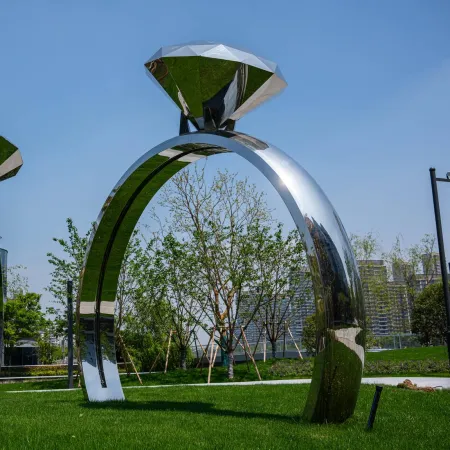
Our sculpture design services include monumental geometric commissions, the public works archive shows the range of our forms, and the Diamond Rings installation demonstrates how precise geometry can become a landmark.
Why Geometry Feels Native to the Modern City
Cities are built from geometry, so a large geometric sculpture enters its environment as a natural citizen rather than a foreign object. The vertical lines of towers, the grids of paving, the curves of a transport hub and the rectangles of glass facades all share a formal language with geometric sculpture, which allows the work to hold a dialogue with its surroundings instead of competing with them. In a contemporary district, a geometric form can feel more site-specific than any organic shape, because it extends the visual grammar the architects have already established.
Geometry also communicates order and intention, qualities that reassure the public in complex urban environments. A precisely composed form suggests that someone thought carefully about this place, and that sense of design intelligence raises the perceived quality of the entire space around it. Plazas framed by strong geometry feel planned rather than accidental, and that feeling of intentionality is part of what makes a large geometric sculpture valuable to developers, planners and the public alike.
The Discipline of Designing With Pure Form
Designing a large geometric sculpture is unforgiving, because geometry exposes every error. A curve that is a few millimetres off, a plane that does not quite meet, a proportion that is subtly wrong, all of these are immediately visible in a form built from pure geometry, where there is no organic texture to hide behind. The designer must therefore work with absolute precision, developing the form in three dimensions, verifying every relationship and testing the silhouette against the site, until the geometry achieves the inevitability that makes great geometric art feel effortless.
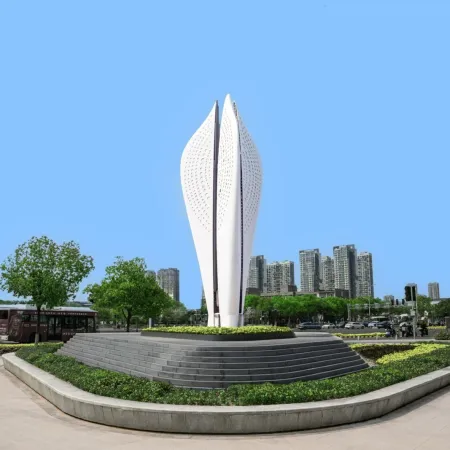
Precision in design must be matched by precision in fabrication. A large geometric sculpture lives or dies on the accuracy of its cutting, forming and assembly, because a misaligned edge or a distorted plane destroys the very clarity that gives the form its power. This is why geometric work demands workshops with CNC cutting, skilled plate forming and rigorous assembly control, and why the best geometric commissions are built by fabricators who understand that tolerance is not a technical detail but an aesthetic principle.
| Geometric Family | Character | Best Settings |
|---|---|---|
| Polyhedral | Faceted, crystalline, precise | Plazas, transport hubs, campuses |
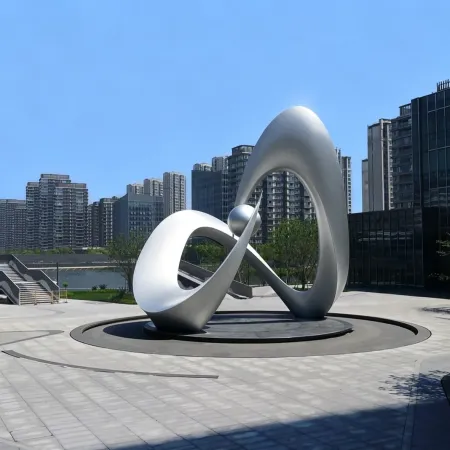
| Arcs and circles | Flowing, framed, rhythmic | Gateways, roundabouts, entries |
| Linear grids | Structural, skeletal, open | Parks, waterfronts, promenades |
| Stacked volumes | Bold, monumental, balanced | Civic squares, commercial centres |
Material and Finish for Geometric Impact
The material of a large geometric sculpture carries much of its meaning, because geometry and surface are read together. Mirror stainless steel doubles the precision of a form by reflecting its surroundings, making the geometry feel lighter and more responsive to the life of the space; painted steel delivers graphic colour and a confident contemporary statement; weathering steel grounds geometric forms in a warm, industrial honesty; and bronze gives pure geometry a classical gravity. The finish must be chosen with the same care as the shape, because it determines whether the work reads as air, image or mass.
Light is the hidden partner of geometric sculpture. A faceted form catches the sun differently on every face, a ring creates shadows that move through the day, and a polished plane reflects the sky so the work changes colour with the weather. Designers of the best geometric work choreograph these effects, positioning the form relative to the sun path and considering how artificial lighting will extend the drama into the night, so the sculpture offers a new face at every hour rather than a single fixed image.
Commissioning a Large Geometric Sculpture
A large geometric sculpture commission should begin with the architecture and the site, because geometry earns its place by answering the language of its surroundings. We study the buildings, the paving, the sightlines and the human flows, then develop geometric concepts that extend or counterpoint the existing design with intention rather than decoration. The client reviews the forms as three-dimensional studies at true scale, and only when the geometry has been proven against the real site does the project move toward engineering and fabrication.
The fabrication of geometric work demands the same precision as its design. Every plane must be formed and joined so that the finished sculpture matches the approved model within tight tolerances, every connection must be engineered to carry the loads, and every finish must be applied so that the surface remains flawless for decades. Our studio holds the whole chain, so the geometric purity conceived in design survives every stage of making, and the work that arrives on site is the work that was approved in the model.
- Match the architecture: geometry should speak to its surroundings
- Choreograph the light: design for sun path and night lighting
- Demand precision: tolerance is an aesthetic, not a detail
- Verify in three dimensions: judge the form at true scale
Geometric Sculpture Delivers to a Site
A modern identity that matches the architecture
A focal point of order and intention
Drama that changes with light all day
A precise form that reads as engineered art
Avoiding the Trap of Decorative Geometry
Not every arrangement of shapes deserves to be called a large geometric sculpture, and the field is full of work that is merely decorative. Decorative geometry adds shapes without meaning, repeating circles or triangles because they look modern, and the result is visual noise that neither speaks to the site nor rewards repeated viewing. Real geometric sculpture is compositional, not decorative, and it succeeds because every relationship in the form, the proportions, the intervals, the balance of solid and void, has been considered and made to carry meaning.
The distinction shows in how the work ages. Decorative geometry quickly feels dated, because it borrowed its vocabulary without understanding it, while composed geometry retains its power because it is built on principles that do not go out of fashion. When commissioning a geometric work, ask the studio to explain the logic of the form, the reason for every proportion and the relationship of the piece to its site, and you will quickly separate the sculptors from the shape-makers.
The Role of Scale Models in Geometric Design
Scale models are not a formality in geometric sculpture but the essential laboratory where the form is tested and refined, because geometry that looks resolved in a rendering often reveals its weaknesses when it becomes a physical object. A model allows the designer to study the play of light across the planes, the relationship of solid and void, and the silhouette from every angle, and it lets the client hold the future work in their hands before committing to the enormous cost of full-scale fabrication. We move through several generations of models, each larger and more detailed than the last, so that the geometry is proven progressively rather than discovered at the moment when correction is most expensive.
The leap from model to monument is the moment when geometric design is truly tested, because tolerances that are invisible at model scale become critical at monumental scale. Every plane must be fabricated within the accuracy that the design demands, every edge must meet its neighbour with precision, and the assembled form must match the approved model so exactly that the public sees the intention rather than the effort. This is why our geometric commissions move from model to full three-dimensional study to a fabrication process governed by the same digital data, and why we encourage clients to visit the workshop as the form takes shape. A large geometric sculpture that is right in the model and right in the workshop will be right in the city, and that chain of accuracy is the quiet craft behind every confident geometric landmark.
Frequently Asked Questions About Large Geometric Sculpture
What is the difference between geometric sculpture and decoration?
Composed geometry uses proportion, interval and balance to carry meaning and hold a site; decoration repeats shapes for surface effect. The difference is visible in how the work relates to its surroundings and how it ages.
Which materials best express pure geometry?
Mirror stainless steel, painted steel and weathering steel lead the field, with bronze for more classical statements. The choice of surface changes how the geometry reads in light.
Can geometric sculpture work in natural landscapes?
Yes, and the contrast between precise geometry and organic nature can be striking. The form and finish must be chosen so the work dialogues with the landscape rather than fighting it.
How is precise geometry fabricated at large scale?
Through CNC cutting, precision plate forming and controlled assembly against the digital model. Fabrication accuracy is what makes the geometry appear effortless in the finished work.
Does geometric sculpture suit a site with a heritage story?
It can, when the geometry is used to interpret the story rather than ignore it. Abstract forms can reference history through proportion, rhythm and material while remaining contemporary.
A large geometric sculpture offers the contemporary city a form of art that matches its own intelligence, bringing order, drama and a sense of intention to the spaces where people gather. Commissioned with compositional discipline and built with precision, it becomes a permanent part of the place it serves.
Let our studio help you find the geometry that will define your space, and give your site a large geometric sculpture built to endure.