What a Plaza Sculpture Manufacturer Must Handle in a Crowded Space
A plaza sculpture manufacturer is working in the most demanding kind of public space. A plaza concentrates people, vehicles, events, deliveries, street furniture and paving into a small area, and anything placed there must coexist with all of it. The sculpture will be photographed, leaned on, sat on, walked around and occasionally bumped by a maintenance vehicle, and it must look right through every one of those encounters.
Yifeng Sculpture Studio has delivered civic and commercial plaza work since 2003, with more than 3000 installed projects across 23 countries. A plaza sculpture manufacturer has to think about sight lines, crowd flow, vehicle protection, night lighting and the paving grid at the same time as the artwork, because in a plaza the setting is part of the work and the work is part of the setting.
Siting, Sight Lines and Crowd Flow
In a plaza, position is everything. A sculpture should be placed where it can be seen on approach, where it does not block the route between the entrances and where it creates a natural gathering point rather than an obstacle. The relationship to the paving pattern, the seating, the tree line and the surrounding facades all matter, and the manufacturer should read the plaza at different times of day to understand how people actually move through it.
Crowd flow also determines the base. A sculpture in the middle of a thoroughfare will be walked into, so the base should be visible, chamfered or raised enough to be read by a pedestrian looking at a phone. In a plaza that hosts markets and events, the work should not obstruct the layout that the operators need, and its position should be agreed with the events team as well as the design team. A plaza sculpture manufacturer who asks those questions early prevents years of small complaints.
| Plaza condition | What it demands | Result when handled well |
|---|---|---|
| Heavy pedestrian flow | Base visible, edges chamfered, no trip hazards | People walk around it without thinking about it |
| Events and markets | Position agreed with operators and service routes kept clear | The plaza keeps working as a plaza |
| Maintenance vehicles | Protection at low level against accidental contact | No dents in year one from a sweeper |
| Night use | Lighting designed with the work, not added to it | The plaza stays legible and safe after dark |
Bases, Seating and the Furniture Question
In a plaza, the base is not just a plinth; it is often a seat. People will sit on any horizontal surface at a comfortable height, so a plaza sculpture manufacturer should either design a base that is deliberately comfortable to sit on, with the right height and a chamfered edge, or design one that clearly is not. A base that is accidentally seat-height but uncomfortable to use generates a small, permanent irritation.
Materials for the base should match the plaza's own palette. Granite, cast stone and precast concrete are common because they are durable and easy to clean, and their colour and texture should sit with the paving rather than fight it. Where the sculpture meets the paving, the junction should be detailed so that water drains away from the base and so that the paving around it can be lifted and relaid without damaging the foundation.
- Decide the seat question: if the base will be used for sitting, design it for that purpose; if not, make the intention unmistakable.
- Match the paving palette: choose a base material and colour that belong to the plaza rather than compete with it.
- Detail the junction: a drainage detail at the base so water does not stand against the plinth or the sculpture.
- Protect at low level: a robust plinth or a discreet bollard ring where vehicles and trolleys routinely pass.
- Allow future relaying: anchors and services positioned so paving can be lifted without disturbing the foundation.
Lighting, Security and the Evening Plaza
A plaza is used at night, and lighting changes how a sculpture is read. A work that is lit from below will show its silhouette and its under-surfaces; a work lit from a distance will read as a shape with no detail; an internally illuminated work becomes a light source in its own right. The lighting design should be part of the sculpture design rather than a separate purchase, and the driver and control gear must be accessible for maintenance.
Security considerations matter in a plaza too. The work should not create hidden areas, should not offer a foothold to climb onto a canopy or a structure, and should not have cavities that collect litter or conceal objects. A plaza sculpture manufacturer should review the design with the site's security team, because small details that seem irrelevant in the studio can become a nightly problem in a busy urban square.
What a Plaza Demands
A position that gathers people instead of blocking them
A base that works as plinth, seat or both, by design
Lighting that belongs to the sculpture
Detailing that resists vehicles, litter and curiosity
Coordinating With the Plaza Programme
A plaza is usually built as part of a larger development, and the sculpture has to fit into a construction programme that is already in motion. The foundation must be built at the right stage, before paving is laid and while the crane can still reach the position. Services for lighting must be ducted before the paving goes down. If those interfaces are missed, the sculpture becomes the reason a finished plaza is cut open again.
Installation in an occupied plaza brings a second set of constraints. Deliveries may have to happen overnight, the crane may need a road closure, and pedestrians must be routed safely around the work. A plaza sculpture manufacturer should produce an installation plan that states the hours, the access, the protection and the sequence, and should coordinate it with the building's management and the local authority before the date is fixed.
- Fix the position early: agree it with the design team, the events operator and the building manager before the paving is designed.
- Duct the services: lighting power and data routes built in before the paving is laid, with access chambers for maintenance.
- Build the base on time: the foundation completed while plant access is still available, not after the plaza is finished.
- Plan the installation: hours, closures, crane position, pedestrian routes and surface protection set out in a written method.
- Leave the plaza clean: reinstate paving, planting and lighting to the standard of the surrounding work, not as a patch.
Wayfinding and the Plaza's Daily Rhythm
A plaza is used in rhythms: the morning commute, the lunch hour, the evening promenade, the weekend market. A sculpture that works at one of those times may fail at another. In the morning it may be backlit and read as a silhouette; at midday it may be lost against a bright facade; in the evening it may need its own light to remain legible. A plaza sculpture manufacturer should study those conditions and, where possible, visit the site at the hours that matter.
The work also becomes a wayfinding landmark whether the designer intends it or not. People will use it to give directions, arrange to meet and describe where they are. That is a benefit, and it can be supported by making the work visible from the main approaches and recognisable from several angles. A sculpture that reads clearly from four directions becomes part of the plaza's navigation rather than an object in the middle of it.
Frequently Asked Questions About a Plaza Sculpture Manufacturer
How do you choose where a plaza sculpture should stand?
By studying how people move through the space at different hours, then placing the work where it is seen on approach, gathers people and does not block routes or event layouts.
Should the base be designed as seating?
Decide it deliberately. If people will sit, design a comfortable height and a chamfered edge; if not, make the base clearly unsuitable so nobody tries.
Can the sculpture be protected from vehicles?
Yes. A robust plinth, a low kerb detail or a discreet bollard arrangement can protect the work without intruding on the composition.
How is lighting integrated into a plaza work?
It is designed with the sculpture, with concealed fixtures, ducted cabling and drivers in an accessible chamber, so the lighting reads as part of the work.
Can installation happen while the plaza is open?
Yes, with a written method covering hours, crane position, road closures, pedestrian routes and surface protection, coordinated with the building management and the local authority.
A plaza sculpture manufacturer is fitting art into the busiest version of public space. The position has to gather rather than obstruct, the base has to work as a plinth and possibly a seat, the lighting has to belong to the work and the detailing has to survive vehicles, litter and curiosity. Get those right and the sculpture becomes the centre of the plaza; get them wrong and it becomes the reason the plaza is difficult to use.
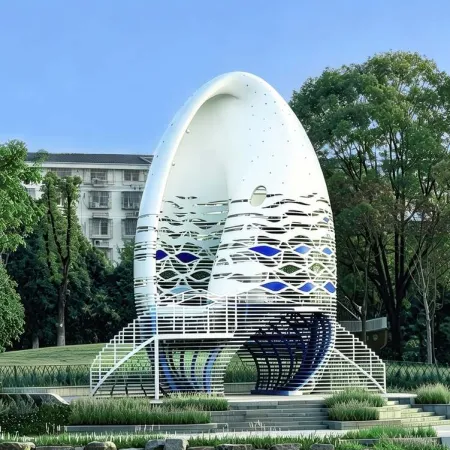
Plaza and civic work is shown in our project gallery, the delivery chain is set out in the services overview, and the Honeycomb Pavilion shows how a structure in a busy public space can shelter, gather and still read as art.
Send us the plaza plan and the way it is used, and we will advise on siting, base and lighting. A plaza sculpture manufacturer who thinks about crowd flow and maintenance vehicles as well as form is one whose work will still be the pride of the square in twenty years.