How a Custom Steel Sculpture Manufacturer Controls Corrosion and Distortion
A custom steel sculpture manufacturer is fighting two opponents at once. Corrosion attacks the work from the outside, through water, salt and pollution, while distortion attacks it from the inside, through the heat of welding and the stresses of forming. A steel sculpture that ignores either one will look wrong long before it fails, and both are controlled by decisions made in the drawing office rather than on the site.
Yifeng Sculpture Studio has fabricated steel sculpture since 2003, delivering more than 3000 works to 23 countries in stainless steel, mild steel, aluminium, bronze, composite and glass. Steel is the most versatile and the least forgiving of those materials, and it rewards clients who ask a custom steel sculpture manufacturer how the coating system was chosen and how the weld sequence was planned.
Choosing the Right Steel for the Site
Steel is a family, not a single material. Mild steel is economical, easy to form and weld and suitable for a painted work, provided the coating system is properly specified. Weathering steel, often called Corten, develops a stable rust patina that protects the metal beneath when it is detailed correctly, with drainage and air access that let the surface dry. Stainless steel resists corrosion without coating but costs more and behaves differently under polishing and welding.
The choice should follow the site. Coastal air carries chlorides that will attack mild steel quickly and can stain nearby paving; industrial atmospheres are acidic; heavy snowfall brings de-icing salt. Weathering steel near a building or a paved plaza will run rust-stained water unless the detailing manages runoff, and a custom steel sculpture manufacturer should raise that risk before the client falls in love with a bare rusted finish in a location that cannot support it.
| Steel type | Best suited to | Key detailing rule |
|---|---|---|
| Mild steel, painted | Colour-critical works, inland sites, tight budgets | Surface preparation and coating thickness decide the service life |
| Weathering steel | Landscape and industrial contexts where rust is wanted | Drainage and airflow, plus control of rust-stained runoff |
| Stainless steel | Coastal sites, high-visibility works, bare metal finishes | Grade selection and post-weld cleaning to restore corrosion resistance |
| Galvanised mild steel | Hidden structures and works that will be over-coated | Venting and drainage so the zinc can form properly inside hollows |
Coating Systems and the Cost of Doing It Twice
Most painted steel failures start at the surface preparation, not the paint. Mill scale, rust, oil and salts must be removed to the standard the coating system requires, and the profile of the blasted surface must match the product's specification. A manufacturer that shortcuts preparation to save a day will hand over a work whose coating begins to fail at the edges and welds within a couple of years, and the repair will cost far more than the preparation ever did.
Coating selection then follows the exposure. A multi-coat system with a primer, an intermediate coat and a UV-stable topcoat is standard for outdoor work, and the total dry film thickness should be specified and measured rather than assumed. Edges, welds and fasteners need extra attention because they are where coatings are thinnest and where corrosion always begins. A custom steel sculpture manufacturer should record the preparation standard, the products and the measured thicknesses in the job file.
- Preparation standard: blasting or mechanical preparation to the grade the coating requires, verified rather than assumed.
- System thickness: specified dry film thickness measured on the work, with extra coats at edges, welds and fixings.
- Drainage detailing: no water traps, no unvented hollows and no pockets where debris can sit against the steel.
- Isolation at interfaces: barriers between steel and other metals to prevent galvanic corrosion at bolted joints.
- Touch-up protocol: a matching repair system supplied for site damage, applied before the work is handed over.
Welding, Heat and Holding the Geometry
Steel moves when it is welded. Each weld shrinks as it cools, and in a long seam the accumulated contraction can bow a panel, twist a frame or pull a curve out of line. The countermeasures are procedural: balanced welding, back-stepping, intermittent passes, tacking against the pull and, where necessary, pre-setting the parts so they finish in the right place. None of this is visible in the finished work, and all of it determines whether the work is straight.
Distortion control also depends on restraint and sequencing. Jigs and fixtures hold parts in position while heat is applied, and the order of assembly is planned so that the least accessible welds are completed first. Where a large steel form must be exact, dimensional checks are taken at defined stages and corrections are made while the metal is still workable. By the time the coating goes on, the geometry is already proven and the painter is not being asked to hide a bow.
Two Enemies, One Discipline
Corrosion defeated at the preparation stage, not the paint tin
Distortion defeated by sequence, jigs and staged measurement
Drainage and ventilation designed in from the first sketch
A job file that records what was actually done
Structure, Connections and Installation
Steel sculpture is structural engineering with an artistic brief. Wind loading, self-weight, thermal movement and, in some locations, snow or seismic loads all have to be considered, and the connections must be designed for the loads rather than chosen from habit. Bolted connections should allow for adjustment during installation, and welded connections should be detailed so they can be inspected. A custom steel sculpture manufacturer works with a structural engineer and shows the client the calculations.
Installation then becomes predictable rather than dramatic. Sections sized to the transport that can reach the site, lifting points designed into the structure, a sequence that keeps the work stable at every stage and a foundation that has been built to the approved drawing before delivery day. When those elements are in place, the crane arrives once and the work goes up as planned. When they are not, a straightforward installation turns into an expensive improvisation.
- Engineer the loads: wind, weight and thermal movement calculated for the site, with connections designed to suit.
- Plan the sections: part sizes matched to the transport that can actually reach the site and the crane that can lift them.
- Build in lifting points: designed and certified rather than improvised with slings around a finished surface.
- Verify the foundation: confirm the base, the anchor group and the setting-out before the work leaves the workshop.
- Sequence the lift: keep the structure stable at every stage and protect finished faces through the whole operation.
Galvanizing as a Corrosion Strategy
Hot-dip galvanizing protects steel by coating it in zinc, which sacrifices itself to protect the metal beneath and continues to do so even where the coating is scratched. For structural elements, hidden frames and works that will be over-coated, it is one of the most reliable corrosion strategies available, and its cost is modest relative to the service life it adds. The process suits fabricated assemblies provided they are designed for it.
Design for galvanizing has its own rules. Every closed section needs a vent and a drain so the zinc can flow in and the air can escape, and the assembly must be able to withstand the temperature of the bath without distorting. Where the work will be painted afterwards, the galvanized surface needs preparation appropriate to the coating, and the two systems must be compatible. A custom steel sculpture manufacturer who raises these points at the drawing stage avoids a costly surprise at the galvanizer's door.
Frequently Asked Questions About a Custom Steel Sculpture Manufacturer
Is weathering steel suitable near buildings and paving?
It can be, but runoff will stain porous surfaces during the early weathering period. Detailing, drainage and sometimes a protective tray are needed, and we raise this before the finish is chosen.
How long will a painted steel sculpture last outdoors?
Service life depends on the preparation standard, the coating system and the measured film thickness, which is why we specify and record all three rather than promising a number of years.
How do you stop a large steel form from twisting?
By planning the weld sequence, using balanced and back-step techniques, holding parts in jigs and measuring at defined stages so corrections happen while the metal is still workable.
Can steel be combined with other materials?
Yes. Steel frames are often used with stainless, aluminium, composite or glass elements, and the interfaces need isolation and movement allowance to prevent galvanic and thermal problems.
What records should I receive for a steel work?
Material certificates, weld procedures and welder qualifications, coating product data and measured thicknesses, dimensional reports and the maintenance note for the finish.
A custom steel sculpture manufacturer is really managing corrosion and distortion at the same time, and both are decided long before the work reaches the site. Choose the grade for the exposure, prepare the surface properly, plan the weld sequence and engineer the connections, and the steel will hold its line and its finish for decades. Skip any of those and the same material becomes a maintenance problem with an artistic label.
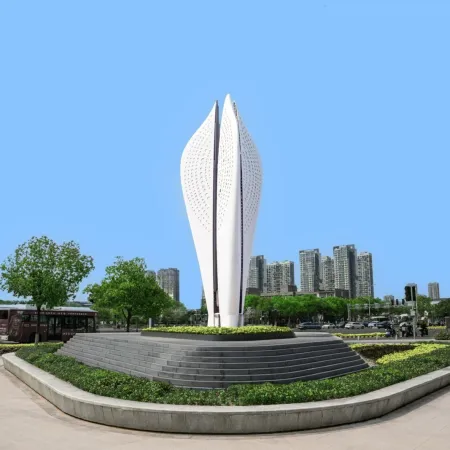
You can see the range of our steel work in the project gallery, read how the full process runs in the services overview, and look at Wind Sail, where structural steel and a demanding finish had to coexist outdoors.
Send us the design and the site conditions, and we will advise on grade, coating and sectioning before anything is cut. A custom steel sculpture manufacturer who can explain both corrosion and distortion is a maker worth keeping.