How a Public Plaza Monument Anchors a City's Gathering Place
A public plaza monument holds one of the most demanding positions in public art: the plaza is where a city gathers, celebrates, protests and passes through, and the monument at its centre must give that gathering a focus without interrupting it. The works that succeed become the image of the plaza itself, the landmark in every photograph and the meeting point in every instruction, while those that fail stand ignored in the middle of the city's busiest conversation.
This guide explains how a public plaza monument is designed, scaled and placed so that it anchors the space and serves its public life, and the questions a commissioning body should ask before committing a plaza to a permanent centrepiece. Our studio has created plaza landmarks across 23 countries since 2003, and the principles below come from works that hold their squares daily.
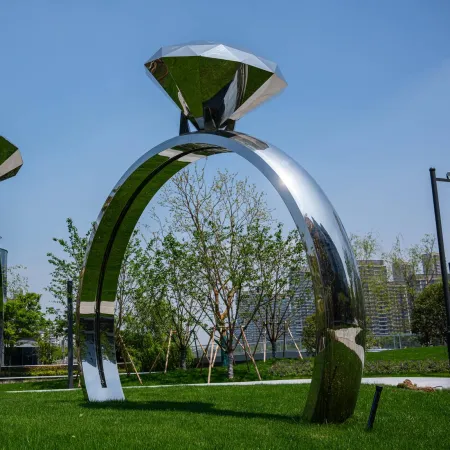
See plaza-scale works in the project gallery, the design and delivery services in our services overview and an urban landmark such as The Diamond Rings.
Understanding the Plaza Before Designing the Monument
A public plaza monument should be designed from a deep reading of the plaza's life, because a plaza is not an empty stage but a busy organism with patterns that the monument must respect. The designer should study how people cross the space, where they gather, where they queue, where the markets and the events set up, where the sightlines open to the surrounding streets and buildings and where the sun and shadow fall through the day, and should then find the position and the form that organise those flows rather than block them. A monument that interrupts the plaza's life will be resented, while one that organises it will be adopted.
The plaza's architecture should also shape the monument, because a plaza is defined by the buildings around it and the monument must converse with them. The scale should relate to the facades, neither crushed by their height nor ignoring their presence; the material should echo or answer the architecture's palette; and the form should complete the space's geometry, closing a vista, marking an axis or balancing a composition. The most successful plaza monuments feel inevitable, as if the plaza had always been waiting for them, and that inevitability is the product of reading the architecture as carefully as the crowds.
Scale, Position and the Life of the Crowd
The scale of a public plaza monument is a dialogue between the monument and the crowd, and the designer must serve two distances at once. From the edges of the plaza and the approaching streets, the monument must have a presence that draws the eye and gives the space an identity; from close range, among the people who gather beneath it, it must relate to the human body and host the informal life of the square, the meetings, the photographs, the resting. A monument scaled only for the long view intimidates the people at its base, while one scaled only for the body disappears from the city's sightlines.
Position within the plaza is a decision of equal weight, and it should be made with the plaza's functions rather than with symmetry alone. A monument at the geometric centre can block the events and the crowds that need the open space, while a monument placed to one side, closing a vista or anchoring a corner, can organise the space and leave the centre free for the plaza's life. The designer should test the position against the plaza's real calendar, its markets, its ceremonies, its protests, and should confirm that the monument hosts those gatherings rather than prevents them, because a plaza that cannot hold its events because of its monument has been given a very expensive problem.
| Plaza function | What the monument must allow | Design response |
|---|---|---|
| Daily crossing | Clear pedestrian flows | Placement that organises movement |
| Gathering and events | Open space for crowds and stages | A focus that leaves the centre free |
| Rest and meeting | Places to sit and wait | Edges and bases that host people |
| Photography and identity | A recognisable image of the place | A silhouette that reads from every side |
| Ceremony and memory | A space for formal occasions | Approach and focus for the ritual |
Designing for the Plaza's Hard Life
A public plaza monument lives a harder life than almost any other public work, and its design must anticipate the treatment a busy urban square delivers. The plaza concentrates foot traffic, bicycles, event equipment, cleaning machinery and the full range of human behaviour, so the monument's surfaces must resist abrasion, staining and graffiti, its edges must survive the knock of carts and crowds and its base must shed the water, salt and debris that the plaza's maintenance brings. The materials should be chosen for that hard life and the detailing should make cleaning and repair straightforward, because a plaza monument is cleaned often and inspected constantly.
Safety in the crowd is a design responsibility that grows with the monument's popularity. The structure must be engineered for the concentrated loads of a packed plaza, with people pressing, climbing and sheltering against it; the edges and the fixings should present no hazard to the crowd; and the surfaces should not become dangerously slippery or burning hot in the plaza's climate. The monument should also be detailed against the deliberate damage that prominent works attract, with surfaces that can be cleaned of graffiti and fixings that resist tampering, because a monument at the centre of a city's life is also at the centre of its attention, and attention of every kind must be anticipated.
Light, Events and the Monument at Night
A public plaza monument lives as much at night as by day, and its lighting should be designed as part of the work. The illumination should reveal the form's best qualities, modelling its depth and its silhouette without flattening it or glaring at the passers-by; it should sit comfortably within the plaza's wider lighting, not fighting the street lamps and the shopfronts for attention; and it should be maintainable, with accessible lamps and a system the city can service. Where the monument can change its light for festivals, celebrations and moments of remembrance, it becomes an instrument of the plaza's calendar, and that participation makes it an institution rather than an ornament.
The monument should also be designed with the plaza's events in mind, because a plaza without events is a plaza without a soul. The work should not block the sightlines to a stage, the power and the access the events need, and the space around it should be able to host markets, screens and ceremonies without the monument becoming an obstacle. We have designed plaza monuments that double as gathering points for festivals, with their bases becoming stages and their forms becoming backdrops, and that flexibility is what keeps a monument relevant to a plaza that must serve a thousand purposes a year.
Commissioning the Plaza's Centrepiece With Confidence
The commissioning of a public plaza monument should gather the voices who understand the space, the city's planners, the plaza's managers, the traders and the community, and should balance their practical knowledge against the artistic vision. The process should test the concept against the plaza's real life, with the position marked on the ground, the scale tested at full size and the events calendar checked against the proposed placement, and it should confirm that the monument enhances the space for everyone who uses it rather than serving only the commissioning interest. A plaza monument is public property in the deepest sense, and its commissioning should be equally public.
The studio chosen for a public plaza monument should bring the full range the position demands: the artistic vision to create a work worthy of the city's centre, the engineering depth to make it safe in the densest crowds, the fabrication craft to resist the hardest public life and the installation discipline to place it without disrupting the plaza it joins. When those capabilities sit in one house, the monument arrives whole and the plaza's life is protected through the work. We built our studio as that house, and it is why the plaza landmarks we deliver still anchor their squares years after the crowds have made them their own.
- Read the plaza's real life, flows, events and architecture.
- Serve two distances, the skyline and the body at once.
- Leave the centre free for the plaza's gatherings.
- Engineer for the packed crowd and the hard daily life.
- Design the night and the events into the work.
What a True Plaza Landmark Achieves
An identity the whole city recognises
A focus that organises the crowd's life
A form that survives the square's hard use
A landmark that hosts the city's rituals
Frequently Asked Questions About Public Plaza Monuments
Where should a monument stand in a plaza?
Where it organises the space without blocking it, often closing a vista or anchoring a corner while leaving the centre free for the crowds and events the plaza must host.
How big should a plaza monument be?
Large enough to hold the plaza's identity from the approaches and the surrounding streets, and human enough to host the people who gather at its base, serving both distances at once.
How do we keep a plaza monument safe in crowds?
Engineer for the concentrated loads of a packed square, detail against slips, sharp edges and tampering and design surfaces that can be cleaned of the graffiti a prominent work attracts.
Can a plaza monument host events and markets?
Yes, when the placement leaves room for stages and stalls and the base and form are designed to serve as gathering points and backdrops for the plaza's festivals and ceremonies.
What lighting should a plaza monument have?
Lighting that models the form and silhouette without glare, sits within the plaza's wider scheme, is serviceable by the city and can change for festivals and moments of remembrance.
A public plaza monument is the city's statement about itself, set in the place where the city gathers to speak, and its success is measured by whether the plaza and the people adopt it as their own. Read the space, serve its two distances, leave the centre free for its life and design for the night and the crowd, and the monument will anchor its square for generations.
If you are planning a public plaza monument and want to test how a work could organise your space rather than interrupt it, our designers will study your plaza's life and bring you scale and placement proposals grounded in its real calendar.