Designing a Light Art Installation That Owns the Night
A light art installation turns the hours after sunset into a canvas: sculpture that exists as much in lumen as in steel, landmarks that change with programmed color, and public spaces that come alive when the sun goes down. Light is the most flexible material in public art — it can be layered over almost any form, updated without demolition and switched off entirely when a site needs rest — yet it demands disciplines that conventional sculpture never faces, from glare control to power engineering to content that stays fresh for years. Yifeng Sculpture Studio has designed illuminated and light-led works since 2003, and this guide covers the design decisions that make a light art installation beautiful, reliable and responsible.
The sections below cover the day-night design problem, lighting techniques and fixtures, programming and content, power and control infrastructure, and the environmental responsibilities of lighting public space.
The first rule of light art is that it must earn its day. A work that only exists after dark is a disappointment every morning; the strongest illuminated installations are designed as complete objects first, with light as a second layer that transforms rather than rescues them.
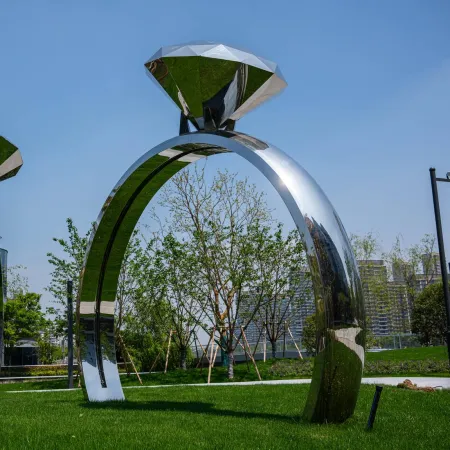
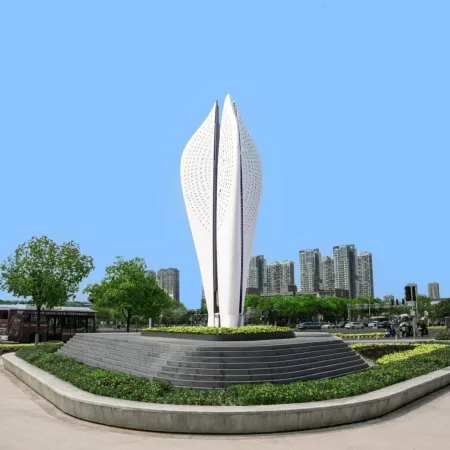
Two illuminated works in our archive show the range: Butterfly Dance, a ten-meter cut-metal form whose lighting becomes its second life, and Artistic Light Columns, where light itself is the primary material; the services overview explains how lighting design sits inside our full commission pipeline.
Designing the Day Form First
A light art installation begins as a sculpture that must be beautiful in daylight, because that is how it lives for most of its hours and how it earns its place in the first place. The daytime form determines where light can hide — behind fins, inside translucent panels, along structural edges — and where it will be seen when darkness falls. We design the two states as one system: surfaces that read sculpturally by day become light-emitting or light-reflecting by night, and the transition between them is choreographed rather than accidental. Clients sometimes ask for the light first and the form second; our answer is always the same, because the form is the light's host, and a beautiful host makes the light unforgettable.
Choosing How the Light Is Made and Shown
The technique determines the character. Edge-lit forms glow with quiet precision; backlit translucent panels wash a surface with even color; direct fixtures sculpt the form with shadow; projected light can repaint an entire facade without touching it; and integrated LED matrices turn a surface into a low-resolution screen for patterns and messages. Each technique carries different costs, maintenance lives and failure modes, and the honest designer matches the technique to the artistic intent and the site's maintenance capacity rather than to the latest catalog. In our experience the most enduring light art favors a small number of robust techniques executed superbly over a festival of effects that will date, dim or break within a few seasons.
Lighting Techniques Compared
| Technique | Character | Maintenance Notes |
|---|---|---|
| Edge lighting | Quiet, precise, sculptural glow | LED modules replaceable by design |
| Backlit panels | Even color fields, graphic strength | Diffuser cleaning and lamp access |
| Direct fixtures | Shadow play, form modeling | Fixture aiming and periodic cleaning |
| Integrated matrices | Patterns, motion, messages | Pixel-level replacement strategy needed |
Programming and Content: Keeping the Light Alive
A static glow is architecture; a light art installation is choreography. The control system should offer a palette of behaviors — a calm everyday sequence, a brighter weekend mode, seasonal color stories, festival responses and a dimmed or resting state for late nights — so the work can be tuned to the life of the site without re-engineering. Content refresh is where most public lighting projects quietly die, so we design content systems that a site team can operate: schedules that follow the calendar, scenes that can be updated from a simple interface, and a library of presets that never require a programmer. The work that still feels alive in year five is the one whose content was designed to evolve from the beginning.
Commissioning teams should also think about how the work participates in the life of its district. The strongest illuminated landmarks carry a civic calendar as naturally as a town clock: a winter festival palette in December, a quieter commemorative mode on solemn days, a brighter celebration for the local team or the national holiday, and a rest state on ordinary late nights. None of this requires new hardware if the control system was designed with scenes, schedules and remote updates from the start. We often recommend that the first content season be commissioned together with the artwork itself, so the opening of the installation is also the opening of its calendar — and the site team inherits a living system, not a fixed display waiting to grow stale.
A second design layer that is frequently underestimated is the work's behavior in degraded modes. Power dips, a failed driver or a broken data link should never leave a landmark looking broken. We program graceful fallbacks — a scene that defaults to a simple, elegant state when the full choreography cannot run — and we document the restart procedure so that any technician can bring the work back without a specialist call. This resilience thinking is what separates a light art installation that the maintenance team quietly loves from one they secretly dread, and it is designed in at the same moment as the beautiful scenes.
What Our Studio Delivers With Every Light Commission
A day-and-night design developed as one system, never light bolted onto form
Robust fixtures with replacement and access planned from the first drawing
Content controls your site team can operate without a specialist
Power, Control and the Infrastructure Nobody Sees
Reliable light art is an electrical engineering problem as much as an artistic one. The installation needs a properly sized power feed, surge protection on every supply, weatherproof junction points with marine-grade connections, and thermal management for fixtures and drivers that run for hours in enclosed spaces. The control system should be accessible for programming yet protected from the public, and its failure mode should be sensible — a work that defaults to a graceful state rather than a dead one when a signal is lost. We engineer all of this before fabrication, and we document it thoroughly, because the difference between a landmark that glows for twenty years and a sculpture full of dark pixels is almost always the infrastructure that nobody photographs.
Lighting Responsibility: Glare, Skyglow and Neighbors
The privilege of lighting public space carries obligations. A responsible light art installation is designed to avoid glare for drivers and pedestrians, to respect the brightness expectations of neighboring buildings and bedrooms, and to avoid contributing to skyglow by directing light where it is intended rather than spilling it upward. Curfews are part of the design: a late-night dimming schedule honors the neighborhood's rest while keeping the landmark present in a quieter register. Dark-sky-friendly practice is not a restriction on art; it is the craft of making light precious again — the same beam that would be banal at midnight is magical when it is the only thing still glowing at two in the morning.
Frequently Asked Questions About Light Art Installations
How much energy does a light art installation use?
Modern LED systems are remarkably efficient, and the real energy story is in the schedule: dimming sequences, curfews and automatic seasonal timing keep consumption proportionate to the site's needs. We design for efficiency because responsible operation is part of a landmark's license to exist.
What happens when an LED or fixture fails?
With a replacement strategy designed in, very little: modules and drivers are specified with access routes and spares, so a failed component is swapped in hours rather than diagnosed for weeks. The maintenance manual names every component and its replacement procedure.
Can lighting be added to an existing sculpture?
Often yes, if power and access exist. We assess the structure, surface and site first, then design a lighting layer that respects the original work and can be maintained without harming it — the retrofit is planned as carefully as a new commission.
How do you avoid disturbing nearby residents with light?
Through the three disciplines of responsible lighting: aiming light where it belongs, setting brightness below the level that intrudes on windows, and programming curfews that dim the work late at night. The landmark stays present; the neighborhood still sleeps.
Can the light change with seasons or events?
Yes, and this is where light art earns its keep as civic infrastructure: seasonal palettes, festival modes and commemorative scenes are all content, not hardware. Once the system is built, changing the mood of a landmark can be as simple as selecting a scene.
A light art installation is one of the highest-visibility investments a city or developer can make, because it owns the hours when most landmarks disappear — and it repays that visibility only when the form, the light, the engineering and the content are designed as one system. Done responsibly, it becomes the place people bring visitors at night, the landmark that gives a district its after-dark address. If your site is ready to own the night, our studio would be honored to light the way — bring us the space and the story, and we will design a light art installation that glows with purpose for decades.