How an Interactive Public Art Installation Turns Visitors Into Participants
An interactive public art installation invites the public to complete the work, and in doing so it changes the relationship between art and audience from observation to participation. The people who touch, trigger, climb or play with a work remember it differently from those who only look, and that difference is the heart of interactive art's power.
This guide explains what makes an interactive public art installation succeed, how interaction is designed and engineered to survive real public life, and what clients should consider before commissioning work that moves, responds or invites touch.
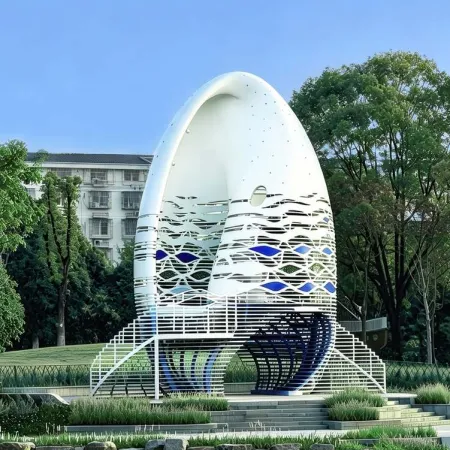
See participatory works in action at Fish Swarm, Rainbow Windmills and Hello Conch.
What Interaction Really Means in Public Art
Interaction in public art exists on a spectrum, and understanding that spectrum is the first step to commissioning the right work. At one end are works that respond physically to the environment, such as sculptures that move in the wind or change with the light; at the middle are works that respond to people, sensing their presence, their movement or their touch and answering with motion, sound or light; and at the far end are works that people physically complete, such as pieces designed to be climbed on, sat in, swung from or played with. Each level of interaction creates a different relationship, from the wonder of watching a form respond to the joy of becoming part of the work itself.
The level of interaction must be chosen deliberately, because it shapes everything that follows: the engineering, the materials, the maintenance and the risk. A work that only responds to the wind is simpler and safer than a work that children climb, but it offers a thinner experience; a work with sensors and motors creates richer moments but carries more that can fail. The honest conversation at the start of a project is about which kind of relationship the client wants the public to have with the work, and the design should be built around that answer rather than around a technology that seemed exciting in a meeting.
Designing for the Way People Really Behave
People behave differently with interactive art than designers expect, and an interactive public art installation must be designed for the public's real behaviour rather than its imagined politeness. Visitors will push, pull, lean, climb and test a work far beyond what its creator intended, and children especially will find every possible way to interact, so the design must anticipate enthusiastic use and engineer for it from the start. Edges should be rounded, materials should tolerate impact, fixings should resist loosening and surfaces should survive the dirt and wear that hands and shoes bring, because a work that cannot survive its public is a work that will spend its life behind barriers.
The design should also make the interaction legible. A work that invites participation should communicate its invitation without a sign, through its form, its sound, its movement or the example of the first brave visitor, because people follow what they see others doing. The response should also be immediate and satisfying, since a delay of even a second can break the magic that makes interaction work. The craft of interactive art lies in these details: the threshold that makes participation feel safe, the response that rewards it and the rhythm that keeps people returning, and a studio that has built such works knows how delicate that choreography is.
The Engineering of Delight and Danger
Every interactive public art installation carries engineering responsibilities that a static sculpture does not, and safety is the first of them. If the work moves, the movement must be engineered so that no part can trap, pinch or strike a visitor; if it carries people, the structure must be designed for the loads of climbing and gathering, with the same rigour as playground equipment; if it uses electricity, the installation must meet the standards for public exposure. The engineering should be performed or verified by qualified engineers and documented in reports that the client, the site owner and the insurers can all review, because public safety is not a matter of opinion.
Durability is the second engineering duty. Interactive works face forces that static works never meet, from the repeated cycling of moving parts to the impact of bodies against surfaces, and every component must be chosen for that duty. Bearings and mechanisms need to be robust and replaceable, sensors and electronics need protection from weather and dust, and finishes need to recover from the contact that will inevitably mark them. The design should also plan for maintenance access, because a mechanism that cannot be reached cannot be repaired, and an interactive work that breaks and stays broken is worse than a static work that never promised more.
| Level of interaction | How the public takes part | Design consequence |
|---|---|---|
| Environmental | Responds to wind, light, weather | Robust bearings and safe motion |
| Sensing | Answers presence, movement, touch | Protected electronics and sensors |
| Physical | Climbed, sat on, swung, played with | Structural loads and soft edges |
| Social | Creates moments people share | Legible invitation and reward |
Technology That Serves, Not Fails
Technology is the servant of an interactive public art installation, and the design should choose the simplest technology that delivers the experience reliably. A mechanical response driven by wind or gravity is often more robust than an electronic one, and an electronic system that works beautifully in a workshop can fail in the heat, cold, damp and dust of a real public site, so the components must be specified for outdoor duty and protected accordingly. The studio should be honest about which technologies have proven themselves in the field and which are still experimental, because the public will not forgive a work that repeatedly breaks, whatever its ambition.
Maintenance is the true test of any interactive work. The client should ask what will need attention and how often, whether the mechanisms and electronics can be serviced by local technicians or only by the maker, and what spare parts the design assumes will be replaced over its life. Some of the most successful interactive installations are beautifully simple, achieving their magic with robust mechanisms that a capable local engineer can maintain, while elaborate works that depend on proprietary systems can become orphans when their maker moves on. The commission should plan for year five and year ten, because an interactive public art installation is a living thing that needs care to keep its promise.
Why Interaction Builds Belonging
An interactive public art installation builds a different kind of relationship with its community than a work that is only looked at, and that relationship is the deepest reason to commission one. When people participate in a work, they become its co-creators, and a person who has made a sculpture move or sing feels a stake in it that a passer-by never feels; children who grow up playing with a work carry it into their memory as part of their place; and the photographs and stories that participation generates spread the work's presence far beyond its site. Participation is how a sculpture becomes a shared possession rather than a public object.
The belonging that interaction creates also protects the work. Communities look after the art they love, reporting damage, guiding visitors and defending the work against vandalism in a way that no amount of surveillance can match, and an interactive installation that has been adopted by its public has gained an army of informal caretakers. This is why interactive work so often becomes the heart of a park or plaza, the place where people arrange to meet and where visitors are taken first. A work that the public has completed with their own participation belongs to them in a way that transforms both the work and the place around it.
Why Interactive Art Works
Participation turns viewers into owners
Memories made with the work endure
Shared moments spread the work's reach
Adopted works are protected by their public
Commissioning an Interactive Work With Confidence
Commissioning an interactive public art installation begins with choosing a studio that has actually built such works, because interaction is a discipline with its own lessons and its own failures. Ask to see installed interactive projects and to speak with the people who maintain them, because the maintenance team knows the truth about a work's reliability better than its creator's portfolio does, and ask how the studio handles the balance between ambition and robustness in its own work. The right studio will be candid about what has failed and why, because that candour is the evidence that it has learned the hard lessons that make interactive art succeed.
The brief should define the experience before the technology. Describe the feeling the work should create, the behaviour it should invite and the people it should serve, and let the studio propose the means, because a brief that demands a specific gadget often produces a work shaped by the gadget rather than by the place. Agree the maintenance reality honestly, budget for the care the work will need and plan the documentation that will let future caretakers understand it. Our studio has created interactive public art installation for sites across more than twenty countries, and the works that lasted were those whose interaction was chosen for its place, engineered for its public and maintained with commitment.
Frequently Asked Questions About Interactive Public Art Installation
What kinds of interaction work best outdoors?
The most reliable outdoor interactions are wind-driven motion, robust mechanical responses and simple sensing. The simpler the technology that delivers the magic, the longer the work keeps its promise.
How safe can interactive art be for children?
Very safe when engineered with playground rigour: rounded edges, structural loads for climbing and gathering, pinch-free motion and protected electronics. Safety must be designed in from the first sketch.
What maintenance does an interactive work need?
Regular inspection of mechanisms, electronics and surfaces, with replaceable parts designed for service. Ask for a maintenance plan and budget for it from the start.
Will people understand how to interact?
Good design makes the invitation legible through form and example. The first visitor shows the next, and the response must be immediate and satisfying to keep the magic alive.
Does interactive art cost more to commission?
Interactive works typically carry higher engineering and maintenance costs than static works, but they also deliver greater engagement and belonging. The budget should reflect both the making and the care.
An interactive public art installation offers something no static work can: the chance for the public to become part of the art and carry that participation into memory. Commission it with a studio that has learned the discipline, choose the interaction for the place and the people, engineer it for real public behaviour and plan its care through the years, and the work will be adopted, loved and protected by the community that completes it every day. The sculpture that moves, responds and plays with its public becomes more than an object in a square; it becomes a relationship, and relationships are what make a place belong to its people.
Choose an interactive public art installation that invites your community to take part, and the work will live in their memory long after they leave.