Why Contemporary Metal Sculpture Is the Backbone of Modern Public Art
Contemporary metal sculpture has become the backbone of modern public art for one simple reason: no other material family can be shaped into so many forms, finished in so many ways and trusted to stand outdoors for so long. Steel can be bent into ribbons, welded into towers, polished into mirrors or left to rust into earth tones; aluminum brings lightness and color; stainless steel brings brilliance and permanence; weathering steel brings gravity and age. Because metal carries structure as naturally as it carries surface, contemporary metal sculpture can reach monumental scale, interact with wind and water, and be engineered to the same standards as the architecture around it. Yifeng Sculpture Studio has fabricated contemporary metal sculpture since 2003 for clients in more than twenty countries, and this guide explains the material family and the craft that shapes it.
We look at the metals a sculptor chooses between, the finishes that decide a work's life outdoors, and how a metal commission moves from concept to standing work.
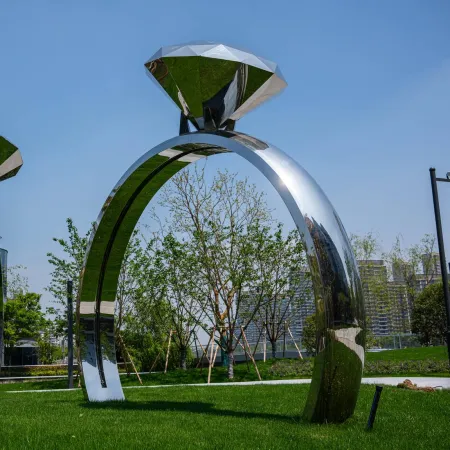
Our project archive is dominated by metal works, the services overview explains our fabrication capability, and the Diamond Rings shows polished metal geometry anchoring a civic space.
The Metal Family and What Each Member Offers
Choosing a metal is choosing a character, and the contemporary sculptor has a rich family to draw from. Carbon steel is the workhorse: strong, weldable and affordable, it is the skeleton of most large metal sculpture and the canvas for painted color. Stainless steel is the aristocrat: its chromium content makes it resist corrosion without coating, and its finishes range from mirror polish that reflects the world to satin brush that absorbs light. Weathering steel is the naturalist: it forms a stable oxide that deepens into earthy browns, harmonizing with landscape. Aluminum is the pragmatist: a third of steel's weight, naturally corrosion-resistant and beautifully paintable, ideal where structure and transport matter. Bronze and other copper alloys are the traditionalists, carrying warmth, patina and permanence. Most ambitious contemporary works combine members of the family — a painted steel form on a stainless base, a corten volume with polished accents — because the contrasts sharpen every material.
| Metal | Signature Strength | Typical Voice |
|---|---|---|
| Carbon steel | Strong, weldable, economical | Painted color and structural scale |
| Stainless steel | Corrosion resistance, brilliance | Mirror, satin, contemporary purity |
| Weathering steel | Self-protecting oxide patina | Earthy gravity for landscape |
| Aluminum | Lightness with corrosion resistance | Large forms, colored and mobile |
| Bronze | Patina depth, tradition | Warmth, commemorative weight |
The Craft of Shaping Metal
Contemporary metal sculpture is a conversation between the artist's vision and the workshop's craft, and the craft is learned over decades. Plate is cut and formed — rolled into cylinders, pressed into curves, fabricated into volumes — with the seams between pieces becoming part of the sculpture's logic. Welding is where strength and surface are won: a structural weld must carry real loads, while a cosmetic weld must be ground and blended until it disappears into the surface, a discipline that separates sculpture from steelwork. The internal framework is engineered so that the visible skin can be as thin and elegant as the design demands, and the whole assembly is sequenced so that distortion from heat is controlled rather than discovered. Finishing follows — grinding, sanding, polishing or coating — each stage bringing the surface toward the exact character the design intends. This is why the studio behind a metal work matters as much as the artist: the craft is the art made durable.
Finishes: The Decision That Decides the Decades
Two identical metal forms with different finishes will age completely differently, which makes finish specification one of the most consequential decisions in a commission. Painted steel relies on a coating system — typically a primer beneath a durable polyurethane or powder coat — whose quality decides how many years pass before the first repaint; a properly specified and applied system can hold its color for a decade or more outdoors. Stainless steel needs no coating; its finish is its protection, and the choice between mirror polish, satin brush and bead blast changes both the look and the maintenance character of the work. Weathering steel is finished by time itself, its protective oxide building over the first seasons. In every case the studio specifies the finish for the site's actual climate — ultraviolet intensity, salt air, industrial pollution — and documents the maintenance cycle that keeps the work at its best. Finish is where the twenty-year promise is kept or broken.
Finishing Systems We Specify
- Powder coating: tough, even color for structural and architectural work
- Polyurethane paint: deep gloss and color retention for sculptural surfaces
- Mirror polish: seamless reflective surfaces in stainless
- Satin and bead blast: soft light absorption for architectural calm
- Chemical patina: controlled oxide color on corten and bronze
Structure, Scale and the Engineering of Metal
Metal's greatest gift to sculpture is that it makes scale safe. A contemporary metal sculpture of ten or twenty meters is not a fragile object but an engineered structure — its skeleton calculated for wind, its foundation sized for overturning, its joints designed for assembly and its public surfaces detailed for safety. Because metal carries load so efficiently, large works can be slender where stone could never be, cantilevered where other materials would collapse, and open where solid mass would dominate a site. The engineering is developed with the design from the first sketches, because at scale the two are inseparable: the structure that makes a form possible also shapes how it is seen. The studio's engineers and fabricators work as one team, so the transition from concept to certified structure loses nothing of the art. The result is that contemporary metal sculpture can hold its own beside the largest architecture — which is exactly where modern cities want their landmarks.
What Our Studio Delivers in Metal
Original metal concepts designed from the material's strengths
Full structural engineering for public safety and scale
Fabrication, finishing and quality documentation in-house
Delivery, installation and a finish-specific care manual
Metal in Motion and Light
Metal's structural honesty also makes it the natural medium for the two great contemporary additions to sculpture: movement and integrated light. Kinetic metal works — forms that turn with the wind, swing on engineered bearings, or articulate through mechanisms — depend on metal's strength and fatigue resistance, and their motion is only as good as the bearings, pivots and drives that the studio engineers into them. Light works similarly rely on metal as the armature for illumination: LED systems are mounted to stainless structure, cabling is concealed in hollow sections, and the metal surface becomes the reflector that gives the light its character. When contemporary metal sculpture adds motion or light, it stops being an object and becomes an event — changing through the day, drawing people at dusk and giving the site a second life after dark. These are the works that cities photograph, that visitors time their evenings for, and that keep a district feeling alive.
Frequently Asked Questions About Contemporary Metal Sculpture
Which metal is best for a coastal or humid site?
Stainless steel is the most forgiving in marine and humid environments, with 316 grade preferred where salt is heavy. Other metals can be used with the right coating systems, but the studio will advise honestly based on your climate.
How long does painted metal color last outdoors?
A properly specified and applied polyurethane or powder system typically holds its color and gloss for many years, depending on ultraviolet exposure. The care manual defines the wash and repaint cycle that keeps the work at its best.
Can metal sculpture be repaired if damaged?
Yes — one of metal's great advantages is repairability. Dents can be worked, coatings can be touched up, and even structural damage can be assessed and repaired. Every work is delivered with the documentation a future repair would need.
How do you keep welded joints invisible?
Through grinding and blending by craftsmen who treat the surface as part of the art, followed by finishing that unifies the whole form. Seam placement is planned at design stage so joints fall where they can be made to disappear.
Can we combine different metals in one work?
Frequently — the contrast between metals is a powerful compositional tool. The studio manages the engineering details that combinations require, such as isolating dissimilar metals to prevent galvanic corrosion, so the dialogue is safe as well as beautiful.
Contemporary metal sculpture is the backbone of modern public art because it is honest: it can be any form, any finish, any scale, and it will stand in the weather and tell the truth for decades. Our studio has worked the material since 2003, delivering contemporary metal sculpture across more than twenty countries from intimate garden works to engineered civic landmarks. If your project calls for a form that steel or stainless can carry further than any other material, bring us the concept — the contemporary metal sculpture we fabricate together will be shaped with craft, engineered for safety and finished to outlast the moment.
Send us your idea or your site drawings, and we will advise on the metal and finish that will carry the contemporary metal sculpture we develop for you into its long life outdoors.